

#25 — Teaching the course LLMs for Software Engineering
My conversation with Danny Yellin

Designing a Syllabus for “LLMs in Software Engineering”
I do think we are at a major inflection point and in a moment of intense reflection in the Computing Education Community. Advances in AI are transforming how we build software, and those changes have significant implications for computing education. This feels like a great moment to talk with Danny Yellin, especially since he’ll be teaching the course “LLMs for Software Engineering” for the third time this coming semester. I thought it would be very timely to invite him to my podcast to discuss how to design a syllabus in such a fast-changing field, while also identifying the core concepts and fundamentals that remain essential despite these rapid advancements. We talked about his proposed curriculum on LLMs for software engineering, how colleges should approach AI in their curricula, the different views on computing education for the AI era and the use of AI in teaching CS.
We had a rich conversation that left me with a lot to think about. It was such an honor and a joy to be in conversation with Danny. You can listen to the episode here or on your favorite podcast app:
What we know about GenAI in Education (so far)
This week I watched this presentation in Spanish from Isaac Alpizar-Chacon at the Tecnológico de Costa Rica titled “Generative AI and Education: What We Know So Far”. The purpose of the talk was to explore critical studies to understand what we currently know—based on evidence—about the implications and consequences of using Generative AI in education (particularly in computing education). As part of the session, he prepared this sheet with a curated list of resources and academic papers, designed as a starter guide for anyone interested in reading critical, evidence-based studies about GenAI in education.
In the talk, Isaac mentioned this paper by my collaborators Paul Denny and James Prather that shed so much light 3 years ago when generative AI research first began in computing education. It made me remember that if back then they found these models’ ability to solve introductory programming exercises was strong (top 20% on a CS1 exam and top quartile in a Data Structures & Algorithms class), what would the results be now?
It’s funny too how there are students who don’t want to use AI, but when they ask their classmates “how do you do this,” they go ask the AI and pass it on to the first student. There’s no way to avoid it, haha.
As part of his observations, Isaac makes a good point that I also share: reviewing student work with AI detection tools can lead to biases against certain students, even when the student’s intention was good (improving their writing, for example). However, he makes an exception for references, because he’s encountered students who generate them with AI and they don’t actually exist.
Wisdom from Ricardo Piñero
I really enjoyed listening to Ricardo Piñero speak about human thought, time, the need to pause, human relationships, the meaning of suffering, hope, work, education, entrepreneurship, the idea of the university, self-knowledge, the art of asking questions, what truly matters, death, beauty, the little things, the unfinished, and opening our eyes. Ricardo is a wise, humble, and approachable person—with an exceptional aesthetic sensibility.
Out of the nearly two-hour conversation, one idea in particular that really stuck with me was his take on the university:
The university is a place where you can show who you are—not just for yourself, but especially for others. There are many ways to be in the world. Ours is about preserving, expanding, and passing on knowledge to humanity.
And this definition of beauty completely blew my mind:
Beauty is an encounter with a reality that changes your life forever.

🔍 Resources for Learning CS
→ How POGIL improves CS learning outcomes
CS POGIL uses team-based guided inquiry to help students construct their own understanding of SE and DS&A concepts—proven to improve outcomes, especially for average and below-average students.
→ Building Better AI Systems
Hamel Husain presents in this GRAILE AI talk a systematic three-phase process (Analyze, Measure, Improve) for building reliable AI products: systematically review AI behavior to understand actual failure modes, translate insights into quantitative metrics to track progress, then use that data to make targeted improvements—reframing evaluation as a continuous learning engine rather than a final step.
→ Stack Overflow’s AI Assistant
As I mentioned in an earlier post, Stack Overflow has launched its AI assistant. Like this user pointed out on Twitter, I do think they might be a bit late to the game, but one thing’s clear: they still have a loyal, niche technical audience that spends a lot of time on the platform — and this assistant should help make searching a lot easier for them.
→ Anthropic’s Free Claude Code Course
Anthropic just released a free official course on Claude Code—and it even comes with a certificate! In this course, you’ll learn how to run commands using Claude Code in the terminal, manage context efficiently, automate workflows with commands, hooks, and MCP, and integrate Claude Code with GitHub.
→ Brian Hall’s CS Learning Guides Just Got an Update
Remember issue #1? I told you about Brian Hall’s computer science learning guides. Well, guess what? He just updated it and it looks incredible.
→ Learn Databases From Aaron Francis
Over the past few weeks, database educator Aaron Francis has been very active on his YouTube channel where he talks with database professionals. If you’re also interested in the database education he teaches, check out.
→ The foundation you need before building with AI
AI tools are genuinely incredible. People are building remarkable things with them. BUT we can’t use them effectively without understanding what they actually are. Full breakdown with examples. Thanks for all your work Brendan!

🔍 Resources for Teaching CS
→ Ask students one question before they leave
The “Muddiest Point” and “One-Minute Paper” are quick formative assessment techniques that boost student engagement and provide immediate feedback. At the end of class, students spend 1-2 minutes writing down either the most confusing concept or a key takeaway from the lesson. This encourages metacognitive reflection and helps instructors identify which topics need clarification in the next session. These low-stakes methods promote active learning, foster self-assessment skills, and create an inclusive environment where students become more aware of their own learning process while instructors can target their teaching more effectively.
→ A workshop that made me think
Workshop in Spanish by Francisco Bellas (UDC) on generative AI in education for secondary school teachers in Costa Rica. Beyond the specific tools, what I found interesting were the underlying ideas, such as the concept of atrophied skills if we remove the process and only focus on the output, and the uses of AI that professors at any level can employ.
→ Framing the AI moment in CS Education
Very interesting conference keynote from R. Benjamin Shapiro at Koli Calling 2025. As I said at the beginning, we are in a period of intense reflection in our field, and I believe this talk helps to frame it well.
→ Haskell for Data Science
I hadn’t thought about it before—people only ever talk about Python and R when it comes to data science or data mining. But based on this article (which includes some great examples), Haskell doesn’t seem like a bad choice at all.
→ Teaching Principles for Computing Education
Huge fan of what the Raspberry Pi Foundation is doing in our field. Their team released their pedagogy principles for computing. Check them out here.
→ Two newsletters on Data Viz and Machine Learning
Came across two newsletters worth checking out:
In one, Lauren Leek explores data visualizations and insights connected to current events and trends.

In the other, Christoph Molnar digs into performance-driven machine learning, grounded in strong statistical thinking.

🦄 Quick bytes from the industry
→ Student Engagement and the Value of CS Education
Let’s see: it’s not that the CS degree is useless, but rather that the goal is different. I get the points Morgan Young is making (and I’m part of the problem/solution—or at least I want to be), but we need to remember that just because we don’t understand or like something doesn’t mean it has no value. We can come to understand it. Sometimes it’s a matter of trust and perseverance, because we’ve gotten too used to instant gratification.
It’s amazing how often these two CS majors implicitly bring up student engagement in this episode:
Being in class but mentally somewhere else:
Literally in my programming languages class, I’d be writing LinkedIn posts instead of paying attention.
Time devoted to class vs. other priorities:
I spent 20% of my freshman year paying attention in class, I spent another 20% partying and socializing. I spent the rest of the 60%… recruiting for internships.
I’m thinking of focusing my next paper on student engagement. I’m open to any ideas, so please leave a comment or email me at dprol@uh.edu
→ Lessons From Werner Vogels
Amazon CTO Werner Vogels joined The Changelog and talked about all sorts of interesting stuff like robot companionship, quantum-safe computing, the importance of remaining curious, the future of software dev, code review and more (he even made his predictions for the new year).
→ Marius Schulz on Frontend Engineering at Meta
Marius Schulz is a frontend engineer at Meta (Threads) where he works on the web team. He focuses on performance, reliability, and quality. If you’re interested in his career trajectory and past experiences at Meta, this episode is for you:
🌎 Computing Education Community
Still one day left to apply to join this lab at UCL in a team working to design and develop AI models that support student learning. There’s also still a bit of time to apply for the Microsoft Research Fellowship and the Bloomberg Data Science Ph.D. Fellowship.
Three PhD opportunities for Fall 2026: Zihan Wu at the University of Maine is seeking 1-2 PhD students to join Puffin Lab, working at the intersection of HCI and Computing Education Research to build personalized learning tools for novices. Jong-in Lee at Texas A&M University is recruiting a PhD student to join the SIID Lab working on AI-powered extended reality interfaces and interaction design. Yu Zhao at Kennesaw State University is also recruiting a motivated PhD student for Fall 2026 focusing on eXtended Reality (AR, VR, MR) and human-centered computing.
Multiple CS faculty positions: SFU’s School of Computing Science (Metro Vancouver) is hiring two tenure-track professors at the assistant or associate levels and one permanent lecturer (apply by Dec 15). UT San Antonio seeks four Associate/Full Professors in AI for Education (Jan 15 deadline). Ontario Tech is hiring an Assistant Teaching Professor in systems/networks (review starts Jan 16). Coe College is recruiting a tenure-track Assistant Professor with expertise in algorithms and programming languages (Dec 15 for full consideration). Vanderbilt University also has openings at all ranks for computing research scholars. Purdue University invites applications for teaching faculty positions (Assistant or Associate Teaching Professor) in West Lafayette and Indianapolis. Wayne State University seeks an Assistant/Associate Professor in Computer Systems or Software Engineering.
SIGCSE TS 2026: Free Professional Development Pre-Symposium for Teaching-Track Faculty!
The Temple HCI Lab is studying how collaboration works in computing courses, with a special focus on the experiences of neurodivergent students. In addition, UVA researchers are collecting responses from students in any discipline for a study on how non–computer-scientists learn coding and teach it to undergraduates.
CCSC:CP – Call For Papers/Participation extended to Dec. 15!
Carnegie Mellon is seeking a Post Doctoral Fellow to join the PLUS project and the National Tutoring Observatory, two leading initiatives in hybrid (human + AI) tutoring and personalized learning. The role focuses on analyzing educational data, evaluating tutoring effectiveness, and advancing AI-driven tools to improve teaching and student outcomes.
ITiCSE 2026 is seeking committed (senior) program committee members to review submissions across all tracks for its July 2026 conference in Madrid.
NWO ICT.OPEN2026 invites abstracts (deadline: January 13, 2026) on integrating, resisting, or navigating Generative AI and new technologies in ICT education—submissions from teachers, practitioners, and employers welcome.
AccessComputing and IACE are hosting two affiliated events at SIGCSE TS 2026 in St. Louis. The AccessComputing session focuses on Accessibility in CS Education—seeking speakers for 15-minute presentations on research and practices. The IACE workshop ($20 fee) addresses AI as a research tool in education, exploring new AI Use Guidelines for ethical decision-making across research stages. For the last one, contact monica@csedresearch.org (AI workshop) if you have any questions.
🤔 Thought(s) For You to Ponder…
In line with today’s main topic, a new College of Computing and Artificial Intelligence is emerging at the University of Wisconsin-Madison—one of the first universities in the U.S. with a college that includes “AI” in its name.
It might make sense to start thinking about dedicated AI colleges worldwide in the future. At Wisconsin, they’ve called it CAI (College of Computing and Artificial Intelligence). Beyond the name, the idea that AI is no longer just a subdiscipline of Computer Science or Statistics, but rather a broad field connecting many disciplines, seems more established now.
It’s great to see cs educators like Sarah Chasins in WIRED talking about all things coding. I loved her communication style.
Totally legit path: https://lalitm.com/software-engineering-outside-the-spotlight/
Lalit Maganti:
The tech industry loves to tell you to move fast. But there is another path. It is a path where leverage comes from depth, patience, and the quiet satisfaction of building the foundation that others stand on.
You don’t have to chase the spotlight to have a meaningful, high-impact career at a big company. Sometimes, the most ambitious thing you can do is stay put, dig in, and build something that lasts. To sit with a problem space for years until you understand it well enough to build a Bigtrace.
📌 The PhD Student Is In
→ Converting Code to Markdown for Better LLM Help
I tried repomix this week to convert my entire codebase project into markdown then use it as context for LLMs. Useful when I want to fix issues or ask the LLM to help me understand the code.
→ New Raspberry Pi Foundation Seminars
The Raspberry Pi Foundation’s seminar series has been updated with two new seminars after being on pause for a few months. In one of them, Karl-Emil Bilstrup from the University of Copenhagen presents the ml-machine.org project, an educational tool for learning about ML practices. In the other, Victoriya Olari from the Free University of Berlin presents a collection of essential data concepts & practices for understanding how AI systems work.
→ A paper that sparked great lab discussion
I enjoyed this paper from Arnon Hershkovitz and Giora Alexandron on the main issues regarding validity, reliability, generalizability, transferability, and applicability of log-based measurement of computer-assisted learning. We had the discussion in the lab on Friday and it was really rich.
🪁 Leisure Line
Spent Friday evening at the Tomball German Christmas Festival! We had schnitzel for dinner and enjoyed very authentic German Christmas carols.


Picked out our Christmas tree yesterday on a warm Texas day (thank goodness for sun in December). After a long search for a tree that wasn’t trimmed and had the shape we wanted, we found it (you can see it in the picture below). Trimming it was a total adventure (it was my first time). After a few attempts, the selfie below confirms that we got it. The staff at Family Roots TX has a system for wrapping the tree before loading our 10 ft tree into the truck. I was impressed with the staff—they took care of every little detail, and how cool was the machine and the pulley system they have! After the hard work, we went for a Christmas donut at Dunkin’ and a burrito at Chipotle—well deserved, right?


My pick for the title winner:

📖📺🍿 Currently Reading, Watching, Listening
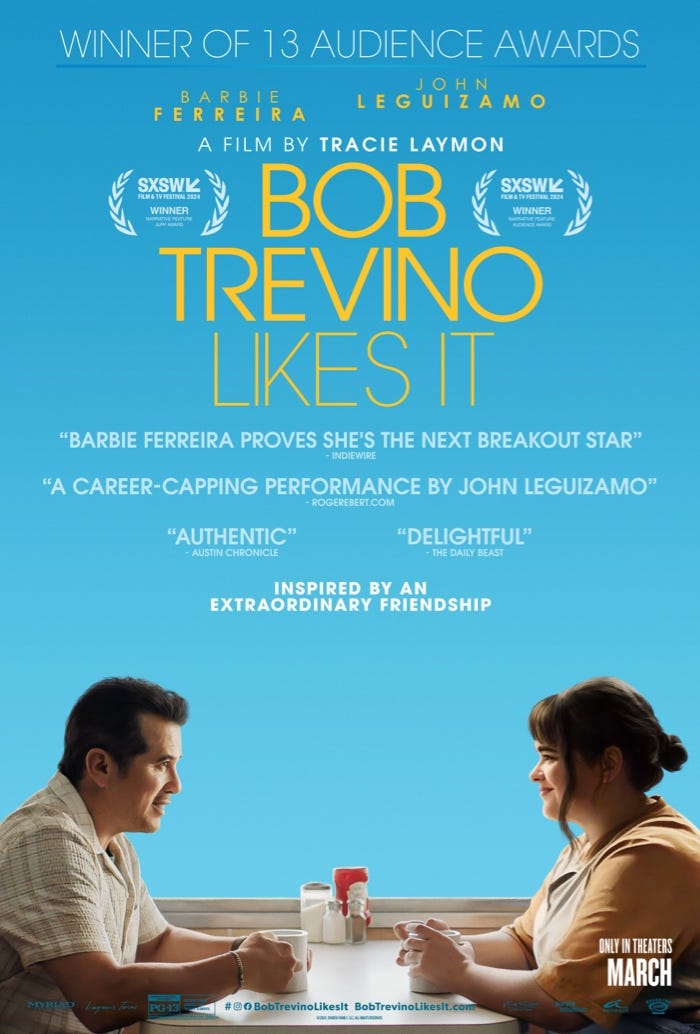
Spectacular. It made me cry. It’s about the friendship between two kindred spirits and a plea to reach out more to others. It’s on Hulu and Disney+.
How old were you in 1985? I hadn’t been born yet. Doesn’t matter. If I say Take On Me, I know it’s already playing in your head—the biggest hit Norwegian music has ever had. I loved this episode from Song Exploder, where Paul Waaktaar-Savoy, the band’s guitarist, tells the story behind the song.
This Oscar-winning animated short directed by Dave Mullins is now available to watch for free. It’s a great opportunity to check it out!
Dr. Peter Kreeft joins Fr. Patrick on this episode of Godsplaining to discuss his conversion from Calvinism to Catholicism and the roadblocks along the way, his experience with fiction and non-fiction, and the top books he recommends:
Scripture was my main arrow pointing to the Catholic Church.
Protestants and Catholics both love Mere Christianity. It’s done more for ecumenism than any other book in modern times.
I don’t feel joy most of the time, but I am absolutely certain that I have it. Because joy is not a feeling, it’s a fact. Jesus is our joy… God, who gives me all sorts of messy things in my life, does so only because he loves me and wants my higher joy.

That's all for this week. Thank you for your time. I value your feedback, as well as your suggestions for future editions. I look forward to hearing from you in the comments.
Hey, great read as always. Definitly agree, this is such a critical time for computing education and the implications for AI are huge.