

#36 — Delegating Understanding
The Map Is Not The Territory

Before we dive in, a quick personal note: I’ve been accepted by the Aalto Science Institute at Aalto University as a Visiting Doctoral Researcher for Summer 2026, and they’re funding me. I’m so excited to be in Helsinki in June and early July with Juho and the rest of the group!
Reflections
The Cost of Delegating Understanding

Let me kick things off today by sharing this piece by Miguel Ávila Monroy on the idea of the delegation of understanding in today’s AI context. Miguel writes about our tendency to hand off the task of thinking for ourselves to a third party. I kept turning this idea over in my head because it describes, with striking accuracy, something I see all the time in computing education. We’ve never had more access to knowledge, and yet we delegate understanding with astonishing ease. At the slightest doubt, we turn to something else to decide for us, not because we can’t figure it out ourselves, but because we’ve come to assume that this third party will always reach a better conclusion than we would.
In computing, this becomes especially visible. A student who never truly debugs a program and who jumps straight to asking an LLM to fix it, learns to follow the map. But the map is not the territory. Knowing that bubble sort compares adjacent elements is very different from having implemented bubble sort, then insertion sort, and feeling in the numbers why one takes seconds and the other milliseconds on a list of ten thousand elements. The same happens with Prim and Dijkstra. You can know that both are greedy algorithms without ever understanding why they are not interchangeable, until you sit with the same graph, run both by hand, and feel the moment where their goals quietly diverge.
That time, which may look unproductive, is where something real actually happens. Truly understanding something changes you. You move from watching where you place your foot to beginning to see the landscape.
And with that often comes something unexpected: an appreciation for the material itself, and a sense of wonder at those who move through it as if they were floating. The question we ask our students (and perhaps the one we should ask ourselves) is not whether they have the ability to dive in. It’s whether they’ll choose to use it.
On Perceptions in Academia vs. Industry
I’ve been asked several times why I decided to switch to academia after working in industry. I connected with this post by Andrew Kyle Lampinen, which raises the broader question of where research is better pursued, academia or industry:

For context, before moving into academia, I spent 10 years in industry, from startups to larger corporations. Now that the academic year is coming to an end, my first year as a PhD student, it feels like a good moment to reflect on which environment better aligns with my philosophy of life, as well as what I appreciate about each.
Unlike the author, I have more experience with startups, but I still found the framework relevant. I adapted some of the categories to my own context and perspective after this past academic year.
Mentorship: In academia, mentorship flows in both directions and is constant. I learn a lot from my advisors and fellow PhD students. As a TA, I also mentor undergraduate students and sometimes other PhD students, although it often feels less like formal mentoring and more like being a supportive peer and sharing what I’ve learned. In industry, mentorship from managers or peers played a smaller role, mostly because of the pace of work. That doesn’t mean the relationships were not strong, but the role of mentorship was different.
Diversity of backgrounds: I learn a lot from my PhD classmates, which is one reason I prefer attending classes in person. Unexpected conversations often come up. I also learn from my research group, which is very diverse, and it is useful to compare perspectives from Europe, Asia, and the U.S.
Advocating for one’s work: “In both academia and industry, part of the job is advocating for your work.” I agree, and I regularly use what I learned in industry. It is transferable.
Work–life balance: This was not an issue in my last company, where I had a flexible schedule. That said, I have generally found more flexibility in academia, even though it often requires more in-person presence, which I am fine with. For example, during Thanksgiving week and Spring Break, I did not work, and that is acceptable as long as your advisor agrees and you meet deadlines. This path allows me to spend more time with my family than the startup world did. I also have friends in large corporations whose lives are more stressful than mine, although there are busy periods here as well.
Stability: In my case, the salary difference has not been large, although I know that in the U.S., the opportunity cost of leaving industry can be high. As long as I can live comfortably, I am okay with that and hope it will pay off later, either in academia or industry. UH has also supported conference travel, and I have volunteered at some events to avoid registration fees. Securing funding is part of academic life. Sometimes it depends on me, and sometimes it does not.
These reflections are not especially deep or surprising, but they reflect my experience so far. I am sure I will have more to add as I continue this academic journey.
The Joy of Reading
Ricardo Calleja reflects on freedom, reading, and the kind of inner life that books make possible in this episode with Helena Farré Vallejo.
The conversation moves from our modern disillusionment with freedom to the idea of reading as a vital priority, not just a pastime, but a way of slowing down, thinking more deeply, and understanding life with greater clarity. Along the way, Ricardo talks about intellectual “diving,” the moral and formative value of reading, the difference between essays and novels, and why the physical book still matters so much. It is a rich conversation about attention, depth, and the search for a fuller human life. Quoting from the podcast:
Freedom
One of the first chapters of the book is about our problem with freedom. I say something that seems quite obvious to me: we idolize freedom while at the same time being afraid to use it and questioning whether we are truly free. That was already true ten years ago, to give a rough estimate.
But now another attitude has appeared: we have become disillusioned with freedom. We have tried everything and found that it does not really satisfy us. I think that is the state we are in now.
Everything I said before still applies, and even if it sounds contradictory, we idolize something we distrust, something that frightens us. But above all, I think our dominant attitude now is disillusionment. And all of this makes us less free. It makes it harder for us to venture into freedom.
Reading as a vital priority
I love reading. In fact, I would love to read even more. It is not that I do not read, but for me, the definition of a better life is a life in which I have more time to read.
When different options and decisions come my way, one of the criteria I use is: will this allow me to read, or will it prevent me from reading altogether?
In that sense, reading is a difficult activity, and I think this is true for many people, not just for me. But yes, I do like reading.
When I am actually able to read, it is a sign that things are going well. It means I am not completely overextended, that I have not gone past my limit. It means I am able to stop the hamster wheel, which is not always possible.
Intellectual diving
Reading, in a very evident way, especially today, allows us to stop and reflect, and to do so more deeply. Thought and reflection have layers of depth, and sometimes we think that once we are on the surface layer, that is enough. “I already think.” Well, yes, you think something, unless you have been totally lobotomized by social media or novelty. But just as with interior silence, there are levels.
As you descend through those levels, you discover a world with greater clarity and more nuance, a world in which everything connects with everything else. Reading is practically the only way we have to make that dive, to go downward.
And like every dive, it means entering an environment that feels somewhat unnatural, difficult, something that makes you want to come back up, see the light, and breathe. But little by little you discover that there is a world down there, and that it is worth staying there and spending hours there.
Reading to understand life
What I look for is understanding. Understanding what? The world, life.
I am drawn to authors who offer a vision of life, not something obvious, not a repetition of commonplaces, but something that shows how the pieces fit together at a level you did not expect.
Reading is, in the end, a search for something more. I think we all have this: dissatisfaction with present life, dissatisfaction with the explanations we have at hand, and the intuition that there is someone who can accompany us better through life, someone who has understood us even before knowing us.
Sometimes books put words to things for which you had no words. Other times, they repeat, almost letter for letter, something you yourself had already sensed. And then you think: how is it possible that this person is saying the same thing I say, not the same thing everyone says on the news every day, but the same thing I say that nobody says?
Reading and moral improvement
The classical tradition spoke of moral virtues and intellectual virtues. Reading demands a certain moral virtue, especially today, because without some degree of self-control, you simply do not read.
But fundamentally, what reading contributes are intellectual habits. Does that make you a better person? Not directly. Precisely the distinction between intellectual and moral habits means that the answer is no. Reading does not make you morally better by itself, because it is not directly a moral habit.
But it does make you grow in an important dimension of being a person, one that is necessary for the full development of the moral virtues, even if it does not automatically bring them about.
Culture, reading, all of that can be misused, obviously. History gives us more than enough examples. And yet reading can also shape us morally. It has always been used that way, educationally and even for self-education.
Good literature cannot be moralistic in the simplistic sense, because in life two things happen. First, not everyone who acts well ends up doing well. That kind of moralism, “the good person prospers and the bad person fails”, is false to life. It is bad literature because it is bad biography and bad morality.
Literature helps us because it allows us to carry out, as it were, an experiment in advance: what would I do? It does not usually ask the question in such a direct way, but as readers we ask it implicitly.
Essay vs. novel
I now have the personal, theoretical, and experiential conviction that I get much more out of a good novel than out of most essays.
The problem is that it is much harder for me to hold my attention on a novel, because my imagination wanders. With an essay, unless it is an extremely complex or fundamental book, I feel in control. I take the book, look at the index, go here and there, skim, stop, underline, skip sections. I do whatever I want with the book and extract what I want from it.
A novel is different. A novel demands a pact of fidelity from the first letter to the last. And you do not know whether you want to make that leap of commitment.
It is not so much fear of commitment as fear of wasting time. I am going to dedicate hours to this, it had better be worth it.
The physical book
I like reading on paper, with a pencil in hand. I do read more on Kindle now, especially because I travel, and I underline there too. But it is very different.
Reading on a Kindle is still reading, of course, but the physical book represents something important: when I read, I am doing a physical activity, and my memory is physical too.
With a physical book, I can feel where I am. I can see that I have reached the halfway point, that I have a little less left, that I have crossed a threshold. That may seem like a trivial thing, but I do not think it is secondary to the reading experience. It is part of it.
And then there is the visual memory of the page. I more or less have a photographic memory, so I can often remember where a passage is depending on its place in the book: the height on the page, the shape of the paragraphs. With Kindle, all of that disappears. It becomes like quicksand. Every page is the same.
Books also matter as objects. Their presence on the shelf matters. Even the books I have not yet read but would like to read are there as a challenge, as a reminder that there are still many worthwhile and delightful things waiting for me.
Some books mentioned in the episode: Mrs. Frisby and the Rats of NIMH; East Wind: West Wind; White Fang; Moby-Dick; The Neverending Story; The Lord of the Rings; Memoirs from Beyond the Grave; Dune; 84, Charing Cross Road; The Road; Hamnet; Laurus; Confessions; 247 Days; The Tartar Steppe; The Ides of March; The Pearl; The Martian Chronicles; The Brothers Karamazov; A Grief Observed; The Marble Cliffs.
If you’re looking for something technical to read, I put together a list of essential tech books in English and Spanish in this Google Doc some time ago. Feel free to check it out.

🔍 Resources for Learning CS
→ Do you want an AI from the Stanford d.school to audit your project?
Scopey asks a few questions about your project to help refine its scope and goals. This chatbot is designed to guide initiatives toward a human-centered design approach.
→ Measuring the quality of AI-generated code
There’s a concern going around among software engineers who use AI: how do I know the code I’m generating is actually good? Kimun is a command-line tool Eduardo Díaz built to objectively measure code quality using metrics backed by decades of research: Halstead metrics, cyclomatic complexity, and Adam Tornhill’s ideas on temporal analysis. The best part: it integrates directly with Claude Code. You use AI to generate code, and then use AI + objective metrics to evaluate it. Read the full post in Spanish here.
→ 10 Things Software Developers Should Learn about Learning
From CACM, 10 Things Software Developers Should Learn about Learning. The title says it all, but it’s also a good reminder for all of us. I especially loved item 6 when it comes to AI: “The Internet Has Not Made Learning Obsolete.”
→ AlgoMasterIO — Bite-sized DSA & LeetCode Patterns
If you’re brushing up on data structures and algorithms, the AlgoMasterIO playlists are worth watching. They break down core concepts into high-signal videos (arrays, graphs, linked lists, etc.) and focus on what actually matters: recognizing patterns rather than memorizing problems. The LeetCode patterns series is especially useful covering essentials like sliding window, two pointers, prefix sums, and more, which are key to solving a wide range of problems efficiently.
🔍 Resources for Teaching CS
→ What is tenure really?
This is a fascinating episode that elaborates on and digs into what tenure is from a legal perspective, as well as the arguments for why it is important beyond the classic reason of academic freedom. It’s a must-listen for anyone who wants to better understand the context and discuss the importance of this idea.
→ Guidelines for teaching informatics
The “Guidelines for Teaching Informatics: Practical Strategies for European Classrooms” have been officially published, providing practical approaches to make computing education more engaging, inclusive, and meaningful for all students; the document is part of a broader EU package on digital education (including AI, disinformation, digital content, and informatics) and will be translated into all 24 EU languages.
→ GenAI Resources for the CS Curriculum
This week in San Diego, the Workshop on Generative AI in Computer Science Education took place. I was browsing through the resources on their website, and they’re worth a look: they’ve published several reference courses that integrate GenAI across the CS curriculum (introductory programming, OOP, algorithms, software engineering, working with large codebases, etc.), with slides and projects that instructors can adapt to their own classes.
→ AI: Understanding the Game
I’d like to recommend a book in Spanish written by Margarita Padilla García, a computer engineer and educator who has spent decades involved in free-software activism. The book doesn’t try to provide definitive answers. Instead, it presents a collection of technical, historical, and philosophical ideas so that each reader can draw their own conclusions.
https://traficantes.net/sites/default/files/pdfs/TDS-UTIL_33_IA_web.pdf
→ National Academies Report — Data & Computing Competencies (K–12)
A new National Academies consensus report explores what it takes to develop data and computing competencies in K–12 education. It outlines seven core competencies and highlights a key challenge: while interest in these areas is growing, access and coherence across grades remain uneven. The report calls for coordinated efforts across curriculum, teacher preparation, assessment, and infrastructure to ensure all students can meaningfully engage with data and computing.
🦄 Quick bytes from the industry
→ Codex, Code Review, and Taste
What a fascinating conversation, especially when it touches on the intersection between research and engineering, and how each one depends on the other; choosing a company based on its consumer impact (including internal impact, like developer tools); how he still reviews the code even while heavily using Codex; how much code review should be done by an agent versus a human; and why deep technical skills are still valuable. I’ll definitely come back to this many times. Michael also has a really interesting technical career story.
I think we do a lot of very meaningful things (at Codex) but if the model weren’t very good it wouldn’t really matter what we did.
I really enjoyed working on Calendar because it was consumer-focused, and I shipped it to a lot of people. I went to Facebook because I thought it would be a huge consumer space, but it ended up not being consumer-focused at all. It turned into developer tools. My users were basically my friends at work. It was just about 20,000 people—not a billion—but it was good enough for me at the time. Then, thinking about OpenAI and the chance to come back to consumer—or at least have a large user base—was exciting. Now, working on Codex, I think there are over a million weekly users. I forget the exact number right now, but it just keeps growing. It’s more like a vertical line than even a hockey stick. That’s way more than the 20–40,000 developers I might have affected at Meta. I’m actually a much bigger user of the Codex app now than I expected to be.
I’m not someone who doesn’t look at the code. For projects that are true prototypes—throwaway projects—I’ll sometimes not look at the code at all. It’s very freeing, and I get why people are excited about it. But for the code that goes into Codex itself, I still need to look at it. That’s pretty important because it affects everyone else. Over time, you start to get a sense that the model will be able to handle certain changes. You end up getting a lot more done. Sometimes I even feel a little bad writing code by hand because I think, “If I had asked the model the right way, it could have done this.” It’s like when you start with something small—just changing three lines—and then 30 minutes later you realize you’ve gone much deeper. Of course, we all still like typing sometimes.
If you asked what percentage of my code is written by me versus generated by the model these days, it would probably be 80–90% model-generated. For things like debugging tests or CI issues, I’ll often ask the model for help—like adding print debugging. Every time I sit down to write something, I ask myself, “Should I write this?” And the answer is almost always no. There are some lower-level things, though. The Codex harness—the part I spend most of my time on—is written in Rust. That means we can do operating-system-specific things. I also spend a lot of time on sandboxing, which is what ensures the security and integrity of the system so the model can’t go outside the bounds you set. I tend to write more of that part by hand because I need to be really sure it’s correct and that our test coverage is solid. Sometimes I’ll seed the structure myself—lay the groundwork for the pieces I care most about—and then let the model fill in the rest. A lot of what I use the model for now is refactoring. For example, I might build up a big pull request that does too many things, and then ask the model to split it into reviewable-sized commits.
I like the approach where the agent does multiple rounds of review until it’s confident that the result is worth a human’s time to look at. But generally speaking, we still review it before it goes in. I think our agents still have an empty file, like everybody else’s does. Sometimes you still find gaps in knowledge where more context needs to be added back in. There are things we just haven’t documented yet—things that the agent doesn’t know but that I, as a human, still happen to know. Because of that, we do still catch issues. One interesting thing is that people are also using AI to write their pull request summaries now, and the summaries across the team have gotten way better. So when I go into a review, it’s already been reviewed by Codex, and there’s a summary that clearly explains both the what and the why behind the PR. That definitely helps us get through reviews faster, which is good because there’s a lot more code to review.
I actively try to go deeper through the layers and understand how things work. Many times I’ve seen other people do this, and now I can do it too. There are problems that other people were able to solve that I couldn’t solve before simply because I didn’t know there was cruft between two layers of the system. I still think it’s important to push yourself to go through the levels of abstraction and understand things at a deeper level. Of course, I think this will change over time. But right now, the questions you ask the agent still affect the quality of the result you get. If you’re not asking the right questions, you might not get the best engineering solution. As things progress, maybe that will become another layer that gets abstracted away. I think that’s probably where we’re heading. I just don’t know the time frame. Things do seem to be moving faster than we expect. In general, learning how to ask the right questions is really important. Even for myself, I haven’t fully figured out what that means for someone who’s just starting out. I’m fortunate that I have experience to fall back on—that’s where my sense of taste or intuition about what to ask comes from. But if you’re new, I’m not entirely sure yet what the best path is. And it’s also hard to say because we don’t fully know where everything is going.
→ Hiring Senior Engineers + behavioral interviews
Austen McDonald led mobile hiring at Meta and served on hundreds of hiring committees during his time there. Ryan Peterman spoke with him about what happens behind the scenes in senior+ engineering hiring and how to succeed in behavioral interviews.
Ryan has mentioned that behavioral interviews often feel less concrete than technical ones for engineers, so this conversation also explores subjectivity and bias in the process.
🌎 Computing Education Community
University of North Carolina Wilmington is hiring a tenure-track Assistant Professor in Computer Science (Software Engineering) within its College of Science and Engineering—applications are now open.
The University of Houston is seeking a Postdoctoral Fellow in Curriculum & Instruction focused on ML approaches to modeling human learning and language. The position involves working with interdisciplinary teams, analyzing learning and language data (including NLP and LLMs), mentoring graduate students, and potentially teaching.
For academics already experimenting with AI, Google has launched a new fellowship focused on tackling real institutional challenges, from assessment and policy to research workflows and how AI reshapes learning. Participants work on one concrete problem within their institution while joining a cohort exploring a broader question: what should responsible AI in education actually look like? Applications for the 2026 cohort are now open.
Hamilton College is hiring up to two visiting faculty (Instructor/Assistant Professor) in Computer Science for 2026–27. Open to all areas, the roles emphasize teaching across the curriculum, from intro to advanced courses, in a liberal arts setting with strong student engagement. One-year appointment, teaching load of five courses, with competitive salary (~$97K–$100K). Review starts April 1, 2026.
The IEEE-CS (with ACM, CRA, and CSAB) is gathering faculty input on a key question: how should high schools prepare students for undergraduate computer science? The survey explores topics like CS exposure, mathematical readiness, study skills, and the evolving role of AI in student preparation. Results will inform community recommendations and future curriculum discussions. Worth contributing if you teach intro CS.
Congrats to Charles H. Bennett and Gilles Brassard, recipients of the 2025 ACM A.M. Turing Award for laying the foundations of quantum information science. Their decades-long collaboration helped redefine information itself, shaping fields from cryptography to computational complexity and driving today’s momentum in quantum technologies.
A new NSF-funded project is recruiting faculty to join a multi-institutional effort on replicable computing education research focused on student teamwork (team formation, functioning, and interventions). Participants can join as Design Team members (co-developing the study; workshop at UVA + stipend) or Replication Team members (implementing it locally). A great opportunity to contribute to more robust CER across institutions. Applications open now (rolling from April 1).
Duke University’s ECE department is hiring a Professor of the Practice (teaching faculty) in areas including software, computer architecture, AI/ML, and HCI. The role focuses on teaching (2–2 load), requires a PhD, and emphasizes contribution to Duke’s teaching mission. Applications are open until late June.
A new study by Tommaso Carraro explores how faculty approach Society, Ethics, and the Profession (SEP) competencies in computing curricula. While frameworks like CS2023 emphasize these areas, they often remain part of a “hidden curriculum” with limited support for instructors. The survey (10–15 minutes) aims to capture how faculty integrate and develop these competencies in practice. Worth contributing if you teach computing.
Looking to make early CS courses more engaging? The BRIDGES workshop at UNC Charlotte introduces a toolkit for integrating real-world data, visualizations, and interactive projects into CS1/CS2, Data Structures, and Algorithms. With APIs for Java, C++, and Python, it’s a practical way to help students connect computing concepts to real problems.
CCSC Midsouth 2026 — Nashville (Apr 10–11)
Submissions are now open for the UK & Ireland Computing Education Research (UKICER) Conference. Deadlines span April–June (papers, workshops, doctoral consortium, posters), with the conference hosted at the University of Cambridge. A great forum connecting researchers and practitioners across Europe and beyond.
Virginia Tech’s Echolab is recruiting CS instructors for a 90-minute co-design workshop on improving student participation in live coding lectures. Open to anyone who regularly uses live coding (no design experience needed), with a $75 gift card for participants. A nice opportunity to reflect on and shape teaching practice in this space.
The Professors’ Open Source Software Experience (POSSE) workshop will take place at Red Hat HQ (Raleigh, NC), helping faculty integrate open source and team-based development into their courses. The program includes an online phase followed by a 2.5-day in-person workshop. No prior OSS experience required, with travel support available. Applications open (rolling until April 20).
The MAP-CS project is collecting faculty input on how institutions review and update undergraduate CS curricula, with a focus on supporting innovation and liberal arts contexts. The 10-minute survey explores current practices and challenges, aiming to inform better resources and share insights with the CS education community.
A full-time Senior Education Researcher position is open (remote), ideal for those interested in applying education research skills in new contexts. Applications are reviewed starting March 23 and close April 3 (or until filled).
CRA-E is running a national survey on the challenges faculty face in making computing courses digitally accessible, ahead of the April 2026 ADA Title II requirements. The goal is to identify barriers, reduce faculty burden, and inform practical resources (tools, guidelines, and best practices). A quick 5–10 minute survey—worth contributing if you teach in the U.S.
The CCSC Central Plains conference will take place at Drury University, with early registration open until March 27.
JetBrains’ KotlinConf will feature an Education Track focused on teaching Kotlin and adapting to changes in computing education. The track brings together educators and industry to explore teaching practices and materials, with insights that extend beyond Kotlin itself.
🤔 Thought(s) For You to Ponder…
What I find interesting about this article in Spanish (Omnes) is the underlying real ethical issue: AI companies (the ones developing these models) should design systems that do not exploit deep human attachment mechanisms. That’s their responsibility. They must make it clear that AI does NOT feel.
I love this segment of A Vivir. What I like most is that they’re still committed to going out to places and talking to people in person. It’s not the same conversation you have with someone over the phone as the one you have face to face and you can tell the difference on the radio, in podcasts, and in life.
Christian García Bello is always worth listening to. Here are a few notes, not necessarily verbatim, that I jotted down while listening to him on this podcast with Alex Sanz Vicente and Javier G. Recuenco:
Science has communicated incredibly well and enjoys a lot of prestige. The arts can do the same: tell compelling stories without lowering the bar.
The sophistication has to live in the work itself. Whatever you put on top of it should be simple and act as a guide: point to an entry point, give a bit of a user manual, let the viewer explore it, and promise that there’s a reward at the end.
We keep educating our taste and our eye the more we consume: we start to notice more twists, more nuance, and so on.
So many people understand Spain through its art: Picasso, Dalí…
When uncertainty enters the picture, the human element has to come in too.
The idea of the “deep gaze” is great as well: everyone naturally does it within their own field. There’s also this idea of “sensory knowledge”—the kind you gain firsthand and that’s hard to pass on, something that emerges naturally. And then there’s “sound judgment”: expert intuition, that sense of “this works”, having a good eye for it.
His criterion for choosing materials is how he can use them to tell stories. I loved the idea of the poetics of concrete.
Ferran Adrià talks about his relationship with Juan Mari Arzak (01:08:40): Setting egos aside to achieve a greater goal, creating a movement and a global brand to position Spain on the world stage so that many people can benefit from it, directly or indirectly.
I’ve started reading a recent Vatican document. It has 164 sections, so it will take me a few days to get through it. I’m particularly drawn to the intersection between Christian anthropology and technology, essentially the relationship between humans and machines. I’m planning to write about this in my newsletter next week, focusing on topics such as cognitive capacities; the distinction between enhancement and replacement; and the difference between suppressing or substituting what is human versus integrating technology in ways that bring human potential to its fullest expression. I’m also interested in exploring the risks: the opacity of automation in sensitive areas, dynamics of isolation, the weakening of critical thinking, the rise of a kind of digital “spiritual marketplace” without genuine community, and the emergence of technological substitutes for ultimate meaning. However, I don’t want to focus only on the risks; I’m equally interested in exploring possible solutions.
Manu de La-Chica from Soul College recorded a great episode of Ágoras with Dominican friar Adrien Candiard. It’s about 30 minutes long, and it absolutely flew by.
A few ideas that really stuck with me:
It’s a mistake to think we have to be saints in order to be loved by God. We can become saints because God has loved us.
Maturity means being free. Free to do what I want—what I believe is right—not to please other people, God, or my parents. To be adults, we have to choose our own lives and actions. God wants us to be adults. He wants us to be adults because He desires a relationship of friendship with us, not one of servitude—and that’s a big difference.
We have to weigh situations carefully. We need to act like adults, like people who recognize where the good is and move toward it. You can’t write a manual of Catholic morality that covers every situation, because morality, properly understood, is the science of the particular. In your personal situation, in every action you take, there are a thousand different factors at play in your mind—and only you can discern the good in that moment.
Of course the commandments help. Of course the experience of others, of the Church, helps. Ignoring that wisdom isn’t a good idea. But in the end, you are the one who acts. And God knows that—He gives us this freedom, which is difficult, demanding, and what ultimately makes us adults.
God’s will is better. Yes, of course it is—but it’s better because it aligns with what I most deeply desire.
The problem with the Pharisees is that they can’t accept that prostitutes and tax collectors are saved—that it would be impossible to be with them if heaven were filled with people like that: “I don’t want to go in.”
And that’s why they killed Jesus—not for any other reason. They killed Him because He opened the Kingdom of God to everyone. Accepting God’s goodness toward others is a major challenge, especially for those who see themselves as righteous, who haven’t committed serious sins. But you can’t love God if you don’t love His will.The work of the Spirit in us is to make us children of God, as St. Paul says in the Letter to the Romans. The Spirit’s action makes us sons and daughters. And prayer is about welcoming that work. Saying a lot of “Our Fathers” can be helpful—but it can also become mechanical. And that doesn’t please God. If I’m just repeating prayers to feel like I’ve done something, it means I haven’t understood that the one acting in prayer is the Holy Spirit—and I need to let Him act.
This isn’t easy. Here too, the demands of the Gospel are high. To be children of God and accept that the primary work in my Christian life is done by the Holy Spirit—not by me—requires a certain humility.
This article by Marcos Rodríguez Vega, a cybersecurity and AI researcher at the University of La Laguna, does a great job explaining the implications of the data generated by our everyday digital activities. Individual data points aren’t all that significant on their own, it’s the analysis of big data and the combination of many small traces that really matter: probabilities, statistics... And that has consequences. It moves from analysis to actually leveraging behavior as a highly sought-after commodity in the digital marketplace. Marcos talks about companies that trade in this data, the importance of safeguarding security and privacy, and the need for net neutrality. Really interesting.
Everyone has something to teach us. We can learn from anyone. When we start becoming polarized, that’s when things go wrong. We should have a deep and consistent love for the truth, while staying clear about the fact that we don’t own that truth. This article by Tsh Oxenreider really made me reflect: our affection can’t depend so much on who we naturally like or dislike. The way we treat others will only be truly just if we make an effort to see people the way God sees them. In every group, there will always be people we naturally click with and others we don’t. But if I rely only on my own perspective, I’ll end up showing warmth and enthusiasm to the same people over and over, while consistently excluding others. True fairness, then, means treating others based on how God sees them, even if they’re not the nicest or easiest person for me. That’s what love is: willing the good of the other and recognizing the good in them.

Related to today’s topic: the problems that come from blind faith in data.
What do you do to rest and recharge? Here are a few things I try to practice:
Reading: having a fixed place and time for it, almost like a sacred block in my schedule.
Moments of silence and deep disconnection are essential to detox from overstimulation: prayer, the rosary, etc.
Walking in silence while listening to enriching podcasts.
Letting myself be bored from time to time to free up my mind. I like going out into nature for that.
📌 Research Corner
As Juho Leinonen and colleagues argue, current approaches to teaching programming mostly add AI on top of existing models but that may not be enough. Their work points toward a deeper shift: learning programming through natural language as part of a new paradigm. In parallel, their award-winning paper “Probing the Unknown” (Best Research Paper at AICSEPAR 2026) explores how students interact with AI-mediated problems at scale, offering early empirical insight into how this transformation is already unfolding.
I took a slower and more careful pass through the Information Gathering Toolkit from Omni Institute, created by Oskar Burger, Shon Reed, and Bianca Gonzalez-De La Rosa. It covers three main methods of data collection: (1) surveys, (2) key informant interviews, and (3) focus groups, and it wraps up with a section on both quantitative and qualitative data analysis.
On the ethics side, the document makes it clear from the start that any data collection effort should adhere to principles like voluntary participation, confidentiality, professional competence, and justice—all grounded in the Belmont Report.
For surveys, the guide walks through how to design them, what types of questions to use (closed-ended, like Likert scales, or open-ended), how to improve response rates, and how to administer them. It also warns about sampling bias and recommends random sampling whenever possible.
When it comes to interviews and focus groups, it emphasizes the importance of having a well-developed discussion guide, building rapport with participants, and separating the roles of facilitator and note-taker. It also offers practical tips for handling tricky situations, like dominant participants or questions that are met with silence.
Finally, in the data analysis section, it distinguishes between quantitative analysis (means, percentages, standard deviation) and qualitative analysis (coding, identifying themes, collaborative interpretation), and stresses the importance of not projecting your own biases onto the data.
🪁 Leisure Line
Two weeks ago, I visited TXRX Labs at the East End Maker Hub in Houston, a makerspace with several workshops, including woodworking. Some of these spaces would be perfect for crafting things in 3D. The next step is to sign up for some classes.


I didn’t write the email last week because I was traveling in New Mexico for spring break. I’m still processing the experience… So much beauty and great company.


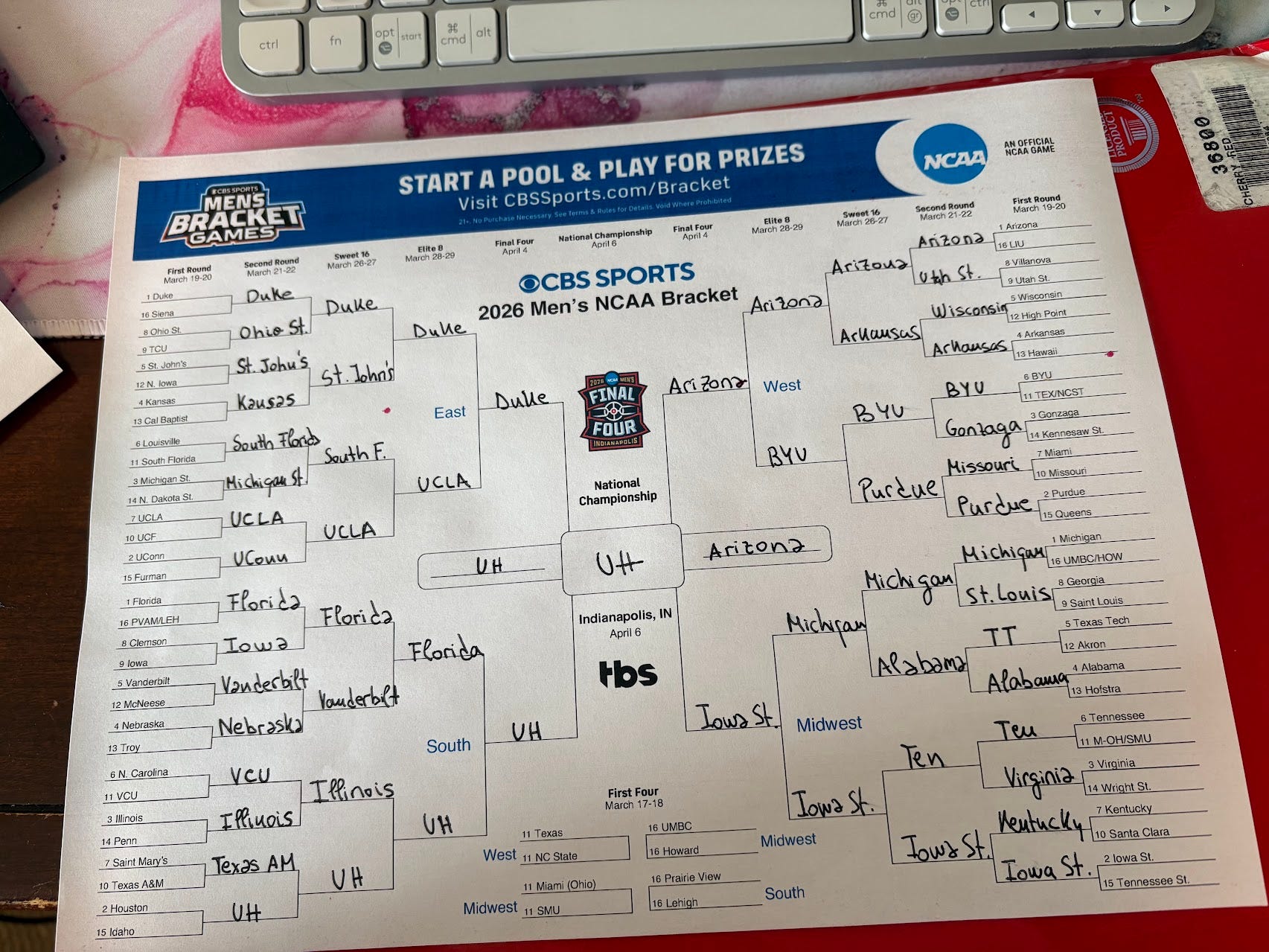
I just finished my bracket! I know Duke or Florida could beat UH, but I can’t bring myself to pick against them. I also think Michigan could beat Iowa State, but both are great teams. I’m confident UCLA will make it to the Elite Eight, beating UConn. I’d love to know what you all think in the comments!
📖📺🍿 Currently Reading, Watching, Listening
The documentary about how IntelliJ IDEA was made.
Solid episode from Arthur Brooks about what leisure actually looks like. Good stuff.
I’ve mentioned Twenty Thousand Hertz before, the Dallas Taylor podcast all about the world of sound. In this episode, they dive into the sonic universe of the Harry Potter audiobooks, and it’s a fascinating listen.
I’ve had the closing song from this newsletter stuck on repeat since Sunday morning. A great deep dive into Taracá with Ángel Carmona. The final segment about the AI-generated song is brilliant: empowering words is like bringing Pancho Villa together with Zacatecas. No matter how sophisticated models become or how well they mimic what we call “judgment,” they’ll always be missing lived experience. They’ll lack context. They won’t have any real-world street smarts.
Jessie Buckley was the queen of the night at the 2026 Oscars. I loved her speech and her take on female empowerment. Two lines in particular are still echoing in my mind: when she said to her husband, “I’d have 20,000 more babies with you,” and when she dedicated her award to “the beautiful chaos of a mother’s heart.” The line about the babies is clearly an exaggeration, but it points to an overflowing experience, that desire for an almost infinite multiplication of life, something that resonates with the idea of vitalism. The second speaks to motherhood as a kind of creative abundance. In the way she frames it, motherhood doesn’t compete with her identity as an artist; it expands it. She doesn’t romanticize the chaos either. She acknowledges it and lives it intensely, but she places professional success within an emotional ecosystem, recognizing her husband and parents, aware that she’s part of something larger. Her vision of female empowerment is rooted in belonging, seeing herself within a network, honoring those who came before and those who will come after, and valuing life and relationships beyond any cost benefit lens. She celebrates both abundance and chaos as the driving forces behind her art.
If you’ve been following me for a while, you already know I’m a big fan of Arthur Brooks. I’ve already pre-ordered his new book. It comes out at the end of this month.
💬 Quotable
We aren’t always free to change things, but we are always free to live through them in faith, hope, and love so that in every situation we grow humanly and spiritually.
Real freedom does not mean being ruled by one’s impulses from one moment to the next. Just the opposite. Being free means not being a slave to one’s moods; it means being guided in a course of action by the fundamental choices one has made, choices one does not repudiate in the face of new circumstances.
― Fr. Jacques Philippe (Fire & Light)
🌐 Cool things from around the internet
A collection of links to stuff I think are worth sharing.
🔗 Google Arts & Culture — curated historical and artistic content.
🔗 Archive of Archives — curated collection of digital archives.
🔗 gradient.horse — draw a horse and watch it run with the rest of the herd.
🔗 Visions of the Future — a graphic project by NASA. Beautiful.
🔗 The Tenth Muse (10M) — a new platform for discovering the world’s greatest art. Created by Paul Jun.
🔗 Series Graph — explore episodes through ratings graphs. The Game of Thrones episode rating chart is really cool.

Issue #36 of Computing Education Things was written while listening to:
🔗 Quick Links
🎧 Listen to Computing Education Things Podcast
💌 Let’s talk: I’m on LinkedIn or Instagram
If you’re enjoying Computing Education Things, please like, comment, or share this post! You can also support this work through Buy Me A Coffee. And if you’re finding value in the newsletter, consider forwarding it to a friend, colleague, or family member to help the community keep growing. Thanks for reading!