

#39 — Is a Computing Degree Still Valuable?
It’s hard to name a better major in a world where AI is a dominant force

Reflections
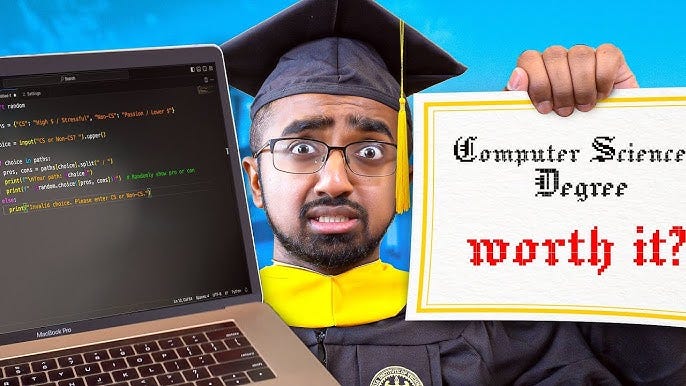
The value of a computing degree has shifted
I took a ton of notes from this conversation between Aman Manazir and Sajjaad Khader. I thought doing a deep dive could be helpful for computing students, aspiring software engineers, and computing faculty alike to reflect on topics such as:
What actually counts as a strong candidate today.
How to make the most of college.
Why being a TA is a smart move.
How to stand out as an intern.
How to build a strong LinkedIn presence.
Why computing degrees are still the best majors in the age of AI.
The different paths for aspiring software engineers in the AI era.
LeetCode and the future of technical interviews.
Full conversation is here if you’re interested. It’s worth your time:
What Actually Counts as a Strong Candidate Today?
The starting point of the conversation was whether we deserve a job and, according to Sajjaad, we don’t. Instead, we have to earn it. And earning it doesn’t mean simply knowing a programming language; it means proving that we can bring value to a company.
Big tech doesn’t need your ability to know Java or Python. They need your ability to bring value to their company.
That value is built through a few concrete things:
Experience: What have you already done, even if it’s small?
Solid technical skills: Fundamentals are essential but they’re just the baseline. Learning to code is the floor, not the ceiling.
Projects with direct impact: Not generic projects. He gives a specific example: is there an extracurricular club on campus struggling to get RSVPs or analyze event turnout? That’s a real technical problem you’re uniquely positioned to solve. Go solve it, don’t charge them, document the impact, and share it.
Extracurriculars: What you do outside the classroom signals leadership, communication, and follow-through. Skills that translate to any professional context.
Demonstrable technical impact: Building something isn’t enough. Who did it help? What changed? What are the measurable results (KPIs)?
Basically, it comes down to this: find a real problem, solve it for free, and showcase it on LinkedIn and your resume.
He shares an example of a friend who started posting about ML (creating a diagram of a neural network and explaining how weights work). After just three posts, recruiters were already reaching out with high-paying opportunities (around $150K).
How Sajjaad Actually Got Into Amazon as a Freshman
He applied to Amazon three separate times. He applied online, at a career fair when Amazon visited his campus, and at a separate tech event the company hosted at his college. Three different channels, three different shots on goal.
According to him, the interview itself was actually easier than getting the callback. The hardest part was getting someone to look at his resume in the first place. He went through multiple rejections, had his resume reviewed and critiqued repeatedly, improved it, and kept applying.
Once he had Amazon on his resume, everything changed. That single name became a powerful signal of credibility. In later applications, he could speak concretely about the AWS tools he used (Glue, Lambda, Redshift, S3), which made a strong impression on interviewers.
As soon as you have Amazon on your resume, that becomes your qualification up to that point. In a sense, it can be more valuable than a degree.
What Matters Is What You Can Do With Your Diploma
The value of a CS degree has shifted. Sajjaad’s framing is that AI models are trained on vast amounts of information. In that context, simply holding a degree doesn’t carry the same weight it once did. What matters now is what you can actually do with it.
That said, it’s worth adding some nuance: the institution still matters. A degree from a school like Georgia Tech doesn’t carry the same weight as one from a less recognized institution. That factor hasn’t disappeared just because the market has changed. Skills and experience are becoming increasingly dominant, but the institution you attended can still help you pass the first screening stage. After that, the playing field tends to level out, and where you studied matters far less.
His Academic Path and an Interesting High School Strategy
Sajjaad finished high school with 60 college credits already completed through AP courses and dual enrollment at a community college near his home. A CS degree at Georgia Tech requires 126 credits, so he entered with roughly half already done. He completed his bachelor’s degree in just two years. During his second year of undergrad, he began taking master’s-level electives, and by the time he graduated, he had already completed about 40% of his master’s degree. He then finished the master’s in one additional year—bringing his total time at Georgia Tech to just three years, graduating at age 20.
However, he doesn’t necessarily recommend this path. His main motivation was financial: Georgia Tech cost around $50,000 per year for out-of-state students, so graduating two years early effectively saved him $100,000. For him, that made it worth it. But if you’re trying to “speed-run” college just for the sake of finishing quickly, he questions the value of that approach. The key question he raises is: what are you actually trying to get out of the experience?
In his case, he already had strong momentum. Before finishing his master’s, he had completed three internships: Amazon during his freshman year, Splunk at the end of his sophomore year, and a data engineering internship he had lined up even before starting college. After his experience at Splunk, he knew he wanted to work there full-time and given the salary, it made sense to leave early rather than stay in school longer without a clear reason.
The Master’s, TAs, and How to Work the System
For students in their final year with little or no experience, Sajjaad believes that pursuing a master’s can make sense—especially as a way to add structure. If someone lacked direction during undergrad, a master’s program can provide a more focused, project-based environment. In his case, his master’s was heavily project-driven, which is where he learned a lot about AI.
That said, his broader recommendation for college students is to graduate and start a startup or build a serious project—not to default to a master’s as a delay tactic.
Try to create a startup. Worst case, you’ll get hired. Best case, you’ll build a million-dollar company and won’t need a job.
When a master’s does make sense, his advice is to approach the TA (teaching assistant) system strategically. He started TA-ing during his second year of undergrad for an Objects and Design course, so by the time he needed a graduate TA position to help fund his master’s, he was already in the system.
His strategy:
TA undergraduate courses first to build a track record.
Take graduate-level electives and perform well.
Reach out directly to professors: “I have TA experience, I took your class, and I earned an A—could we work something out?”
Because he became a graduate TA, his full tuition was waived for both semesters. After finishing his master’s, he was even allowed to continue as a graduate TA (with minimal hours—mainly office hours and forum responses), earning an additional $2,000 per month.
In effect, his master’s was free.
His broader point is that finances are often the biggest constraint in the graduate school decision. If you can solve that piece, the entire equation changes.
How to Be Memorable as an Intern
Sajjaad’s manager at Splunk told him he accomplished more in four weeks than most interns do in an entire summer. What he describes from that experience is essentially a masterclass in how to show up. The word he kept coming back to was impact—impact through your technical work, impact through making your presence known, and impact through being genuinely helpful and easy to work with.
Here’s what that looked like in practice:
Get on a project as quickly as possible. Don’t wait to be assigned work. When his manager was introducing a project, he was already engaging: What if we do this? What if we add that?
Ask thoughtful, well-researched questions. He drew a clear distinction here. A weak question is: “I have no idea how to do this—can you help?”
A strong question is: “I looked into approaches X, Y, and Z. X doesn’t seem right because of this. Y and Z both seem viable—what do you think is the better direction?”
You’ve done the groundwork; the other person just needs to react.Distribute your questions across the team. Don’t rely on a single person. If your team has six to eight members, rotate who you go to. By the time you circle back, it feels natural—and no one sees you as overly dependent.
Write high-quality code. Think beyond just “it works.” Handle edge cases, write test cases, and produce solid design docs and technical artifacts. He emphasized this point: it’s often underappreciated in the moment, but it saves hours of meetings and rework later.
Never miss a deadline. And if something might slip, communicate it early—before it becomes an issue.
For securing a return offer, his advice is simple: talk about impact. Be explicit about what you delivered, what problems you solved, and the value you created.
He also made a deliberate effort to build visibility beyond his direct manager—setting up one-on-ones with his manager’s manager and connecting with teammates across the team. He made his presence known in a meaningful way.
LinkedIn and Networking: What Works for Him
Sajjaad took a highly proactive approach to networking—reaching out to 30 to 50 people every single day across various tech companies. His message was simple and direct: who he is, what his experience and skill set look like, and a request for a quick 10–15 minute call to learn about their experience and opportunities at the company.
People can usually tell you’re ultimately looking for a referral, but his approach wasn’t overly explicit or off-putting. He led by demonstrating value first.
The call itself is the critical step. If an engineer’s team is actively hiring and they tell their hiring manager, “I spoke with this person—they’re actually strong,” that can fast-track a candidate straight to a final round. According to Sajjaad, this happens—and it’s a pathway the standard “apply online” route rarely opens.
Referrals also work because of incentive alignment: employees often receive a bonus for successful referrals, which gives them a reason to help.
On LinkedIn specifically, he’s very clear—it’s one of the largest databases recruiters actively search. His advice:
Have a strong headshot and a clear headline that highlights your areas of expertise
Document your journey publicly—it doesn’t need to be polished or overly curated. Share what you’re learning, what you’re building, and what you’re exploring
Show proof of activity—hackathon photos with key takeaways, offer announcements, graduation posts, or project highlights. Anything that demonstrates real-world engagement
His core principle is consistency.
The real advantage is the consistency of your output. If you haven’t started posting on LinkedIn, you don’t even know your own voice yet.
Everything else—emotional hooks, storytelling frameworks—is secondary.
The Market Has Changed. Are CS Students Cooked?
No—but his framing is sharp:
Most computer science students cook themselves. They aren’t cooked by the market.
Instead of saying “the market is cooked,” reframe it: my application is cooked, my resume is cooked, my lack of referrals is cooked. The point is to focus on what you can control. The more you externalize responsibility, the less agency you have to improve your situation.
His diagnosis is that many CS majors focus narrowly on coding, grinding LeetCode, and submitting applications. When rejections come in, they conclude the market is broken. But he argues that this is often a coping mechanism—it traps you into thinking there’s nothing you can do.
The reality in today’s market is that:
Coding is the baseline
LeetCode is the baseline
Applying to jobs is the baseline
The real question is: what are you doing beyond that?
Can you build something that solves a real business problem? Can you share it so people actually see it? Can you proactively reach out and secure referrals?
The bar is higher now and the only real option is to adjust to it.
Is Studying CompSci Still Worth It?
Yes.
It’s hard to name a better major in a world where technology is a dominant force and AI sits within the broader field of computer science.
I’d add a bit of nuance: AI is increasingly evolving into its own discipline in a more meaningful way. Still, the core point stands building strong fundamentals in computer science has compounding value over time.
For learning to code, his recommendations are:
Start with CS50 to build problem-solving skills before focusing on syntax
Move to Python, using resources like Bro Code on YouTube or freeCodeCamp
Use two screens (or split-screen): one for the tutorial, one for coding—because you don’t learn by just watching
Try beginner GitHub projects, but don’t copy them directly—build your own simple versions
For data structures and algorithms (DSA):
Start with seven core structures: arrays, linked lists, sets, hash maps, stacks, queues, and priority queues
Use GeeksForGeeks to understand the concepts
Use csvistool.com (built by Georgia Tech students) to visualize how each structure works alongside the code
Practice with LeetCode to apply what you’ve learned
On whether university is necessary, his answer is: it depends on your level of discipline. University offers a highly structured environment but it also comes with a high cost. If your only goal is to learn how to code, paying $100K can be difficult to justify. Alternatives like mentors, coding communities, and online resources can often get you there
The Two Paths for Software Engineers in the AI Era
This was the part of the conversation that probably made me think the most.
It’s not the first time this idea has come up, and Sajjaad reinforces it: software engineers are increasingly becoming software managers. Previously, software engineers received requirements, designed features, wrote code, tested it, and deployed it. Now, AI agents can handle much of the planning, coding, testing, and deployment under human direction.
The role starts to look more like a conductor leading an orchestra. The conductor doesn’t play every instrument—they coordinate: you play, you play, you play.
From this shift, two main paths emerge:
1. The deep technical path
This means going deep into machine learning at the level of the models themselves. Sajjaad is very clear about what this requires: you need to genuinely enjoy math, probability, and statistics.
He also pushes back on the hype. The work isn’t always as exciting as people imagine—it often involves fine-tuning, hyperparameter optimization, and incremental improvements. Before ChatGPT, very few people paid attention to this space, and even now, progress is often iterative and driven by large teams. You’re one part of a much bigger system.
This path typically requires a master’s or PhD. But if you genuinely enjoy the work, it compounds over time and can be highly rewarding—both intellectually and financially.
2. The tools-and-orchestration path
This is about becoming exceptionally good at directing AI systems—essentially, a high-leverage “conductor.”
Sajjaad highlights tools like Claude Code, especially its sub-agent capabilities for parallel task execution and message queuing, which can make you feel like you’re truly managing a team of AI agents. He also mentions Cursor as part of this toolkit.
That said, here’s an important nuance: tools change quickly. Building your entire edge around a specific tool is risky if it’s your only strategy.
A stronger approach is to build solid fundamentals first—then layer AI tools on top. That’s when they become force multipliers rather than crutches that break when the ecosystem shifts.
He also mentions Wispr Flow, a voice-to-text tool that formats output cleanly with proper grammar, punctuation, and even code. He types at around 57 words per minute, but with WhisperFlow, he effectively operates at 157. It’s easy to see the productivity gain there—though personally, I still prefer writing.
LeetCode and the Future of Technical Interviews
Sajjaad argues that data structures and algorithms (DSA) aren’t heavily used in day-to-day software engineering. Instead, LeetCode functions more like a cognitive shortcut. It tests whether you have a solid coding foundation and a certain level of problem-solving ability—then companies bet they can teach you the rest on the job.
In that sense, it’s similar to the SAT of software engineering.
However, some startups are already moving toward a more realistic evaluation model: giving candidates a real feature to build using AI tools, within a set time frame, and asking them to explain both their code and the decisions behind it. In some cases, candidates are even paid for this work—and if hired, the feature may actually ship. That approach looks much closer to the actual job.
So why don’t large companies adopt this model? Mainly because of cost. Evaluating that kind of work requires significant time from experienced engineers and that time is expensive. LeetCode-style interviews, by contrast, are cheap to administer and easy to standardize across a global candidate pool.
I agree with Sajjaad on where this is heading: system design will likely become even more important as AI takes over more of the implementation.
If your role shifts toward orchestrating AI agents, the key question is no longer “Can you write this function?” but rather “Do you understand how the entire system fits together?” How do different components interact? What are the trade-offs? What are the failure modes?
The role of the engineer is shifting from executing tasks to designing and directing how those tasks get done. And for that, a holistic understanding of systems isn’t optional.
On Getting Satya Nadella and Reid Hoffman on His Podcast
Finally, I want to briefly highlight this last part of the conversation because I really liked how Sajjaad frames it: confidence in your ability, combined with consistency in your output, compounds into access that seems impossible from the outside.
He built his interviewing skills by starting small—talking to everyday software engineers. Over time, he grew an audience, started getting invited to events, and pitched himself while he was there.
When Microsoft invited him to Microsoft Build, he asked if he could interview Satya Nadella, pointing to his previous interviews with GitHub’s CPO and COO as proof of experience. They said yes—and then expanded the opportunity to include Anders Hejlsberg (creator of C# and TypeScript), Brendan Burns (co-creator of Kubernetes), and a Microsoft VP. Through that, GitHub connected him with even more people.
In the case of Reid Hoffman, the dynamic flipped. Hoffman’s team reached out to him after he posted a reaction to one of Hoffman’s videos on career advice in the AI era.
The takeaway isn’t that you need to start a YouTube channel. It’s that skills like interviewing, consistently putting out content, and having the confidence to ask, even when the worst outcome is just a “no”, compound over time into opportunities that look like luck from the outside.
Token Anxiety
The whole “token anxiety” thing can’t be healthy. Felix is right. Patrick too.


We can drive ourselves crazy running a bunch of tasks in parallel and none of which are actually the ones we should be working on. Maybe it has more to do with choosing the right problem, thinking before executing, deciding what’s worth doing… Not just cranking things out at insane speed.
One of the issues that comes with having a tool as powerful as Claude Code is this illusion that we’re winning, when in reality we’re not focused on what actually matters or creates real value.
It’s a particularly sneaky form of procrastination because it looks like productivity. It’s not watching Netflix. It’s not scrolling Instagram. It’s spending hours in front of your computer.
Back in the 2000s, Getting Things Done by David Allen became the go-to playbook for a whole generation of knowledge workers who felt overwhelmed. The promise was simple: capture everything, organize it well, and review the system regularly so your brain is free to think instead of remember. It was compelling. The problem was the system itself. Spending hours on a Sunday afternoon setting up tools while your real work sat untouched was clearly self-deception.
ThePrimeagen does a great job explaining this current AI agent frenzy.
He starts by describing something developers will recognize: that deep focus state where, even when you’re not at your computer, your brain keeps working on the problem. The “shower moment” where the solution suddenly clicks. That low thrum behind your ears that sticks with you even while you’re having dinner with your family.
But now, he says, that state no longer requires a hard problem. The agents are always running. There’s always something processing. The thrum never stops.
He quotes a Substack post describing how, in San Francisco, a friend of the author left a party at 9:30 on a Saturday night, not because he was tired or sick, but because he wanted to get back to his agents. Nobody questioned it. Half the people still at the party were thinking the same thing. The other half were probably checking their agents’ progress on their phones.

The CEO of Y Combinator announced he quit alcohol for Claude Code.

There are people spending $1,000 a day on tokens. Multiple agents running in parallel. Ideas generating ideas that generate more ideas. Everything is moving forward. But toward what?
What makes AI-driven procrastination more dangerous than older versions is that the results are real. It’s efficient. The system works. The code gets written. Features show up. Commits pile up. You’re producing real things.
The problem is, you can produce the wrong things at an incredible speed.
ThePrimeagen puts it well: the problem was never programming. The problem has always been choosing the right problem. And now we have tools that let us avoid choosing, because we can run many ideas at once. The premise isn’t the problem. The slope is. There’s a point where the marginal return of improving the system is lower than the cost of not doing the actual work, and it’s surprisingly easy to cross that line without noticing.
ThePrimeagen ends his video with advice to his younger self, back in 2009 when he’d stay up all night building his startup in NetBeans, writing PHP:
One extra feature in your calendar app is not worth skipping out on some good times with your friends. Hard work got me to where I am now, but it is not who I am.
What hasn’t changed is the nature of meaningful work. It’s still the same: understanding the right problem, thinking before executing, and choosing what not to do. No agent automates that. If anything, agents make that skill more important, because execution is no longer the bottleneck.
I can have many things running in parallel. The real question is whether any of those five are actually the thing I should be doing.
I’m going to follow Felix and Patrick’s example and unplug from Claude Code as much as I can this weekend.

🔍 Resources for Learning CS
→ The XZ Backdoor
I learned what a backdoor is in my college security course, but I wasn’t aware of the 2024 XZ backdoor case. I highly recommend it to anyone interested in cybersecurity. It explains the incident remarkably well while also teaching many of the fundamental concepts needed to understand the sophistication of the attack.
→ Chess in Pure SQL
It’s a crazy idea, but really interesting and refreshing in this AI era.
→ Merges and Joins: From SQL to Stata
This is a super clear visual guide to joins.
→ City2Graph
A Python library that turns geospatial data into graph structures for GNNs bridging GIS and deep learning for urban analytics and GeoAI.
🔍 Resources for Teaching CS
→ Join me on a new Computing Educators Forum!
Kristin Stephens-Martinez and Geoffrey Challen are building a new forum for computing educators at computingeducators.org.
Computing education is changing rapidly. AI is reshaping our courses, enrollment shifts are affecting our programs, and there are growing questions about what and how we should be teaching. We need more effective ways to have these conversations online.
Current options fall short. Slack workspaces are often fragmented across institutions and interest groups, conversations disappear over time, and the cost of maintaining them increases with each additional member.
They believe a Discourse-based forum is a better solution. Discourse powers over 22,000 online communities and offers strong support for thoughtful, structured discussion. Conversations are permanent and searchable, participation is asynchronous, and the community becomes more valuable as it grows without becoming more expensive.
If you’re interested, sign up at computingeducators.org and introduce yourself. The forum is still in its early stages, so your participation can help shape the direction of the community.
Looking forward to seeing you there!
→ Writebook: Publish digital manuals for free
The process is simple: add a title and upload a cover, then include your text, images, and organize everything into sections. You can also add co-authors and build a library with all your publications. Just a heads-up: you’ll need your own domain and hosting to use it. Here you can check out one example and another example of what the final published books look like.
🦄 Quick bytes from the industry
This episode introduces Chris Lattner, creator of LLVM, Clang, MLIR, and Swift, and co-founder/CEO of Modular AI. Modular aims to build a modern and portable AI software platform that spans compilers, runtimes, and programming languages, with the goal of democratizing access to accelerated computing and closing the gap between top-tier labs and the rest of the industry.
A key challenge highlighted is the disconnect between traditional CPU programming and the reality that modern AI workloads run on GPUs and other accelerators. Existing tools like CUDA and C++ are seen as outdated and restrictive, limiting accessibility. Modular’s approach is to raise the level of abstraction, making these systems easier to use without sacrificing performance. Chris draws a parallel between the transition from Objective-C to Swift and today’s GPU tooling, positioning Mojo, built on the MLIR compiler stack, as a solution that offers both high performance and portability across hardware, even demonstrating significant speed improvements and ease of installation.
Modular is framed as the culmination of Chris’s previous work on projects like TPU, XLA, TensorFlow, and MLIR, representing a long-term effort to enable scalable and heterogeneous computing.
Looking ahead, Chris envisions AI as an additional programming paradigm that expands what’s possible, especially at the boundary between humans and computers but he doesn’t believe these models can replace all traditional software.
The conversation also explores the complex relationship between AI and open source. While AI has the potential to foster more open ecosystems, it also raises concerns about slop contributions overwhelming maintainers and reviewers, as well as unresolved copyright and licensing challenges. Chris also emphasizes the importance of maintaining quality and originality amid this influx of generated code. The goal is not more code, but better, high-quality software. He argues that all software engineers must adopt a more “managerial” mindset, since AI can amplify both good and bad decisions.
I also found it interesting how he highlights the weaknesses AI can introduce into development processes. By accelerating certain tasks, AI can expose or worsen existing bottlenecks, such as slow CI pipelines, insufficient testing, and growing technical debt. To avoid these issues, Chris recommends that teams invest in strong software engineering practices. At Modular AI, for example, they use a monorepo structure, fast CI, extensive open sourcing, shared development environments, and a culture that prioritizes long-term/principled engineering decisions.
DHH has almost completely stopped writing code by hand. Here’s what his new workflow looks like:
🌎 Computing Education Community
ITiCSE 2026 WG3 survey on agentic AI in computing education seeks broad input across institutions (shared by Alison Clear).
Raspberry Pi seminar (Apr 14): Kathryn Jessen Eller on teaching students to critically evaluate AI in healthcare through data science and ML.
UKICER 2026 (Cambridge, Sept 3–4): abstracts due April 13 and full papers April 21 (shared by Jane Waite and Sally Fincher).
The American University in Bulgaria (AUBG) seeks a full-time CS faculty member (with possible tenure-track) to teach core systems or web/security courses.
Illinois CS Summer Teaching Workshop abstracts are due April 15 (shared by Yael Gertner).
CSTA Responsible AI Fellowship (K–12, 6 months) offers $1K stipend + conference support to help educators lead ethical AI integration. Apply by May 1 (shared by Michelle Shomo).
CRA-E Career Landscape Workshop (May 5, 12, 19; virtual, free) helps grad students and early-career folks explore teaching-focused computing careers (shared by Borja Sotomayor).
Postdoc opportunity @ Columbia: Community-Centered Computer Science (STEM+CS focus) for a practitioner-oriented scholar committed to community impact (shared by Colby Tofel-Grehl).
Trailblazers in Engineering (Purdue, July 27–30): a 4-day workshop for late-stage PhDs/postdocs exploring faculty careers. Apply by May 1 (shared by David Bahr).
Faculty positions (2) at Pontificia Universidad Católica de Chile in “Systems and Human Computing” (CS Department).
CMU LearnLab Summer School (July 27–31, Pittsburgh): a 5-day hands-on program in learning science & EdTech (ITS, EDM, CSEd, OLI).
Hello World is hiring a part-time (remote) Technical Curriculum Developer to build AI-powered K–12 CS content (shared by Hannah Walden).
🤔 Thought(s) For You to Ponder…
Last week was Holy Week, and it got me thinking about an episode of Aladetres featuring José María Zavala, the author of El Profeta. A few ideas really stuck with me:
When you feel seen by Jesus, you feel, in some way, called out by Him. But it’s not a look of disapproval—it’s a look of love. As if to say, ‘I will find you, if you want me to, because I respect your freedom—I made you free.’ But if you entrust your life to me, if you give me your freedom so I can do with it whatever I will, then you will truly be happy. You’ll learn to love others and to love yourself as well, to practice charity toward yourself so you can be well and give yourself to others.’ And that is a very powerful, very relevant, and very necessary message today.
Why is someone who comes to preach love considered a nuisance in the 21st century?
As John Paul II said in Crossing the Threshold of Hope, no one can say with certainty that Judas was condemned. And that’s both comforting and instructive, because we are not the ones to judge others—neither by appearances nor by their actions. You don’t know when Jesus will knock on your door or when you’ll be able to say yes to Him without conditions. In that sense, I think one of the great messages of my book is the lost sheep, the prodigal son—that we are all called to love and be loved. And we cannot judge. Because those people, like me, deserve a second, a third, a fourth, a fifth chance. Let’s not forget that Jesus’ patience is infinite.
In the book, I wanted to pay tribute to those women who stood at the foot of the cross. While ten of the apostles—except for Judas Iscariot and John—had scattered in fear. Because fear is very human. But those women, who had accompanied Jesus throughout His public ministry, were able to stand firm through both the good times and the hard times.
The ten die because they have the courage to stand up for Christ, to preach what no one wants to hear, in the image and likeness of their Master. And that’s not because they are especially brave on their own, but because they receive that transforming strength of the Holy Spirit, which enables them to rise to the occasion and offer their lives for Christ.
Mary’s role is fundamental in the lives of the apostles: she is their great support in difficult moments. She is there as a teacher and as a mother, at the foot of the cross, fully aware of every moment of the Passion. She witnesses the harshest moments and becomes an example of the immeasurable strength of a woman, of a mother. She symbolizes, like no one else in human history, a mother’s pain for her son, who is being tortured and ultimately dies on the cross, even though He later rises again. In a way, she organizes and sustains the apostles. We don’t know whether Saint Peter took on that role more visibly, but what we do know is that the apostles already had Mary as their mother, in fulfillment of Jesus’ words on the cross: ‘Behold your mother… behold your son.’ That’s why John feels called and goes to Ephesus with Mary. From then on, the apostles have her as a constant reference point. She is the one who gives guidance in difficult moments, who is always present. Above all, she preaches by example: she understands the Passion, accompanies His mission, and is present throughout His entire life—from His childhood and youth to His years of public ministry. None of this can be understood without Mary of Nazareth.
Science and religion go hand in hand; they complement each other. When it comes to the historicity of the Gospels, of Jesus, and of the apostles, archaeology continues to provide evidence even today. The major archaeological discoveries took place in the late 19th century, especially throughout the 20th century, and into the 21st.
A large part of society sees Jesus like Lucio Fedro in my book: with skepticism, and some even with hatred and resentment. That’s why I chose the character of Lucio Fedro, this Praetorian guard who sets out to spy on Jesus, having already judged and condemned Him without truly knowing Him. He ultimately represents that skeptical взгляд. And then a transformation happens—that’s the key. Lucio Fedro symbolizes modern man. I use this character because he embodies the contemporary person: skeptical, distrustful, and sometimes even hostile toward Jesus. I think it works, because many of the messages I’m receiving are from non-believers who had that same hesitation toward Jesus of Nazareth and have come to realize that He was, for them, largely unknown or misunderstood. And that’s remarkable. All of this coincides with a certain resurgence of the figure of Jesus of Nazareth. There really is a kind of revival happening: although today’s society still views Him with suspicion, there’s also a parallel movement of conversions, people discovering or rediscovering who Jesus of Nazareth truly was.
I know, I know I keep bringing up Arthur Brooks, but with his new book that dropped at the end of March, he’s everywhere right now, and it’s genuinely great stuff. I really loved his thoughts about how to build meaning into everyday life. I’m excited to dive deeper into these thoughts as I get into his new book over the next few weeks.
I’m really looking forward to reading the book Antonio Pérez is writing about Spec-Driven Development and this new way of programming with AI. There’s something he said on X that I completely agree with:
I don’t know if SDD will be the solution, but I’m sure that “vibes” are the problem and we need to say it out loud. AI, yes but with a clear head.
Two ideas from Camilo Chacón in this episode really stuck with me:
(1) Use a multi-agent system (I use Cloud Code) with clearly defined roles (engineer, scientist, philosopher, writer, skeptic, etc.) to maintain coherence, introduce productive friction, and validate hypotheses or projects at different stages.
(2) Maintain global memory and avoid anthropomorphism: log experiences and decisions in persistent files to build knowledge across projects; do not give agents human names or personalities.
A very insightful Substack post by Raúl Hernández about not letting your education pass by without making an impact, and ensuring it truly sticks.

With this podcast I always learn a ton and have a great time. They’re phenomenal conversations. This episode with Catalina Arroyave really made me appreciate the work of casting directors and their process.
The example of the actress who gave it everything in a scene but still didn’t get the part was fascinating because in film, everything has to work together at once. All those elements have to come together like a symphony.
The part about casting (which AI can’t do) as a relationship was also excellent: only a human can do that. It’s human, it’s real, it can’t be replicated. It’s a space where actors connect with what they love most and with each other. Pure presence. “This is everything I am, and I’m giving it to you.” Communication expands us. And I loved how they connected that idea to seeking out places to rest, in a similar way.
I’ve been mulling over this idea from Stefan all week:
We’ve seen something similar (enrollment drops) in the early 2000’s when the dot-com implosion and outsourcing scare ganged up to redirect prospective students into other majors. Per what I heard at SIGCSE in St. Louis, it doesn’t seem like the end of the discipline is here, but it will probably be several years of lower enrollments until there is a partial return to the numbers we had before. One of my thoughts for surviving the meantime is to offer “AI for everybody” courses that are both of value to students across all disciplines and likely to see decent enrollment, enough to get concerned administrators to hold off for a while. And maybe offering “Coding with AI” courses that could emphasize learning to read code enough to understand whether you AI is doing what you want. In the long run, one course on how to code with AI is insufficient, but is better than trying to vibe code with no coding experience, and some of the students may decide to learn more about computer science.
An interview by Fran Otero to chew on.
What happens to me with Deep Work by Cal Newport is that, on paper, his ideas sound great. In practice (with email, AI, phone, social media, time blocking, shutdown routines…), they tend to be harder to apply (I’m not a fan of extremes. I believe in growing in virtue and using freedom oriented toward what’s good), or sometimes just a bad idea. There are situations where replying to an email ASAP makes sense for better service and simple fairness, like answering a student, for example. That said, I do agree with many of his other points, like asking whether using AI will actually improve the final quality (of your work, products, etc.) and real productivity; that reading makes us better; that good habits help with distraction; and that doing fewer things at once reduces shallow work and increases your capacity for deep work.
Víctor Correal seems very excited about everything Claude has to offer:
This is the logo designed by María del Mar Chapa for the Pope’s trip to Spain. It features an open circle of human figures linked together, embracing and supporting one another. At the center is the Virgin of Almudena. The design also includes geographic references to each stop on the visit: Madrid’s Puerta de Alcalá, Barcelona’s Sagrada Familia, and the ocean surrounding the Canary Islands. Great work.
Aimar: Make what matters interesting. The media has the responsibility to highlight what’s relevant—what truly matters—to prioritize and curate it, and not numb people. The audience also has a responsibility to dig deeper and choose how and where they stay informed.
Wow! Already 1,300 of us on Instagram!
I just share the kind of things I’d like to read, hear, or see myself. And I learn a lot from how others express and present things here, too. I really like how Ricardo Piñero describes the modern world as a puddle where the most beautiful things can be reflected. Instagram can be that kind of puddle too.
📌 Research Corner
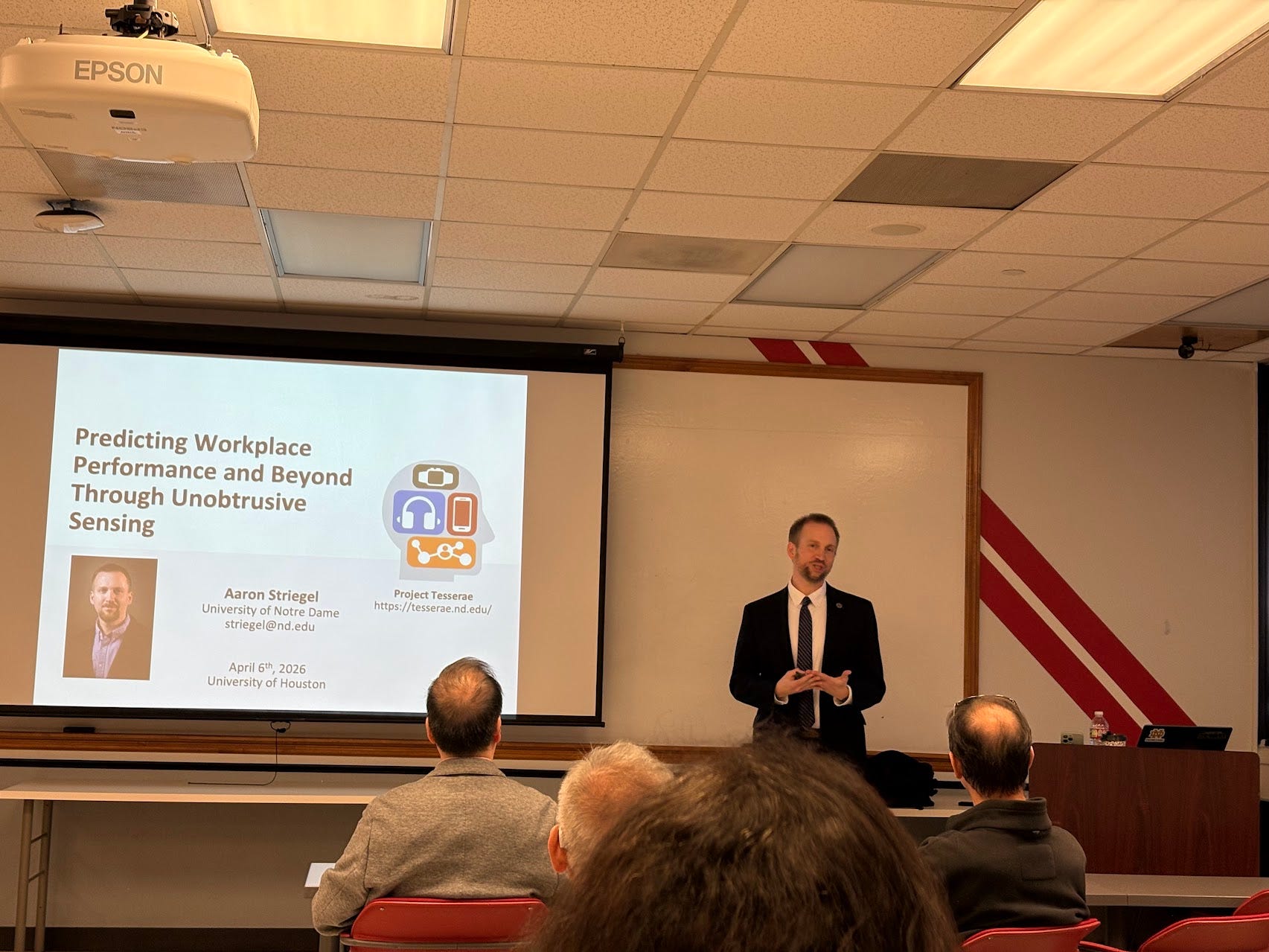
I attended a seminar on Monday by Notre Dame professor Aaron Striegel, who is a candidate to become chair of my CS department at UH. He did a great job explaining the Tesserae project and how it uses wearables, smartphone agents, beacons, and social media to predict job performance.
This video summarizes a recent paper and the discovery of “functional emotions” in AI. Read more about this research.
On Wednesday, in my research methods class, we had a guest lecture by UH Professor Jaspal Subhlok on giving technical talks, which really got me thinking. He shared valuable general advice on how to approach a technical presentation. One slide, in particular, stood out to me, it focused on how to adjust your approach based on the audience’s expectations. I’ve included it below. You can find the original slides here.


Interesting arXiv paper proposing a combination of psychometrics and educational data mining to identify which questions are more vulnerable to AI and what makes certain tasks easier or harder for LLMs. I agree that designing assessments in the AI era requires a clear understanding of where human and AI performance diverge! Thanks for sharing, Giora Alexandron!
Bill Pugh (Univ. of Maryland) shared slides on AI coding assistants in CS education.
I love seeing design tools emerge that push back against AI standardization:
This one comes with installable skills so your AI agent can generate color palettes with real intention. Another adds a design layer that teaches core design fundamentals and includes 18 commands to help steer, critique, and refine UI beyond generic AI output.
🪁 Leisure Line
On Thursday, as is customary in the Catholic Church, we visit seven churches as a way of telling the Lord that not only on Maundy Thursday but every day of our lives, we want to come and keep Him company, never leaving Him alone because we are truly grateful.


Friday was a day of reflection on the Passion, as well as a day of special mortification, fasting, and abstinence. In the afternoon, I attended my first Good Friday service in Houston at the University of St. Thomas, which has a beautiful campus. The Basilian Fathers did an excellent job, and the service was very well organized. On Friday night, as has become a tradition in recent years, I watched The Passion of the Christ by Mel Gibson. One of the things I appreciate most is how the Passion is tied to the Lord’s own preaching. I think the catechetical aspect is very powerful.


Saturday was a day of silence, waiting in prayer for the Resurrection of the Lord and contemplating Mary with admiration and love through the Rosary. That evening, I was able to attend the Easter Vigil at the Co-Cathedral in Houston. It was a beautiful celebration led by Bishop Joe S. Vásquez of Galveston-Houston, where we welcomed 17 new Catholics through the baptismal liturgy. Welcome home! The celebration continued afterward at home. For me, the highlight is the growing number of adult baptisms at Easter, especially the figures coming out of the U.S. and France.
Happy Easter! He is truly risen!


📖📺🍿 Currently Reading, Watching, Listening
I never get tired of listening to “Human” live.
Such a stunning animation in this music video, directed by Axel Digoix and produced by WIZZ for the band Tinariwen.
I’ve been listening to the Sisters of Life on their Let Love podcast from Ascension for a while now, and I’m so happy to see they’ve grown to 140 members and have so many vocations. They radiate so much joy and peace. A sign of hope in a society marked by noise and distraction. It’s a great episode to learn more about where they come from, their charism, their life stories, religious life, and more. This episode really moved me. It makes some great points, and it’s very well expressed. I’ve put together a Google Doc with some ideas in case it helps you pray as much as it helped me.
I really liked this musical retrospective by Margot Martín on Bruno Mars’ career ahead of his fourth studio album.
Another powerful episode from Radio Ambulante.
I’ve been listening to Charlie Puth’s new album on repeat all week. Do yourself a favor and listen to it from track one through twelve, no interruptions, with headphones on.
💬 Quotable
It’s the little things, I expect. Little treasures we find without knowing their origin. And they come when we least expect them. It’s beautiful, when you think about it.
― T.J. Klune, The House in the Cerulean Sea
🌐 Cool things from around the internet
A collection of links to stuff I think are worth sharing.
🔗 Architecture In Music — what a stunning Kickstarter campaign from photographer Charles Brooks, who had the brilliant idea of photographing the insides of instruments as if they were buildings.
🔗 Artemis II — wanna track Orion live? There’s a way to do that! Here are images from the mission.
🔗 Compose — simple ergonomics, beautifully done.
🔗 uncut.wtf — list of freely available fonts.
🔗 Retune — if you’re using React, Next, Vite, or Remix, this visual layer for making real-time design changes with Claude looks pretty interesting.
🔗 Port Menu — mac menubar app that shows which ports you currently have running.
🔗 TableLens — edit, visualize & export web tables.
🔗 LA in Full Bloom — LA28 Look of the Games.

Issue #39 of Computing Education Things was written while listening to:
🔗 Quick Links
🎧 Listen to Computing Education Things Podcast
💌 Let’s talk: I’m on LinkedIn or Instagram
If you’re enjoying Computing Education Things, please like, comment, or share this post! You can also support this work through Buy Me A Coffee. And if you’re finding value in the newsletter, consider forwarding it to a friend, colleague, or family member to help the community keep growing. Thanks for reading!