

#47 — Some Thoughts on Content Curation in CER
How I Filter, Prioritize, and Make Sense of Content

Reflections

Personally, I consume content to orient myself. I read papers, follow people, subscribe to newsletters, and listen to analysis because, at the end of the day, I want to better understand the world around me but also the academic world, so I can make better decisions within it.
The challenge today is no longer access to information. It is filtering it, prioritizing it, and making sense of it. Never before have we had so many tools to help us understand everything. Yet today I want to share a reflection on curation, which is partly about judgment, but not only that.
For me, the key is developing the ability and the taste to navigate an overwhelming volume of information. The gap between abundance and understanding is where curation lives.
The real value is no longer in generating more content, but in generating meaning.
As a result, more and more people are paying attention to and paying for trusted human filters: curators who help them decide what matters, what to trust, what is missing, and what deserves attention next.
That is why curation is so important in Computing Education Research (CER). When anyone can generate content, ideas, summaries, and even entire research agendas, the ability to select, connect, and make sense of what already exists becomes more valuable than the content itself. The current AI context only amplifies this trend.
In many ways, that is what I try to do with this newsletter. I try to be a content curator. To choose with purpose. Not simply to entertain or distract, but to inform, explain, orient, and guide in ways that ultimately benefit others. It is also what I appreciate most in the people I follow.
My process is simple. I intentionally collect a large amount of material, mostly through email, which has effectively become my database. Then I select based on my own criteria: credibility, novelty, usefulness to my audience, and relevance to the field. Finally, I add context, my own perspective, and present it in the clearest and most engaging way I can.
The content I share genuinely interests me and sparks my curiosity. My hope is that it does the same for my subscribers, although there are no guarantees. I also try to be consistent and disciplined, drawing not only on my experience in academia and industry, but also on insights from other areas of life and study.
I do not primarily optimize for popularity or trends, although sometimes those are worth discussing too. Instead, I focus on what I believe is relevant to Computing Education, what I feel has not been discussed enough, or where I think I have a perspective that can contribute to the conversation.
My sources are diverse, and that is one of the things I love most about this field. Computing Education draws from researchers, educators, designers, operators, entrepreneurs, writers, and thinkers from many different disciplines. It is through exposure to all of them that I refine my taste, identify patterns, and occasionally discover hidden gems that others overlook.
That is why I would love to see more content curators emerge within Computing Education Research. We have no shortage of ideas. What we need are more people willing to connect them, contextualize them, and help others navigate them.
The benchmark, in my view, is the kind of curation practiced by some of the great newsletters on the internet:
Understanding Code Execution
Philip Guo, the creator of Python Tutor and Pandas Tutor, was recently a guest on Teaching Python. The episode is about an hour long, and I found every minute worth listening to. The discussion explores how these tools can help students trace code and better understand programming fundamentals. They also examine the challenges that AI-generated code creates in the classroom and consider ways to support student learning. You can read the transcript here.
My takeaways:
Much of the conversation focuses on the impact of AI-generated code on student learning. Kelly Paredes describes using AI-generated code with eighth-grade students and explains how difficult it can be for them to understand functions, parameters, return values, and other fundamentals when code is generated all at once. She notes that students can often produce working programs without developing a mental model of how the code actually executes. Philip suggests that tools such as Python Tutor can help students trace code execution step by step, visualize variables and function calls, and better understand what is happening behind the scenes. They discuss how AI may allow students to bypass important moments of productive struggle and why understanding execution remains essential even when code generation becomes commonplace.
Philip explains that Python Tutor currently visualizes code execution and includes an AI chat feature that can answer questions about code and errors. He describes the tool as a way of making invisible computational processes visible to learners. They discuss possible future features, including simplified AI-generated examples tailored to a student’s level of understanding, alternative execution views that display only the lines that actually run, and more guided inline help tied to specific code segments, variables, or program states. The broader goal is to help learners focus on key concepts without being overwhelmed by the complexity of complete programs.
Kelly describes using a Socratic-style code review process in which students discuss code aloud in groups and collectively reason about what each section of a program is doing. Rather than relying solely on written submissions, she increasingly asks students to explain their thinking verbally, sometimes using voice recordings to capture and assess their reasoning. They discuss using spoken explanations, short oral assessments, and live code walkthroughs to determine whether students can genuinely explain what code is doing rather than simply copying or prompting AI-generated answers. Both suggest that the ability to articulate reasoning may become a more important assessment skill in the age of AI-assisted programming.
The conversation also touches on how programming education may need to evolve. Philip argues that prompting AI systems is becoming a valuable skill, but that it should complement rather than replace fundamental programming knowledge. They discuss the importance of helping students develop conceptual understanding while still taking advantage of new tools. The challenge for educators is not to prevent AI use altogether but to design learning experiences that encourage students to understand, critique, and improve AI-generated solutions.
Philip briefly discusses a new research direction he is pursuing with a PhD student. The project focuses on AI support for work beyond the desk, including physical and embodied tasks in science labs, hardware projects, and fieldwork. He contrasts this with traditional desk-based AI applications that focus primarily on text, code, and documents. The research explores how AI systems might assist with activities that involve interaction with the physical world, where context is less structured and tasks are often more difficult for current AI systems to support effectively.
AI Makes Content Cheap. Great Storytelling Remains Expensive.
If producing content becomes increasingly cheap, then what ceases to be scarce is not the material itself, but the ability to create something worth paying attention to. In that world, the real bottleneck is no longer production capacity but storytelling talent.
AI is driving down the cost of both production and distribution. But making something cheaper is not the same as replacing judgment, taste, or the ability to create meaning. If everyone can generate images, videos, and nearly infinite variations of them, then the real differentiator becomes something else entirely: who can build a world, find a distinctive voice, and tell a compelling story.
This Netflix documentary on Rafael Nadal is a good reminder of that. It knows how to tell a story. And good storytelling remains extraordinarily difficult. It requires an understanding of emotions, human motivations, pacing, conflict, dialogue, and all those things that seem intuitive from the outside right up until you try to do them well yourself.
The Education of Wonder
The Austrian philosopher Ludwig Wittgenstein once wrote that “the limits of my language mean the limits of my world.” This week, I have been reflecting on how our computing students might improve their speaking and writing skills. I see fewer conversations around a table and less deep reading, and more TikTok, YouTube, and smartphones.
It is easy to become overly pessimistic about these issues, and I do not intend to do so. But we are surrounded by too many stimuli. The British writer and philosopher G. K. Chesterton observed that a child is not amazed because a dragon appears when a door opens, but by the simple fact that the door opens at all. Perhaps we need to lower the level of stimulation.
Human beings have an innate capacity for wonder. Sometimes, it is simply better to close the laptop and give our full attention to the professor. Such an environment creates the conditions for wonder on its own.
Some classes will inevitably be more ambiguous, complex, or demanding than others. But, as I argued before, that cannot disappear. If classes no longer present challenges and every possibility of misunderstanding or confusion is eliminated, they lose much of their power to engage students and perhaps one of their fundamental purposes.
I sometimes wonder whether we could do more as a system. Just as English teachers encourage deeper reading and make it a priority in the classroom, perhaps computing educators should also work harder to awaken students’ curiosity about what we teach. We should foster more collaborative work, develop students’ critical thinking skills, and help them make sense of the world around them. We should also pay closer attention to their ability to express themselves, both in writing and in speech.
For the generation currently entering university, the media ecosystem has changed dramatically. Their primary way of accessing information is audiovisual rather than written. Even videos are often consumed at 1.5x or 2x speed. As Gregorio Luri argues, every professor, regardless of subject, should also be a professor of language. The ability to articulate ideas will become even more important in the age of AI. The most important decisions will remain human decisions, and that means that understanding, reasoning, and persuading others will continue to be essential skills.

🔍 Resources for Learning and Teaching Computing
→ AI Engineering Podcast: 2026
This is a podcast I’d definitely subscribe to. Gaurav Sen is doing great work here.
→ FlashLib
It’s still early days, but it’s an interesting project for anyone running machine learning workloads on NVIDIA GPUs.
→ Programming 1 – Aalto University
This is the platform used to run Aalto’s introductory programming course, Programming 1 (O1). One thing I particularly like is that the course is publicly available, so anyone can browse the materials. I highly recommend taking a look. The materials are remarkably complete, and there are plenty of interesting ideas for anyone interested in programming education.
→ Introduction to Computer Graphics
If you’re looking for a Computer Graphics text for students beyond the introductory level, this is worth a look. The explanations are clear and concise, and the software ecosystem is designed to work across platforms without too much friction.
🦄 Quick bytes from the industry
→ Autonomous Drone Delivery at Scale
I wasn’t familiar with Zipline before, but they now operate a fleet of fully autonomous drones delivering food, groceries, and medicine across Africa, Japan, and the United States. Just wow.
Imagine everything that goes into making that work: hardware, software, cloud infrastructure, telemetry, operations, support, and more.
In this episode of Software Engineering Daily, Gregor Vand talks with Kyle Madonia, Zipline’s VP of Application Software and IT and a former SpaceX engineer. Rather than focusing on the hardware or avionics, the conversation dives into the software side: the customer-facing systems, what happens once an order enters Zipline’s platform, and the internal software that keeps the entire operation running.
→ Sourish Kundu on Learning Hard Technical Skills
Sourish Kundu quit a $250K job at TikTok and, within three months, landed a role at one of Silicon Valley’s hottest AI companies: Luma AI.
Watch the full episode:
Philosophy on learning hard things fast
Kundu argues that real learning happens through friction. He believes many people use AI in ways that remove the struggle required to build understanding. If AI is doing the thinking for you, you are probably not learning much.
He is particularly skeptical of using AI to generate notes or write code while learning. Instead, he recommends using AI as a guide that breaks a difficult topic into a sequence of small, manageable projects. For example, when studying a complex research paper, he asks AI to design a series of programming exercises that gradually build the knowledge needed to understand the paper.
A recurring theme is that implementation is understanding. Watching videos, reading blog posts, or consuming beautifully explained content can create the illusion of learning. Real learning begins when you pause the video, take notes, write code, derive equations, and struggle through the concepts yourself. As he puts it, learning occurs when you maximize the friction between your brain and the information you are trying to absorb.
Are we training ourselves to be useless?
Kundu worries that many developers are becoming overly dependent on AI coding tools. As an interviewer, he has encountered candidates who openly admit they have not written code without AI assistance for months or even a year. In his view, this creates a dangerous gap between producing code and understanding it.
AI systems often reinforce users’ assumptions and can create a kind of intellectual echo chamber. When people rely on AI to answer everything, they risk losing the habits of critical thinking, verification, and independent problem solving.
Developers should constantly ask themselves whether they genuinely learned something from a coding session or whether the model did most of the work. The danger is self-deception. In his view, the people who benefit most from AI will be those who continue to build strong fundamentals and use AI as an amplifier.
→ A rational take on AI from Benedict Evans
Rational conversation on where AI is actually going with Benedict Evans, one of the most thoughtful technology analysts around.
You didn’t realize it was boring manual labor that could be automated. You thought it was something else.
🌎 Computing Education Community
EAAI 2027 (Feb 21–23) is accepting submissions on teaching and learning Artificial Intelligence, including AI curricula, pedagogy, generative AI education, K–12 AI literacy, and model AI assignments, with paper abstracts due Sept. 1 and full submissions due Sept. 8. Shared by Lisa Zhang and Bradford Mott.
University of Washington researchers are recruiting multilingual CS students and recent graduates for interviews exploring how non-English languages are used to learn computer science in English-dominant educational settings. Shared by Amy Ko and Janet Jiang.
SIGCSE TS 2027 (Feb. 17–20, Sacramento) is now accepting submissions, with paper abstracts due June 26 and full papers, panels, tutorials, and special sessions due July 3. Shared by Deepti Joshi, Zack Butler, Natalie Kiesler, Eric Fouh, and Ryan Dougherty.
The Raspberry Pi Foundation’s Applied AI seminar series continues with talks by Gianfranco Polizzi (June 16) on media literacy in the age of AI and Dan Verständig (July 14) on social explainable AI and critical computational literacy. Shared by Bonnie Sheppard.
SIGCSE Virtual 2026 is recruiting participants for six collaborative Working Groups on topics including GenAI in research and assessment, teaching assistants, computing concept inventories, physical computing, and foundational computing concepts. Applications close June 12. Shared by Juho Leinonen and Chandrika Satyavolu.
CRA-E is hosting two June events: a Raleigh workshop on mentoring undergraduate researchers and designing research experiences, and a Chicago summit for teaching-track computing faculty focused on pedagogy, AI in CS education, and academic career development. Shared by the CRA-E Team.
The inaugural ACM AI Leadership Summit 2026 (Aug. 30–Sept. 2) is inviting registrations, paper submissions, and student volunteers for a cross-disciplinary event focused on AI research, education, governance, ethics, workforce transformation, and societal impact. Shared by Brian Dorn.
Bridgewater State University is hiring two full-time temporary faculty (2026–27) in Computer Science and Cybersecurity, with future tenure-track searches planned in both areas. Shared by Martina Arndt.
An upcoming ACM SIGSOFT webinar, AI Won’t Fix Software Engineering—People Will (June 19), explores how collaboration, human behavior, and inclusivity shape software engineering outcomes, and how AI can support teams beyond code generation. Shared by Sandeep Kuttal.
A4NE 2026, the SIGCOMM workshop on Networking Education for the AI Generation, has extended its submission deadline to June 7 and welcomes work on networking and AI-related computing education in a hybrid format. Shared by Ranysha Ware.
Registration is now open for ICER 2026 (Aug. 11–14, Uppsala, Sweden), with early-bird rates available until June 12. Shared by ICER 2026 Co-Chairs Calkin Suero Montero, Neil Brown, Sebastian Baltes, and Kristin Seke.
🤔 Thought(s) For You to Ponder…
During the last two weeks at my parents’ house, I found myself noticing something that aligns closely with a recent study by Signal Hill Insights and FlightStory: I’m not the only one consuming podcasts on a smart TV. After smartphones, it’s now one of the most common devices for podcast consumption. For years now and I’ve heard the same from many other people I’ve barely watched traditional television. Yet in some ways the habit remains remarkably similar. What has changed is the product itself: it has been wrapped in a digital aesthetic that makes it feel new. Podcasts, originally designed to accompany us while we did other things, are increasingly evolving into a hybrid audio-video format consumed on smart TVs, either alone or with others. Podcasts are no longer just listened to. They are watched, discussed, and integrated into our broader audiovisual routines. Understanding this shift seems essential for anyone trying to compete in the space. Great content still matters, of course. But understanding how, where, and with whom content is consumed matters too.
Casey Muratori analyzed Eric Schmidt’s speech at the University of Arizona:
Colombia is a country I’ve lived in and grown very fond of. To my surprise, Abelardo de la Espriella, a figure often compared to leaders such as Milei, Bukele, or Trump, came out on top in the first round of Colombia’s presidential election. I had expected Cepeda, the government-backed candidate, to finish first. There will be a runoff since no candidate surpassed the 50% threshold. I originally thought the second round would be very close, but looking at these results, it now seems that Abelardo has a strong statistical advantage. David González analyzes the numbers well here. Meanwhile, Paloma Valencia, the more institutionalist candidate from the Democratic Center party, finished far behind and is out of the race.
I needed this short-and-sweet reminder from Darren Rowse that sometimes God speaks to us through our distractions.

This interview in Ecclesia with the Abbot of Montserrat leaves plenty to reflect on. Highly recommended.
I really enjoyed this reflection on the meaning of home by Esther Peñas in Ethic.
I enjoyed this episode of Pausa on vision featuring Dr. Javier Hurtado, an ophthalmologist at Spain’s National Vision Institute. It’s fascinating how much a pair of glasses can influence attention. Vision is not just about the eyes; it’s an extension of the brain and of how we perceive the world. I’m not sure whether Marta García Aller will continue Pausa after joining La Brújula on Onda Cero, but if this turns out to be the end of the podcast, it will certainly be missed.
José Luis Antúnez writes: “Essence is what survives change. Identity is the system of signs and actions that make you who you are.”
I also like to speak of spirit.
When thinking about universities, schools, Church institutions, cities, people, media organizations, etc, an interesting question arises: does the essence remain, or has the spirit become diluted? The answer often reveals something profound about their identity.
Pure gold. This Rebeldes Podcast episode with José Carlos González-Hurtado is going straight into the Natural Theology archive:
I’m continuing to read the new encyclical little by little. One idea that has stayed with me is the Pope’s call to become workers for the Heavenly Jerusalem.
Not architects of a new Babel that remains confined to this world, but workers for the Heavenly Jerusalem: people who think of others, who refuse to close themselves off, and who seek to give themselves in service to those around them.
It is a beautiful reminder that our work, our relationships, and our lives find their fullest meaning when they are directed not only toward ourselves, but toward God and others.
I love the analogy of radio as theater. To me, higher education has a lot in common with theater and performance when it comes to pedagogy and teaching. It’s what David Malan refers to as memorable moments, motivation as content, or, more simply, not boring your students.
The goal is not entertainment for its own sake, but creating the kind of experience that captures attention, sparks curiosity, and makes learning stick.
Radio is careful planning and spontaneity on air, but also the ability to blow everything up when the occasion demands it. There’s a strong element of performance to it as well.
From minute 7:55 onward, Manuel Jabois reflects on his relationship with AI while writing his novel. I found his perspective interesting: the key question is not whether to use AI or not, but where to draw the line and when. In that sense, working with AI feels less like a rejection and more like a negotiation with your own instincts, judgment, and style.
Code.org becomes CodeAI.
Spiritual reading is food for prayer. It is a quiet and intimate encounter with God, a moment in which He speaks to us through what we read. One resource I have found especially helpful:
Santi García Cremades makes an interesting point through the story of mathematician G. H. Hardy, who took pride in working on “useless” mathematics only for it to become fundamental, decades later, to the development of cryptography.
When you solve a derivative, you are not just learning a technique; you are learning how to think and shaping your mind. The value of education lies not only in the immediate usefulness of knowledge, but also in its ability to develop structured thinking, intellectual depth, and ultimately greater freedom.
📌 Research Corner
First week wrapped up at Aalto! This week I started as a visiting researcher here. I’m deploying my educational tool in the Basics in Programming course, and I’ll be here until July 9 under the supervision of Professor Juho Leinonen. I met some great people this week, received valuable feedback on the tool, and now have a much clearer research direction. The week was mostly focused on meeting people, attending meetings, and adapting the tool to fit the specific needs and context of Aalto’s course. The selfie below was taken in the Aalto CS building, and the other photo shows one of the views I get on my way to campus: Laajalahti, seen from Kuusisaarentie. Looking forward to the weeks ahead!


One of the conversations I had this week at Aalto was with a postdoctoral researcher who shared how she had conceptualized teamwork in one of her courses after I told her about the difficulties many instructors face when trying to build effective student teams.
She explained that one strategy that worked well was asking students at the beginning of the course what grade they expected to earn. Her reasoning was that students often have very different goals and expectations, and grouping together those with similar aspirations helped align motivation and commitment levels within teams.
Another approach was allowing students to choose whether they wanted to work individually or in groups, and, if working in groups, letting them decide who they wanted to work with.
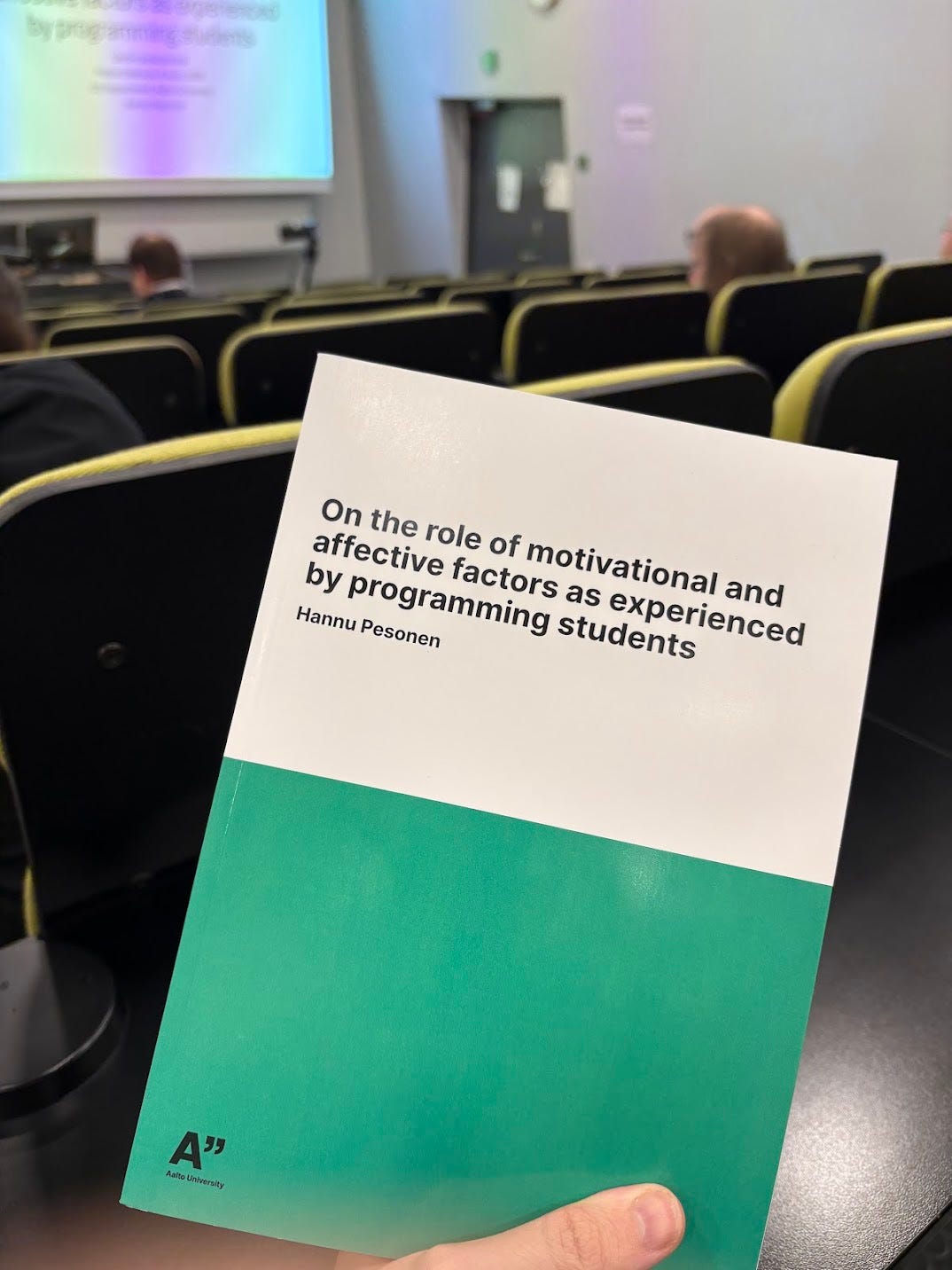
Currently attending Hannu Pesonen’s doctoral dissertation defense.
I’m looking forward to reading his book, whose themes resonate strongly with my own field of research.
🪁 Leisure Line
Contrary to what I expected, there’s a lot of daylight in Helsinki! We often think of Finland as a country immersed in perpetual darkness, but things look very different this time of year. The days seem to go on forever, and the weather has been surprisingly nice too.


Another early lesson from Helsinki: excellent public transport isn’t free. I just got my HSL card, and a single trip costs €3.30 and is valid for 80 minutes. After a few rides, I started to understand a bit better how they fund such a good system.


And thanks to a recent Sketchplanations post, I’ve even been inspired to learn a few basic Finnish words. So far, my progress is limited, but at least I can pretend I’m integrating into the local culture.
📖📺🍿 Currently Reading, Watching, Listening
What a team PSG have. Fully deserved champions. Arsenal fought all the way to the end, but it wasn’t enough. What a beautiful Champions League final.
On my way to Helsinki, I listened to this podcast episode featuring Antonio Pampliega. It’s not an easy listen, but I found it to be an honest, professional, and deeply human account. He spent ten months being held hostage in Syria.
In his Cancioneros session for KEXP, Juanes describes this album as one that marked a before and after in the history of Colombian popular music. A true work of art. Taking traditional vallenato and bringing it into conversation with rock and funk. Embracing what Colombia is with pride and transforming it into great music. I spent this week listening to the remastered version, and it’s remarkable how well it holds up.
First street circuit of the season this weekend! Monaco is one of those tracks where outright engine performance matters less. Electrical deployment is less dominant, the super-clipping issue largely disappears, and, in theory, we could see a very different kind of weekend from what we’ve seen so far.
Saturday is the real spectacle. Qualifying is decisive, and everyone is driving right on the limit, with the walls never far away. I’m especially interested in the battles at the front involving the two Mercedes, Ferrari, McLaren, and of course Verstappen, who can always make the difference through sheer driving talent. Really looking forward to this race.

One of the conversations I enjoyed most this week. David Llano and Álvaro González Alorda discuss personal transformation, mentorship, purpose, leadership, and many other practical aspects of life and work. Thoughtful, honest, and well worth listening to. Here it is:
After a period in Colombia, I joined Cabify. About a year later, I decided it was time to look for new challenges, but I was very happy during my time there.
I remember it as a startup deeply focused on serving a community of users who were constantly demanding improvements. It was another reminder of something Y Combinator talks about often: talk to users and build something people love.
Like any startup, Cabify was under constant pressure to grow in each market, and that sometimes meant scaling back or exiting markets that were underperforming. During my time there (2016–2017), the company laid off nearly the entire team in Peru. There was also ongoing tension around regulations, taxis, and ride-hailing services.
It was a challenging period, but I learned a tremendous amount about CRM systems, growth, Latin American markets, and startup culture in general.
💬 Quotable
Attention is the rarest and purest form of generosity.
― Simone Weil
🌐 Cool things from around the internet
A collection of links to stuff I think are worth sharing.
🔗 Cotypist — Autocomplete for Your Mac.
🔗 Apple Design Awards — Love browsing this list every year to discover cool new apps.
🔗 Flask — A beautifully designed tool for video feedback.

Issue #47 of Computing Education Things was written while listening to:
🔗 Quick Links
🎧 Listen to Computing Education Things Podcast
💌 Let’s talk: I’m on LinkedIn or Instagram
If you’re enjoying Computing Education Things, please like, comment, or share this post! You can also support this work through Buy Me A Coffee. And if you’re finding value in the newsletter, consider forwarding it to a friend, colleague, or family member to help the community keep growing. Thanks for reading!