

#48 — Are AI-Generated Explanations Actually Good, or Just Fancy?
A great explanation is the visible surface of deep mastery

Reflections

Max Schoening and Geoffrey Litt started a podcast a few weeks ago where they nerd out about human AI collaboration and malleable software.
It had been sitting on my watch list for a while, but this week I finally listened to the conversation and found myself circling around a few ideas that I wanted to share with you today.
The part of the discussion that left me thinking the most starts around minute 21, when they explore how AI might change the way we read, understand, and learn from explanations.
Geoffrey introduces the recent excitement around the idea that HTML might become the new Markdown. Instead of asking an AI to produce a plain text or Markdown explanation, people are increasingly asking it to generate a richer artifact with layout, visual hierarchy, diagrams, colors, gradients, and interactive elements.
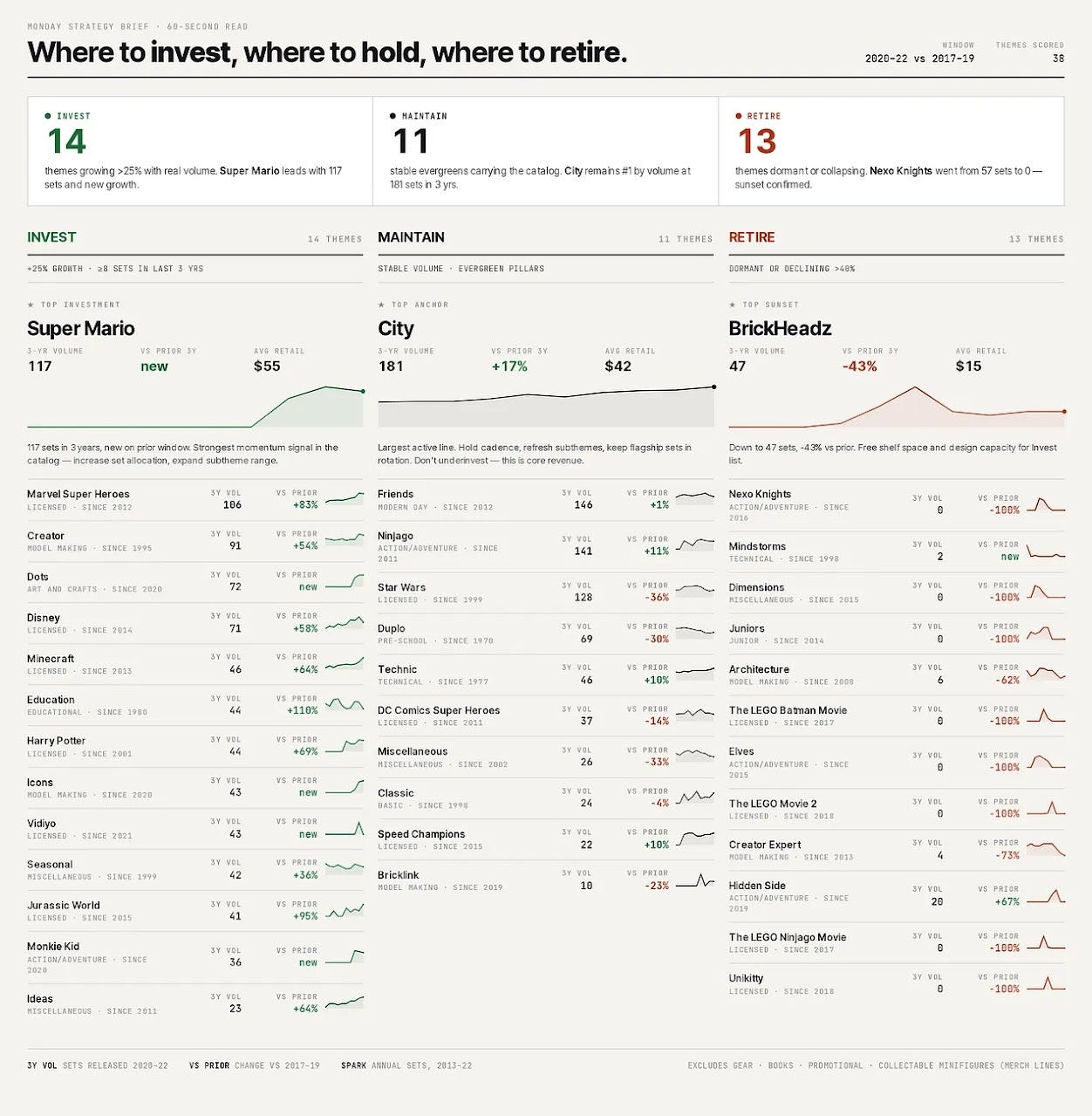
A plain Markdown document can feel sterile, while an HTML page can structure information visually and make it more engaging. The underlying claim is that people may be more willing to read and engage with an explanation if it is presented in a richer or more designed form.
But the hosts quickly move beyond the surface level excitement and ask a deeper question: does visual polish actually improve understanding, or does it simply create the feeling that something important has happened?
A central distinction in this section is between communication and understanding. Max brings in Bret Victor’s Magic Ink essay and its distinction between different kinds of software, including information software and communication software. This becomes a useful lens for evaluating AI generated HTML.
If the artifact is meant for someone else, then communication matters. Structure, polish, layout, and visual design can help someone else enter the material. But if the artifact is meant for you, the goal is not simply communication. The goal is understanding. In that case, the important work is not producing a beautiful artifact, but wrestling with the problem until your thinking changes.
Max formulates the question that gives this issue its title: “Is it actually good, or is it just fancy?”
The question cuts through the novelty of AI generated HTML. A generated page may look impressive, but that does not mean it explains well. A flashy website can still have very low nutritional value. Conversely, a plain text explanation can be excellent if it draws the reader in and helps them understand the concept.
If the AI can write a plain text explanation worth reading, people will read it. If it can create an HTML explanation worth reading, people will read that too. The real issue is not Markdown versus HTML, but whether the explanation is good.
The hosts also discuss the danger of offloading too much cognitive effort to the model. AI can now generate artifacts that look like the result of careful design work: headings, spacing, gradients, interactive sections, diagrams, and visual structure. But if the human has not done the thinking behind the design, the artifact may simply become a polished container for shallow understanding.
Good information design still requires human judgment. AI may lower the cost of creating visual artifacts, but it does not remove the need to know what should be emphasized, what should be simplified, and what the learner actually needs to understand.
A particularly important part of the conversation concerns visual explanations. Geoffrey points out that AI generated diagrams can create a very convincing illusion of understanding. A diagram with boxes and arrows can make the reader think, “Oh, now I get it.”
But do you actually get it?
In some ways, visual explanations leave less room to hide than prose. With prose, you can remain vague. With a diagram, you must decide what the parts are, how they relate, where information flows, and what the conceptual structure looks like. If you are not clear on what is happening, you often cannot draw it well.
This makes genuinely good visual explanation difficult.
The hosts then offer a more generous account of what HTML can enable. Geoffrey notes that some of his own code explainers at Notion produced HTML files, and one of the most useful features was not visual polish but interaction.
In particular, he mentions adding a quiz at the bottom of the explanation.
This matters because a quiz functions as a kind of speed bump in the reading process. It interrupts the passive feeling of understanding and forces the reader to test whether they actually followed the material. You may skim an explanation and feel that you understand it, but when you reach a question you cannot answer, the illusion breaks.
This is where interaction can genuinely support learning.
The conversation then moves to Andy Matuschak and the idea that books by themselves often fail to make people retain or transform their understanding. One proposed remedy is embedding retrieval practice and spaced repetition directly into the reading experience.
In this sense, HTML is not valuable merely because it looks better than Markdown. It becomes valuable when it enables learning interactions that static prose does not easily support: quizzes, checkpoints, prompts, progressive disclosure, or other mechanisms that make it harder for the learner to remain passive.
The discussion then broadens into what explanations might look like in the future.
The hosts consider whether the future is really HTML or whether it may involve AI generated images, posters, visual reports, interactive documents, or entirely new explanatory media.
Geoffrey imagines a future where, when trying to understand a concept, he receives a beautifully designed report or poster that uses visual design to genuinely clarify the idea.
But they remain skeptical about current models’ ability to do this well.
AI can often produce boxes and arrows. The crux of the explanation is frequently missing.
Good visual explanation requires compression, taste, precision, and deep understanding.
They mention examples such as Wait But Why sketches and Matt Levine’s writing as models of high quality explanation.
Wait But Why compresses complex ideas into simple drawings with an extraordinary amount of intelligence and emotional clarity. Matt Levine explains finance so effectively because he understands the domain deeply enough to simplify it without distorting it.
This becomes a key educational point.
Great explanation is not just a style.
It is the visible surface of deep mastery.
AI can imitate the tropes of a good explainer, but it often misses the underlying thing that makes the explanation work.
The discussion then turns toward personalized learning.
One of the most promising uses of AI is not simply making explanations prettier, but adapting them to what the learner already knows.
Geoffrey describes the possibility of explanations that map new ideas onto concepts already present in the learner’s mind. If someone knows Ruby and JavaScript, an AI can explain Rust by translating unfamiliar concepts into familiar ones and filling in the gaps.
This is where AI tutoring becomes powerful.
Not because it generates a generic explanation.
Because it meets the learner exactly where they are.
The value is not presentation. The value is conceptual translation.
By the end of the discussion, the hosts arrive at a balanced view.
HTML can be useful, but not because visual design automatically produces understanding.
It can help when it supports communication, when it gives the reader something concrete to react to, when it enables interaction, or when it helps structure learning.
But if it is used as a shortcut to avoid cognitive effort, it fails.
A Markdown document and an HTML page are both only as good as the explanation they contain.
The key educational question is whether the artifact helps the learner do the hard work of understanding.
Bret Victor returns as an important influence in the final section, particularly through the idea of explorable explanations and his talk Stop Drawing Dead Fish. The hosts are interested in explanations that are not merely static descriptions, but interactive environments where learners can manipulate variables, move parts, observe consequences, and build intuition.
This connects back to the HTML discussion.
The most valuable future may not be a prettier document.
It may be an explanation that becomes a manipulable system.
They also discuss spatial and game inspired representations. Examples such as Gather Town and a Notion hackathon project based on The Office illustrate how spatial environments can make complex interactions more engaging and sometimes more understandable than a traditional chat interface.
Still, the hosts apply the same standard as before.
If the explanation is not good, the medium does not save it.
A game that fails to explain a concept is no better than a beautiful HTML page that fails to explain it.
One of the most interesting metaphors appears near the end.
Geoffrey compares software work with working on a race car. In a garage, people can gather around a physical object, inspect its parts, see what is broken, and understand how components relate to one another. Software, by contrast, often feels like an invisible sea of processes with no shared spatial representation.
The dream is to create representations of software systems that people can gather around, inspect, manipulate, and understand together.
The Toyota Prius energy flow diagram becomes another useful example. It does not represent the whole car, but it helps the driver develop intuition about how energy moves through the system.
This is an important lesson for both HCI and education.
A model does not need to be complete to be useful.
It needs to be simple enough to grasp and accurate enough to build intuition.
The final part of the discussion returns to the ideal of excellent explanations.
The hosts mention people like Bartosz Ciechanowski, whose interactive essays explain complex systems with extraordinary clarity. If AI ever becomes capable of producing explanations at that level, it will require much more than layout, diagrams, or visual polish. It will require deep understanding, compression, human judgment, and the ability to explain difficult ideas in a way that feels both simple and accurate.
That is why I found this conversation so interesting.
The future of AI generated explanations is not really about HTML versus Markdown.
It is about whether AI generated artifacts help people understand.
HTML, diagrams, quizzes, interactive media, real time interfaces, and explorable explanations are valuable only insofar as they support genuine cognitive work.
A beautiful artifact is not the goal.
Understanding is.
For computing education, this distinction feels especially important. The danger is not that students will use AI generated explanations. The danger is that polished artifacts will make students feel that they understand before they have actually done the work of understanding.
Great explanations are not a style.
They are the visible surface of deep mastery.
Watch the full discussion on YouTube:

🔍 Resources for Learning and Teaching Computing
→ Making Software is out now!
Making Software by Dan Hollick is now available in early access, offering a visually rich exploration of software fundamentals with 20 of 32 chapters already complete and more than 600 technical illustrations.
→ Cloud Computing Curriculum Design
Recommended paper for instructors designing a cloud computing course.
→ Test-Driven Data Analysis
This book by Nicholas J. Radcliffe introduces practical techniques for catching errors before they affect results, covering data validation, pipeline and model testing, visualization pitfalls, reproducibility, data drift, and more. The book is free to read online, with additional chapters being released over time.
→ What it feels like to work with Mythos
Ethan Mollick tested Anthropic’s new Claude Fable model on several ambitious projects and found that it could autonomously coordinate research, coding, testing, and synthesis through multiple agents, shifting the human role from directing the process to primarily commissioning the work.

→ Programming, Illustrated
Hello World by Dale Biagio is earning praise not just for its programming content, but for its design and storytelling. Readers have highlighted its engaging treatment of topics ranging from CUDA to Seymour Papert, calling it one of the most enjoyable and visually striking programming books they’ve read in years. Shared by Greg Wilson.
🦄 Quick bytes from the industry
→ Max Stoiber’s Journey from Open Source to OpenAI
I’ve been following Max Stoiber since his days working on projects like Spectrum and various open-source developer tools. He now works at OpenAI on plugins, apps, connectors, MCPs, in other words, right at the intersection of Codex and ChatGPT.
I really enjoyed this episode of The Changelog, where he reflects on his journey and shares an interesting perspective near the end on why ChatGPT apps feel like a new surface for software.
If AI gets even better, do abstractions even matter? Or are we just going to be programming in English? I don’t know. But I know for myself, since I joined OpenAI in December, I’ve shipped many, many PRs here and made lots of changes to ChatGPT. I haven’t written a single line of code. I’m just managing codex agents now. And I know many people in the industry since December have had much of the same experience. And that’s crazy.
I feel like most of the time that I spend now is spent on reviewing the abstractions that the coding agents create. Just like you’re saying with the type interface. I’m really making sure that it’s less, Ryan Florence is a saying of like, he’s always said this. He said he wants to draw the right boxes and then whatever’s in the boxes is fine. But he wants to draw the right boxes and he wants to make sure that the boxes are drawn in the right way and connect together in the right way. And I feel like that’s what I spent most of my time on now. The implementation of it, I review much less than thinking about the overarching architecture and the boxes that exist and how do they interface with each other? How do they talk to each other? Is that actually the right level of abstraction? Or should we be solving this problem at a different layer, at a different level, in a different way? That’s most of the time that I spend thinking is actually more about the architectural overall system versus the individual lines of code. Like, is this if statement correct? Mostly those are correct, but the abstractions, I agree with you, are currently where I spend most of my time.
Well worth a listen:
→ Tony Fadell on AI-Generated Software, Craftsmanship, and Ethics
His argument is that AI can generate outputs but it still struggles with maintainability, security, and system-level thinking.
He points to the recent Claude code leak as an example: the code worked, but key parts of the architecture, including the main loop, were brittle, difficult to read, and ultimately required human oversight.
More broadly, Fadell warns that code can pass tests and still be fragile, insecure, and expensive to maintain. Without architects, security reviews, and teams that combine different forms of expertise, AI-assisted development risks creating short-term gains at the cost of long-term technical debt.
One analogy I particularly liked was his comparison between AI-generated software and fast fashion. AI is excellent for producing something quickly and cheaply. But durable, differentiated products require craftsmanship, judgment, and intentional design.
His recommendation: prototype aggressively with AI, then invest human effort in designing robust subsystems, reviewing security assumptions, and building maintainable foundations before committing to a final product.
Fadell extends this idea beyond engineering to product design. Great products are often built around a small number of core ideas that humans can understand and obsess over. AI can help explore possibilities, but it cannot substitute for strong product judgment. As he puts it, version one of a product still requires opinionated design and craftsmanship.
His example is Flighty. Later iterations may benefit from AI-assisted development, but the original product stood out because of clear design choices, careful architecture, and attention to detail at the pixel level. Those qualities remain difficult to automate.
He argues that designers and product managers need a clear set of values to guide their decisions, especially as AI becomes more deeply embedded in the products we use every day. Without that foundation, it becomes easy to drift toward harmful incentives, manipulative experiences, or overly addictive engagement patterns.
In Fadell’s view, principles are not a constraint on innovation. They are what keep innovation aligned with human well-being. As AI expands what products can do, the challenge becomes deciding what they should do. Technology can optimize for attention, engagement, and growth. Ethics help determine where the limits should be.
→ Chema Alonso on Cybersecurity
This morning on my way to Aalto, I listened to a conversation between Bernat Ferrero and Chema Alonso.
They cover a wide range of topics, including Informática 64, cybersecurity, academia, Chema’s years at Telefónica, public speaking, hacking, AI for cybersecurity, Cloudflare, learning, and much more.
Well worth a listen.
This really resonated with me when it comes to giving technical talks:
I realized that success is not about proving that I know the material. Success is about helping the audience learn. If the knowledge does not pass through them and come alive in their minds, then I have not accomplished anything.
Another point that resonated with me was his take on conference speaking. He argues that good talks are not the result of natural talent or improvisation. They are the result of preparation.
If someone wants to build a career around conferences or use speaking as part of their work, they should understand that it doesn’t just happen naturally. You have to work at it. I prepare my talks carefully. It’s true that after giving two or three thousand talks, I already know how to structure a story and build the narrative. That experience helps. But it is still the result of practice and preparation.
I also found his perspective on the current state of cybersecurity particularly interesting:
Everything is becoming more tense. From my position at Cloudflare, I don’t think I’ve ever seen more tension in cybersecurity than I see today. But if you ask me how I view it, I see it with interest from both an academic and technological perspective. What we’re witnessing is a period of rapid evolution, and the changes we’re seeing are fascinating.
🌎 Computing Education Community
CRA-E’s UR2PhD program is offering a free webinar on June 22 introducing its open-access Pre-Research Experience Course (Pre-REC), a modular resource designed to help students develop foundational computing research skills before joining research projects. Shared by Megan Olsen.
SIGCSE is seeking a new volunteer Information Director to help moderate the community mailing lists and manage memberships. The role involves less than two hours of work per week and applications are open until June 30. Shared by David Zabner.
CRA-E’s UR2PhD program is hosting a free virtual workshop on June 22 to help faculty mentors streamline undergraduate research onboarding using its open-access Pre-Research Experience Course (Pre-REC) materials. Shared by the UR2PhD team.
The UKICER 2026 conference has extended the deadline for RIPPA (Research in Practice Project Activities) proposals to June 15. Shared by Olga Petrovska and Cristina Alexandru.
ACM has updated its authorship policy on AI use. Shared by Thomas Zimmermann and Brian Dorn.
A free webinar series (July 6–9) will showcase Runestone Academy’s interactive computing and math ebooks, including AI-powered learning tools, Peer Instruction activities, personalized Parsons problems, and practical guidance for instructors using the platform in their courses. Shared by Barbara Ericson.
Indiana University is recruiting computing educators for a study on how assignments and assessments are being redesigned in response to generative AI. Participants will discuss their experiences in a 60-minute interview and may be invited to follow-up design workshops focused on authentic assessment, with a $200 honorarium available for workshop participants. Shared by Akesha Horton.
CRA-E is hosting its inaugural Chicago Regional Summit for Teaching-Track Faculty in Computing on June 30, bringing together faculty to discuss pedagogy, promotion pathways, scholarship, AI in CS education, and community-building. Shared by Borja Sotomayor.
GenAIinCSEdu is a Dutch national community that brings together researchers and educators from universities and universities of applied sciences to explore the role of generative AI in computer science and software engineering education.
Conrad Borchers will join Vanderbilt University in Fall 2026 as a tenure-track Assistant Professor of Artificial Intelligence in Education. He will launch the Learning, AI & Pathway Systems (LAPS) Lab, focusing on AI in education, learning analytics, student pathways, motivation, and human-AI learning systems. Shared by Conrad Borchers.
The Ohio State University’s Engineering Education Department is recruiting a senior scholar, offering an opportunity for experienced researchers and educators to contribute to one of the leading programs in engineering education. Shared by Monique Ross.
Dominik Hangleiter is recruiting a PhD student in quantum computing theory at ETH Zurich.
Daniel Zingaro highlights a new book by Paul Pu and Jim Slotta exploring what teaching and learning might look like in the GenAI era. The book argues that as information becomes abundant, the scarce and valuable skills are judgment, meaning-making, responsibility, and the ability to apply knowledge in ways that withstand real-world scrutiny. Shared by Daniel Zingaro.
Magdalena Wischnewski is preparing to recruit a PhD student to join her new Human Factors in AI Systems research group, focusing on human-AI interaction and trustworthy AI. Shared by Magdalena Wischnewski.
🤔 Thought(s) For You to Ponder…
I found José María de Pablo’s comments in this episode of Aladetres particularly interesting. The criminal lawyer argues that media overexposure creates pressure on judges and can distort the administration of justice. Continuous media coverage during the investigation phase can damage a person’s reputation and sometimes even their health long before a case is resolved. It reminded me of the recent case involving the Spanish singer Julio Iglesias. Some media outlets effectively portrayed him as guilty, only for the complaint to be later dismissed. Cases like this are a good reminder of the importance of prudence and of waiting for the judicial process to run its course before reaching conclusions.
The conversation also touched on the role of AI in legal proceedings. De Pablo’s argument is that judging involves much more than processing information. Assessing a witness’s credibility depends not only on what is said, but also how it is said. Judges must interpret evidence, weigh competing narratives, and exercise judgment in ways that remain deeply human. AI can certainly assist with legal work, improve efficiency, and help analyze large amounts of information. But it can also make mistakes, which means its outputs must be carefully reviewed. And when it comes to judging itself, there remains a fundamentally human element: persuasion in oral argument, empathy, credibility assessment, and the exercise of practical judgment.
The Register: Europe wants to reduce its dependence on the US for cloud services, but much of the underlying infrastructure still relies on Intel and AMD processors. It will be difficult to achieve true independence until the entire value chain is located in Europe.
This from David Oks is interesting: The lack of RAM is especially affecting many people who rely on low-cost smartphones:
Leonardo Padura on A Vivir: “For a writer, even listening to how the people one writes about speak and the people one wants to write about is important.”
The quality of Spain’s weekend magazine and radio programs is remarkably high. A great decision by Julia Otero to trust EOM with the program.
Dani Primo has given me several ideas that I’m not taking full advantage of yet when working with my favorite coding agent, CC: Plan Mode, Skills, Git integration, testing workflows, MCP, Specification-Driven Development (SDD), and OpenSpec for defining specifications.
Interesting take from Hussein Nasser:

Performance and troubleshooting engineers who understand the atomic fundamentals of software will be in high demand in the years to come.
A good reminder from Akesha Horton that onboarding whether in higher education, industry, or elsewhere needs to be intentional. It cannot rely solely on systems, documentation, or processes. It also requires human guidance, cultural integration, and a sense of belonging. Newcomers need to learn not only how to turn on the lights, but how to live in the house.
A historic moment this week in Spain: the Pope addressed the Congress of Deputies for the first time in history. I especially enjoyed Diego Garrocho’s reflection on the event for Ethic.
A very good interview with Juan Manuel Cotelo. It really made me reflect.
At one point, someone told Cotelo: “I adopted a little girl because I watched that interview.” Cotelo’s response was striking: “This is about bringing about conversions to Love.”
I was also intrigued by the producer’s comment that he does not force anyone to consume certain content, yet he would not allow his own children to consume it either. It reminded me of The Social Dilemma, where some of the very people who designed social media platforms admitted that they do not let their own children use them.
In the end, we are instruments. As Javier García Herrería often says, what matters is the fruit that remains in society.
If life has placed us in a position to serve others, then we are already privileged.
I got into cinema thanks to María Guerra and La Script. Her voice is unmistakable.
One thing I really like is how Cadena SER takes these recurring segments from its programs and develops them into podcasts in their own right. It gives them a life beyond the live broadcast and makes them much easier to follow regularly. I’m subscribed to Gatopardo, for example, but not to El Faro.
The Colombian podcast Por el canto del libro dedicated its very first episode to Jorge Carrión, and it’s a delight.
Being a writer is less important than being a father.
Jorge had spent decades trying to become the writer he had always known he was meant to be. He had traveled to Australia, journeyed across Latin America, met Cozarinsky, found his voice, and published books. Along that creative path, he discovered something he wasn’t looking for: a love far more important than literature—the love he felt for his children.
A wonderful conversation between Andrés Acevedo and José Rodríguez Iturbe.
One idea in particular stayed with me:
“In Venezuela, there is no utopia. The only utopia is power. And once power is obtained, the goal is to keep it. Chavismo was never a serious project.”
I really related to Santiago Pampillón’s story (formerly at Salesforce). We’ve followed surprisingly similar paths. Thanks so much for sharing it.
OpenAI just opened an office in Madrid.
📌 Research Corner
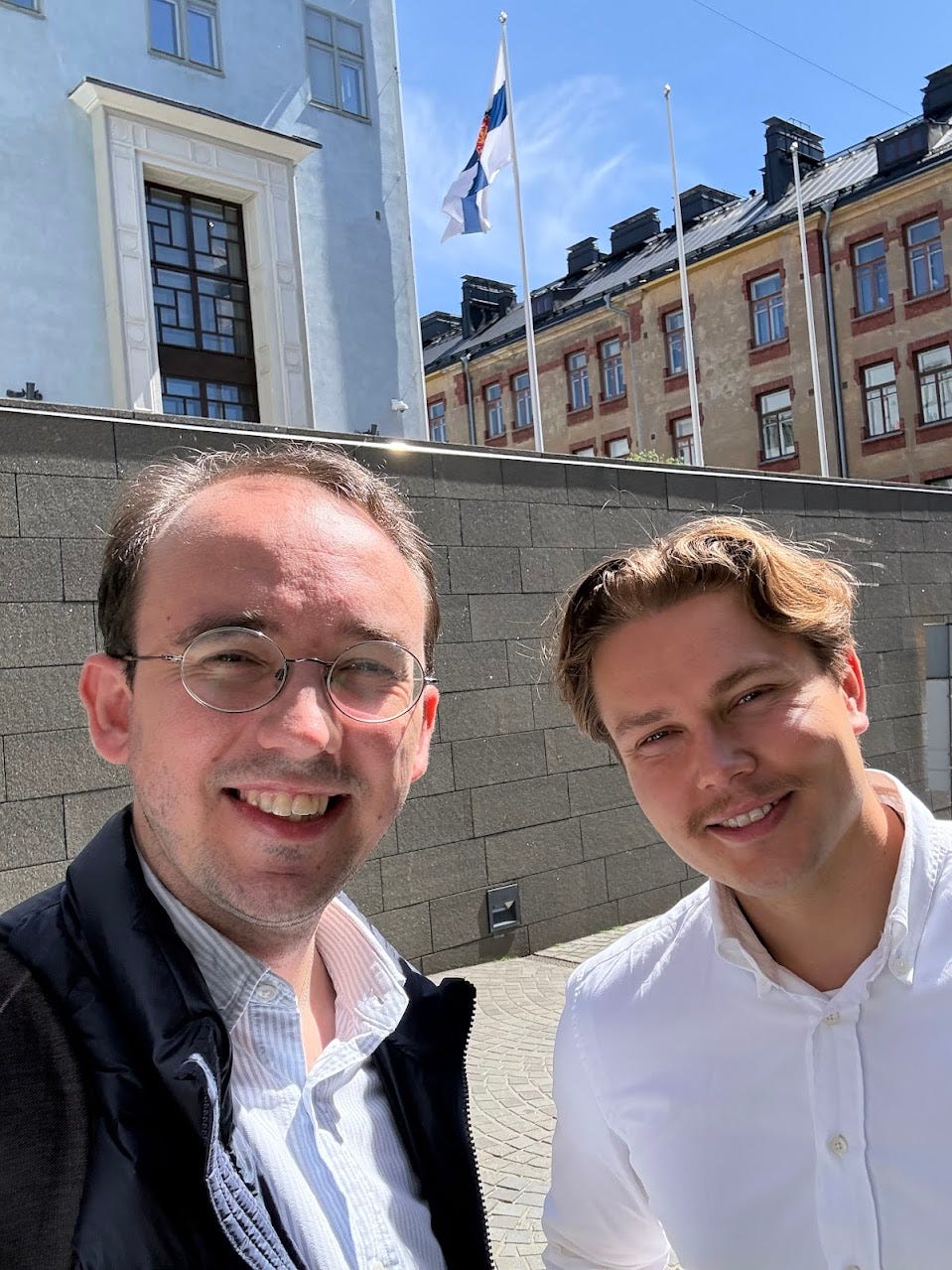
On Wednesday, Felix gave me a tour of the Education Hub at the University of Helsinki. I was really impressed by what they’ve built to help identify potential business opportunities emerging from academic research. It’s a unique approach to bridging the gap between research and real-world impact. I could easily see many of these ideas being adapted to a Computing context as well.
Once again, Pausa hits the bullseye. I just hope that now that Marta has joined La Brújula, the show doesn’t get put on pause.
I was reflecting on this episode about the language of machines and many other fascinating topics with Pilar Manchón, who holds a PhD in Computational Linguistics from the University of Seville.
A few notes and takeaways:
No, AI does not feel, suffer, have empathy, possess an inner world, or have consciousness.
Education is a never-ending journey. What matters now is adapting and learning how to use AI as a traveling companion. Pilar mentioned that her son studies at Berkeley and that she is glad his program still includes a strong humanities component.
In this episode, they discussed assessment formats. Interestingly, my new tool helps computing educators understand student interactions with Parsons problems and identify which students and concepts need additional support.
By its very nature, AI can identify and predict patterns of behavior. There are tools being developed that can estimate, based on students’ behavior during the first days of class, the likelihood that they will pass or fail a course. AI can predict how someone is likely to perform based on how they study, read, and interact with digital environments. This raises an ethical dilemma because the technology can be incredibly valuable for identifying students who need extra support—those who are easily distracted, struggling to absorb material, or having difficulty staying focused. It can help target assistance where it is most needed. On the other hand, the same predictions could be used to justify taking away a scholarship. Those are ultimately political and policy decisions rather than technological ones, but they certainly give us something to think about.
🪁 Leisure Line


On Tuesday, Aalto organized its CS Summer Day for faculty and PhD students.
We spent the day in Porvoo, on the Gulf of Finland, a beautiful city surrounded by nature and full of stunning views.
One of the highlights was meeting people from all over the world. I met Ali from Iran, who earned his PhD at the University of Limerick (Ireland) and completed a postdoc at Indiana University before joining Aalto. He now works as a Research Fellow and Data Scientist in the CS Department. We had a great conversation about political systems while taking in the views from the boat.
I also met Korawit from Thailand, who seems to have lived in half the world, including Santiago de Compostela! Great conversation, great company, and, for those wondering, I survived the axe photo unharmed.
Another activity was Nature by Sense, a guided experience focused on silence and connecting with nature. There I met Andrew from Vietnam, who has just finished his first year of his PhD at Aalto. He is part of the Probabilistic Machine Learning Group and works on Bayesian decision-making under uncertainty. I really enjoyed meeting him and our conversation, and I hope we’ll stay in touch.
Finally, I got to try archery for the first time. I’ll let the photo speak for itself.
Until next time, Porvoo.
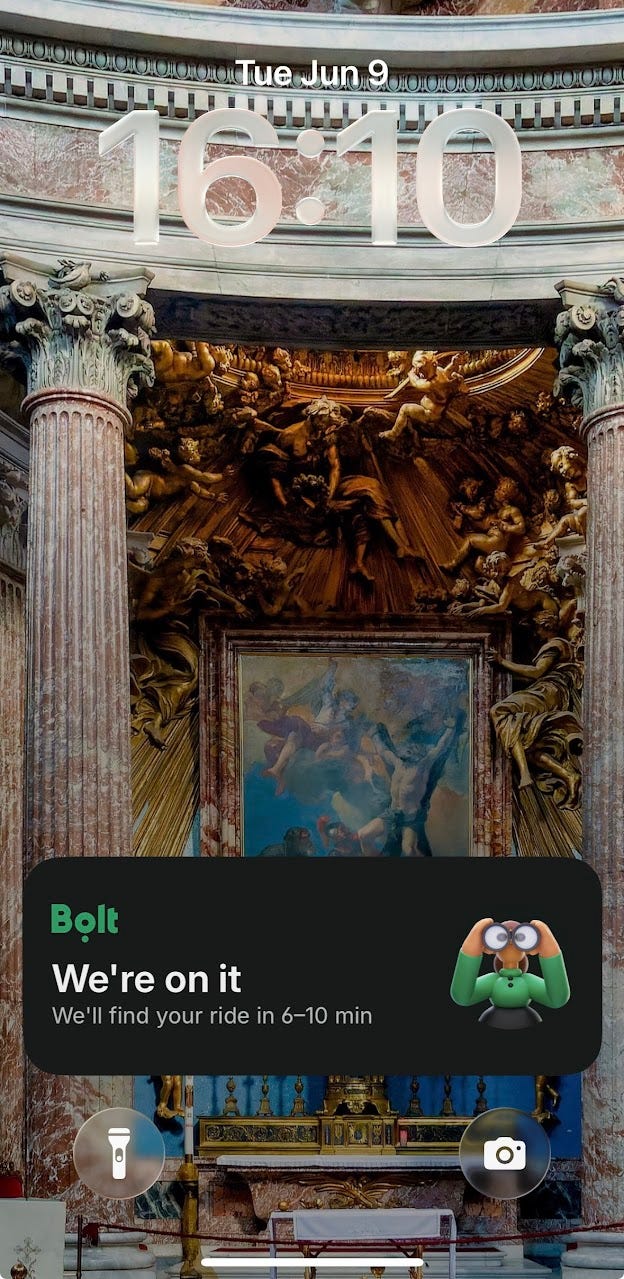
Tested out Bolt on a rainy day here in Helsinki last Tuesday. Their Live Activities integration on the lock screen is pretty cool.
📖📺🍿 Currently Reading, Watching, Listening
A remarkable piece of reporting by Eliezer Budasoff (El Hilo), together with Marcela Turati and Thelma Gómez Durán. A moving and deeply reported investigation into modern slavery in Mexico. One of those stories that feels almost unbelievable and yet is real. It could easily inspire a Netflix series.
I learned a lot about Gaudí and Sagrada Familia from this RNE documentary. Excellent audio documentary. The production quality and narration are superb. A real treat for anyone looking to understand a subject in depth, without the hurry and fragmentation that characterize so much of today’s media.
A powerful testimony from Carlo Acutis’s mother. Full of practical wisdom and concrete insights.
Montmeló this weekend!
It’s always special to see the Spanish drivers racing at home. Let’s see if they can get themselves into the points.
My guess is that McLaren, Ferrari, and Max Verstappen will be right back in the fight at the front. That said, I still think Mercedes should be considered the team to beat.
Either way, it should be a great weekend of racing. Enjoy it!
🌐 Cool things from around the internet
A collection of links to stuff I think are worth sharing.
🔗 World Cup 2026 — impressive World Cup guide from The Guardian.
🔗 AI Incident Database — discovered this repository, thanks to Jorge Carrión, which documents real-world incidents and failures involving AI systems from around the world.
🔗 ninejs — interactive plotnine Charts.

Issue #48 of Computing Education Things was written while listening to:
🔗 Quick Links
🎧 Listen to Computing Education Things Podcast
💌 Let’s talk: I’m on LinkedIn or Instagram
If you’re enjoying Computing Education Things, please like, comment, or share this post! You can also support this work through Buy Me A Coffee. And if you’re finding value in the newsletter, consider forwarding it to a friend, colleague, or family member to help the community keep growing. Thanks for reading!