

#30 — The fight to keep thinking
The serum that develops deep thought


This edition of Derek Thompson’s newsletter argues that the greatest risk of AI is that people may stop thinking. Beyond the common argument that students and professionals are outsourcing writing and reasoning to models—thus eroding basic cognitive skills—Thompson contends that writing is thinking, and deep reading is training for the mind.
I believe the rise of LLMs is further accelerating the shift away from long-form reading. We now tend to prefer other formats, such as podcasts, videos or social media, and our content consumption has become more fragmented.
Yet in this new economy, we still need the ability for symbolic and systemic thinking. As both Cal Newport and Walter Ong have noted, reading and writing are the serum that develops deep thought.
The conclusion: we must sit with difficult ideas, read, write without shortcuts, and resist the comfort of total automation to prevent the decline of thinking people.

Example 1: Hussein Nasser argues that the most effective way to design software is by writing, not coding or diagramming first. His process starts with detailed workflows, moves to a technical design overview, then component-level documents, and only ends with diagrams—accepting the time cost in exchange for clarity, rigor, and confidence when reasoning about the system.

Example 2: Windsurf Codemaps is an AI-powered way to build structured, navigable mental models of large codebases. Instead of replacing thinking with “vibe coding,” Codemaps helps engineers read, reason about, and stay accountable for complex systems—turning AI into a tool that keeps your brain on, not off.
Brute Force Exploration
Ralph Wiggum is a script that runs Claude Code in an infinite loop, feeding it prompts until it either solves a problem or runs out of budget. It relates to today’s topic because this new methodology involves no guided exploration—just a loop that generates, evaluates, fails, and repeats. The thinking isn’t in the process itself but in the acceptance criteria. It’ll probably work; after all, it’s still a valid approach, much like machine learning or many other areas of computer science.
Outside of critical systems—where the priority may still be on hand-coding—the focus in software engineering is increasingly shifting from writing software by hand to understanding what to build and why. It’s about exercising judgment, taste, and strategic thinking. It’s about tackling complex problems, designing robust solutions, and making tough calls. In that context, AI is just another tool.
As Eduardo Díaz puts it on his blog, we are complexity managers—translators between the chaotic world of human problems and the formal world of computational instructions.
What worries me is that Ralph Wiggum doesn’t actually think. He says things that sound accidentally profound—but he doesn’t understand why they’re profound. I believe that kind of thinking is still our responsibility—at least for as long as we have the judgment to know what to build and the taste to recognize when it’s well done.
If Ralph Wiggum feels unsettling, Michael Arnaldi’s “The Death of Software Development” pushes the same idea further. His argument is simple: software development as a craft is dead, but software engineering is alive and well. What matters now is not writing code, but designing the processes that produce it. With the right methods, “good enough” agents can build systems that once required entire teams:
The role has transformed. Engineers are no longer writing software — they’re designing higher-order systems. They’ve moved from crafting code to designing systems that write code. They build techniques. They build skills. They develop the mental models and architectural intuitions that guide AI toward good solutions. This new reality requires rethinking everything. Forty years of best practices are now outdated. The patterns we relied on, the team structures we built, the processes we followed — all of it needs to be reconsidered. Individuals are far more powerful than before. A single person with the right skills can now do what used to require an entire team.
If Arnaldi describes the technical inflection point, Peter Rojas’s “How Mozilla Builds Now” articulates the human response. The real work is making systems legible, bounded, and worthy of trust. Rather than optimizing for speed alone, Mozilla frames building as a responsibility — designing tools that assume users can think, judge, and remain in control.
Long live the factory
Quinn and Thorsten recorded a new episode of Raising an Agent, many months after the last one. The agent’s all grown up now—and hey: “the assistant’s dead, long live the factory.”
FYI: I created an AI assistant last year 😂 There are still ways to capitalize on it (e.g., research manifestos, proposals, etc.).
This week, I saw a thought-provoking tweet from Ryan Dahl, creator of Node.js and Deno:
This has been said a thousand times before, but allow me to add my own voice: the era of humans writing code is over. Disturbing for those of us who identify as SWEs, but no less true. That’s not to say SWEs don’t have work to do, but writing syntax directly is not it.
For years, the dominant mental model for AI in software engineering has been the assistant: a one-to-one interaction, a conversational partner that helps you write code faster, autocomplete functions, or clean up rough edges. Useful, yes—but fundamentally limited.
What Thorsten Ball articulates in this conversation feels like something deeper: the assistant is no longer the center of gravity. The factory is.
This shift didn’t happen in a vacuum. It coincides with a real inflection point in model capabilities. When Gemini 3 landed, it quietly reset expectations. A week later, Sonnet 4.5 (and its peers at the frontier) erased what many thought were hard limits: agents couldn’t sustain long tasks or operate autonomously without constant human steering. Suddenly, those assumptions were outdated.
What’s striking is not just that these models can write more code—it’s that they can hold the shape of a problem for longer. They don’t need to be micromanaged step by step. You can give them a longer leash—and they don’t just run, they navigate.
That’s where the “factory” metaphor becomes especially compelling. If agents writing code is now a given, the more interesting question is: what happens when we stop treating them as tools waiting for instructions, and instead see them as systems we can embed directly into our codebases—systems that can explore, test, verify, and iterate independently?
This reframes the human role entirely. The challenge is no longer writing every line of code correctly—it’s preserving the thinking behind it: choosing the right problems to solve, designing environments where agents can thrive, and building feedback loops that encode judgment, not just execution.
There’s a quiet but profound tension here. As agents get better, the temptation is to think less—to delegate not only labor, but thinking itself. Yet the opposite may be required. To build agent-native systems, humans must think more clearly about structure, constraints, verification, and intent. Deep thought doesn’t disappear; it moves upstream. In that sense, agentic factories aren’t the end of thinking—they may be the catalyst that compels us to sharpen it.

🔍 Resources for Learning CS
→ What is Continuous Delivery?
In this post, Thierry de Pauw emphasizes that Continuous Delivery isn’t an end state or a one-time project—it’s an ongoing practice of continuous improvement aimed at making deployments safe, reliable, and routine.
→ Using enumerate and List Transformations in Python
This is a great video by Prof. Kurmas featuring examples of how to use Python’s enumerate function and how to build a new list based on an existing one.
→ Book recommendation
The Magic of Code by Samuel Arbesman is a valuable supplementary resource for computer science education. Framing computing as a humanistic liberal art, the book explores the cultural, historical, and philosophical dimensions of code and computation. While it does not teach programming directly, it offers rich insights that can deepen one’s understanding of computing as a discipline. A PDF of the introduction is available here for those interested.
→ Deep Learning with Python, Third Edition
A clear & code-first guide to deep learning—from first principles to generative models, by François Chollet and Matthew Watson. No heavy math, just hands-on examples in Keras, PyTorch, TensorFlow, and JAX. Read online.
→ Large Language Model tools for R
Explore the R packages that turn large language models into practical tools—from structured prompts and local model support to IDE assistants and agents that work directly in your R session. This guide is also available in Spanish.
→ A Diary of a Data Engineer
Thinking about becoming a data engineer? This honest post by Simon Späti captures what the job really feels like—beyond the tools and hype.
→ Pioneers of RL: Barto & Sutton
ByteCast Episode 80 features Turing Award winners Andrew Barto and Richard Sutton, pioneers of reinforcement learning. Hear them discuss the foundations of modern AI—including AlphaGo and ChatGPT.
Don’t chase fashionable problems—follow your intrinsic curiosity and look for the “obvious” truths your field is overlooking, because lasting breakthroughs come from developing what others don’t yet see, not from riding the trend of the moment.
🔍 Resources for Teaching CS
→ Developing Syllabus Statements for AI
If you’re still working on your syllabus, you might find some inspiration here: how to craft AI policies that go beyond simply allowing or banning its use. The goal isn’t control, but helping students understand why certain uses of AI can support—or undermine—their learning, and guiding them to develop sound judgment.
→ Computer Science In 100 Images
I highly recommend Computer Science in 100 Images by Dr. Ashish Bamania. The book distills 100 foundational computer science and software engineering concepts into clear, thoughtfully designed visuals, each accompanied by concise explanations.
→ Intro to Bias and LLMs
This video from Google does a great job explaining bias in models and could serve as a quick primer for students to get a sense of what bias can look like. It’s also a useful starting point for discussing more serious forms of bias that may arise. This second video, focused on LLMs, offers a solid overview of how large language models are trained, how they work, and even touches on transformers. It gets a bit technical toward the end, but overall, it’s a great introduction. Thanks to Ismael for sharing these valuable resources!
→ An episode on rethinking Learning Objectives with AI
This episode did a great job of exploring the nuance in the tension between acknowledging that using AI may now be a learning objective, while also recognizing that it might be one of the first objectives potentially at odds with others. However, this means we need to rethink our learning objectives and how we assess them — which is possible, though challenging.
→ Teaching Neural Networks with Snap!
Check out Jens Mönig, research expert at Snap!, as he shows how this visual programming language—developed by SAP in collaboration with UC Berkeley—can be used to create, train, and understand neural networks in a fun and accessible way. If you’re interested in diving deeper into Snap!, there are some great resources and examples worth checking out:
Mark Guzdial’s course using Snap!: Alien Anatomy: How ChatGPT Works
SAP blog post: What’s Next: Generative AI with Snap! GPT
Ken Kahn’s project collection: AI tools for beginners
Eckart Modrow’s SciSnap: Programming with SciSnap PDF
→ Building intuition about LLMs
I really enjoyed Mark Riedl’s blog posts—they’re some of the best at building intuition around how LLMs work. For those of you teaching or designing AI-related curriculum, his writing strikes a great balance: technically grounded, yet accessible enough to spark classroom discussion or help students connect theory to practice.
I especially recommend these two posts:
They’re valuable reads for anyone thinking about how to teach LLMs in a way that moves beyond architecture diagrams and gets to the why behind model behavior.
→ AI & ML Materials for High School and Intro CS
Dr. Daniel Bauer (Columbia University) designed and taught a course on AI and ML for advanced high school students, blending core concepts with accessible materials. He’s made the course resources available on GitHub, some of which he also adapted for his introductory computing course at the university level.
David Czechowski uses unplugged AI activities in AP CS Principles to teach Machine Learning and Generative AI through hands-on/low-tech models. Students play Spicy Marshmallow, a reinforcement learning game inspired by MENACE (demo, write-up, middle-school version), and explore generative AI with a Markov Chain built from magnetic poetry (DIY kit, Scratch demo).
→ Causal Inference in Practice
Two hands-on courses—Program Evaluation for Public Service (Dr. Andrew Heiss, Georgia State University) and Causal Inference (Dr. Molly Offer-Westort, University of Wisconsin–Madison)—offer R-based, real-world approaches to teaching causality, research design, and ethical data analysis. Ideal for CS instructors seeking interdisciplinary examples of applied statistics.
🦄 Quick bytes from the industry
→ How Todoist is Built
Gonçalo Silva, CTO of Doist (the company behind Todoist and Twist), says: “I do see it as my responsibility as a leader… to help people navigate into the new world.” This idea closely aligns with what I discussed in Edition 17, about the importance of teaching others how to navigate an over-informed world. Silva also emphasizes that in the age of AI, clarity of thought—as well as the ability to communicate, plan, review, and iterate—is more crucial than ever. He stresses that the fundamentals remain irreplaceable when it comes to building that clarity and effectively guiding AI. Along the same lines, he points out that “architecture has always been important, but now even more so,” because producing more code, faster, makes mistakes significantly more costly—an observation that ties directly to Edition 22, which was inspired by ideas from Chris Lattner. He also notes a practical shift in day-to-day work—“more PRs instead of feature requests”—and highlights something essential for technical leadership today: as long as there’s critical thinking, it doesn’t matter whether someone is optimistic or skeptical about AI; both perspectives should be valued and rewarded.

→ Nimit Sohoni on AI Research vs. Quant Careers
Nimit Sohoni (Stanford PhD) moved from AI research into quantitative research at Citadel Securities, and later joined Cartesia as an AI Research Scientist, where he works on real-time voice AI. In this conversation, he compares the day-to-day realities of AI research and quant work, explains what a PhD does unlock, and shares a practical playbook for building a career around deep technical fundamentals.
Five ideas worth keeping from the episode:
1. What a PhD Changes
Very few careers are strictly unavailable without a PhD (academia being the main exception), but a PhD makes certain paths much easier—especially industry AI research and quantitative finance. It helps both at the filtering stage (getting interviews) and in developing a key internal skill set: research taste. Without a PhD, AI roles often skew toward engineering-heavy work (infrastructure, data pipelines, evaluation), while a PhD can enable more exploratory, architecture-level research with longer time horizons. Still, both paths can succeed; startups in particular can allow role transitions if there is clear evidence of research ability. The core requirement is not the credential itself, but demonstrable depth in fundamentals.
2. Research Taste
Nimit emphasizes that “90% of the battle” in research is choosing the right problems—ones that are meaningful, tractable, and worth caring about. This skill develops through immersion: skimming large volumes of papers (X, coworkers), recognizing patterns in the literature, and progressively moving from small extensions to larger original ideas. Across both AI research and quant work, strong fundamentals matter more than domain-specific knowledge. Math intuition, numerical methods, linear algebra, stochastic calculus, and coding skill are transferable; finance concepts or new AI subfields can be learned on top. His advice is disciplined focus: build deep technical skills, read extensively, and avoid diluting your efforts across too many directions.
3. AI Research vs. Quant Finance
Quant and AI research share a similar math+CS core but differ sharply in culture. Quant roles vary widely (alpha generation, risk, data analysis, monetization), often involve heavy coding (frequently C++), and can offer surprisingly good work-life balance due to clustering around trading hours. Finance is also far more secretive than tech, even internally, with pod structures, strict information boundaries, non-competes, and garden leave designed to protect alpha. Compensation in quant is opaque and less standardized than tech, often bonus- and performance-driven, with higher upside and risk. In both quant and AI, top performers separate themselves through a mix of raw technical ability, execution speed, judgment, and being in the right place at the right time—but quant tends to have clearer, harder metrics for success. In this context, Nimit references firms such as Citadel Securities, Jane Street, Renaissance Technologies, Jump Trading, Hudson River Trading, as well as newer or more specialized players like XTX Markets, Radix Trading, and TGS Management.
4. Startups
After Citadel, Nimit returned to AI by joining Cartesia, drawn by the rapid acceleration of the field post–ChatGPT, trust in the founding team, and the opportunity to take risk after gaining stability. Cartesia focuses on real-time voice AI (text-to-speech, speech-to-text, voice agents), where low latency and tightly integrated end-to-end systems are critical for natural, usable interactions. He contrasts big AI labs—rich in resources but sometimes risk-averse—with startups that can challenge orthodoxy (e.g., state space models, hybrid architectures, learning tokenization from raw text). Voice, as a modality, benefits from architectural compression (SSMs) due to redundancy, making hybrid approaches especially powerful. More broadly, he argues that durable AI companies need both product and research: research-only startups face extreme risk, while products built purely on top of others’ models are easily overtaken as base models improve. Shipping real products reveals real failure modes, and those failures should guide model-level research.
5. Advice for Moving into AI Research
Nimit’s advice centers on depth over positioning. He argues that the most reliable path into AI research is to build strong fundamentals—coding ability, mathematical intuition, and the habit of reading papers—because solid technical foundations eventually attract opportunities on their own. For software engineers looking to pivot, credentials like a master’s degree can help signal readiness, but evidence of real skill matters more than titles. Startups can be especially effective environments for transitioning into research roles, since they allow more flexibility and organic role evolution—provided you can demonstrate the capability.
→ OpenAI and Codex with Thibault Sottiaux and Ed Bayes
Kevin Ball interviewed Thibault Sottiaux, Engineering Lead for Codex, and Ed Bayes, Codex Product Designer, both from OpenAI. Their conversation covered a range of topics, including models and harnesses, the future of multi-agent systems, model specialization, and considerations around latency and performance.
🌎 Computing Education Community
ByteByteGo is hiring for two roles: Technical Deep Dive Writer (System Design / AI Systems) and Lead Instructor (Building Production AI Systems). Both are part-time, remote roles focused on high-quality technical education and real-world AI systems. Apply at jobs@bytebytego.com.
Latent Space is hiring a Researcher/Writer to produce high-quality essays on AI research, products, and industry trends for a 100k+ audience. Remote (US timezone) or SF-based, $100k–$250k+ (part-time available).
LAK26 registration is now open and the full program is available.
RIT’s Future Faculty Career Exploration Program (Sept. 30–Oct. 3, 2026) is a four-day immersive experience for those interested in academic careers. The program offers insight into faculty life at RIT, including research, teaching, and service, along with networking, research presentations, job-talk feedback, and professional development. Travel, lodging, and meals may be covered for selected participants. The application deadline is February 27.
The first SIGCSE Journal Club of 2026 will take place on Monday, February 2 at 2:00 PM (UK time) and will be held online via Zoom. The session will focus on Semantic Waves in Computer Science Education and will feature Jane Waite (University of Cambridge) and Paul Curzon (Queen Mary University of London). The Zoom link is public (https://zoom.us/j/96465296256), while the password is available in the SIGCSE Slack channel, which can be joined via the instructions at sigcse.cs.manchester.ac.uk/join-us I’m in!
Working Groups are now forming for ITiCSE 2026, to be held in Madrid, Spain (July 10–15, 2026), and are seeking participants. WG6 focuses on building a global computing terminology resource by gathering and analyzing region-specific terms. WG4 examines how replication studies are conducted and published in computing education research, while WG10 explores teamwork in computing education, with attention to the skills, values, and virtues that enable effective collaboration. Find all Working Groups and application details here.
Heading to SIGCSE TS? Don’t miss Tutorial #405, Developing Peer Mentoring Programs for K–12 CS Teachers. This session will offer practical tools, strategies, and insights from four years of equity-focused mentoring work to support and sustain computer science teacher communities. You can also join the Professional Development Session for New and Aspiring Educators.
Undergraduate CS students are invited to submit abstracts for the CCSCNE 2026 Poster Competition at Smith College—top posters win cash prizes.
Haverford College is hiring a full-time Visiting Assistant Professor of Computer Science.
California State University, Long Beach is hiring three tenure-track Assistant Professors in Software Engineering, Computer Engineering, and Cybersecurity starting August 2026.
CS educators are invited to Devnexus 2026—a leading AI and Java conference—with a 40% discount using code EDUDN26F@CULTY. Join the educator session on March 5 and explore how Devnexus connects academia and industry.
The submission deadline for WCCCE 2026 is approaching.
CMMRS 2026 is a one-week pre-doctoral research school (Aug 3–7, Saarbrücken, Germany) where top undergrad and Master’s students explore CS with leading researchers from Cornell, Maryland, and Max Planck—apply by Feb 14, 2026 (AOE).
A new free online seminar series starting February 2026 will explore how AI is used and taught across disciplines beyond computing with a focus on computational literacy, critical evaluation, and classroom-ready research insights. Now available: a recent session featuring Jesús Moreno-León, where he explored methods for measuring and evaluating AI literacy, presenting an assessment instrument validated across multiple studies with thousands of primary and secondary students in Spain, and discussing its strengths and limitations.
USF’s Bellini College of AI, Cybersecurity and Computing is hiring Assistant and Associate Professors of Instruction for full-time instructional roles in AI, cybersecurity, and computer science, starting Fall 2026.
🤔 Thought(s) For You to Ponder…
I truly believe that the things which serve no practical purpose are what keep us from suffocating. It’s the useless that turns a flat life into one that flows—dynamic and driven by curiosity about the human spirit and the world around us. This thought was inspired by Sean Goedecke’s recent post.
Quan Nguyen on the soft skills gaining momentum for software engineers in 2026: Clearly defining problems, communicating effectively (especially in writing), asking sharp questions, and surfacing hidden assumptions or trade-offs.
It’s interesting how investing more, but with intention, in fewer well-made, high-quality clothes connects so naturally with the idea of sobriety:

I’m all for what Stacey Margarita Johnson is proposing in her new blog series, “Teaching the Good Stuff”: bringing current events, industry news, and real-world cases into the classroom so students can connect what they’re learning with what’s actually happening in the world. I think for that to happen, instructors need to be curious themselves first—but it’s just as important to create spaces where students can take the lead too (like a forum on Canvas, a Teams group, etc.).
I like the analogy brought up by Javier Vidal-Quadras about loving in the background—like a thought that’s always there, subtly noticeable, working beneath the surface, running in the unconscious until it becomes something that permeates every part of our life. In the background, yet always present.
The theme of fighting slop really resonates as generative AI increasingly strips authenticity from creation. It reflects a growing concern about not knowing whether code, content, or conversations are genuinely human or AI-generated.
Great piece. In what ways can I show love to others, especially those around me?
McKinsey is taking agents to the next level. It’s getting more embedded in the culture.
Back in my startup days, I always liked standup meetings—when they’re done properly. I don’t run them anymore as a researcher, but if I were to introduce one, I’d start by sharing this piece by Marc G. Gauthier.
Speaking of startups, Lawrence‘s honesty is admirable. He left a comfortable position at Amazon for a high-paying startup job in San Francisco, lured by the money, the fast pace, and the promise of making an impact. But at the startup, he quickly realized the culture demanded total commitment and emotional investment—something he didn’t feel. Within three weeks, he was let go after admitting he wasn’t enjoying the work. The experience turned out to be a tough but valuable lesson about the intensity of startup life, the importance of alignment, and choosing work that truly resonates—not just financially, but personally.

Although this MIT Media Lab paper came out last year, it still feels incredibly relevant. It tries to measure what happens in the brain when people write a text on their own, with the help of a search engine, or using ChatGPT. What they found is pretty clear: when people write without any assistance, their brains show more activity and stronger connections between different regions. When they use a search engine, the activity drops a bit. But when they use a model like ChatGPT, brain connectivity is the lowest of the three. This is what we call cognitive offloading. The more we outsource mental effort to a tool, the less our brain engages in the task. It’s kind of obvious, I know—but now there’s scientific evidence backing it up. What’s more, the study shows that the impact isn’t just “in the moment.” After multiple sessions, participants who used ChatGPT were less engaged, relied more on copy-pasting, and felt less ownership over what they wrote. They also had a harder time remembering or citing what they had written.
After weeks of having it on my watchlist, I finally caught up with the ACM-SIGSOFT session titled What Do Professional Software Developers Need to Know to Succeed in an Age of Artificial Intelligence?, featuring Matthew Kam (Google), Miaoxin Wang (Google), Vikram Tiwari (ClickUp), and moderated by Sridhar Chimalakonda and Andrew Begel. The talk is based on a recent paper that immediately clicked with this week’s theme. My main takeaway from the paper:
Productivity gains favor senior developers with strong mental models, while junior developers face a real risk of stagnation or deskilling as AI automates tasks that traditionally supported learning.
Also this week, I watched another ACM Tech Talk on How to Extract Meaningful Insights from Data. Angelica Lo Duca (IIT-CNR, University of Pisa) explored how insights emerge before any narrative or visualization, with Victor Yocco (ServiceNow) hosting the session. The talk emphasized practical analytical heuristics—temporal, spatial, multi-category, zoom, and anomaly analysis—to help decide what actually matters in real datasets. A recurring message was to focus on one insight at a time, treat peaks as outcomes rather than explanations, and recognize that flat data, missing values, and apparent anomalies often contain signal. The closing idea tied it all together: insights are relatively stable, but communication changes by audience.
📌 Research Corner
I’m currently deep in paper-writing mode. This week I’ve been testing out Flow for voice writing. It’s easy to use—just place your cursor, hit the keyboard shortcut, and start talking. It captures everything with impressive accuracy and even formats the text for you (perfect for creating lists). The free plan gives you 2,000 words per week. Available for Mac, iOS, and Windows.
Speaking of tools for researchers, TurboScribe is one of my favorite apps for transcribing audio. It’s fast, detects how many speakers are talking, and even lets you transcribe three 30-minute files for free every day. I use the paid version so I can get unlimited transcriptions and longer durations.
The deadline to submit the abstract for the EDM conference is next Monday. It’s been months of research—a whole experience. I know the bar is high, and this is my first paper as first author, but I’ll be happy as long as it makes an impact in the Computing Education Research community and the reviewers find it novel.
Speaking of conferences, I’ll be at SIGCSE TS from Wednesday, February 18 to Saturday, February 21. If you’re around and want to talk Computing Education, AI in programming, or anything related, I’d love to connect!
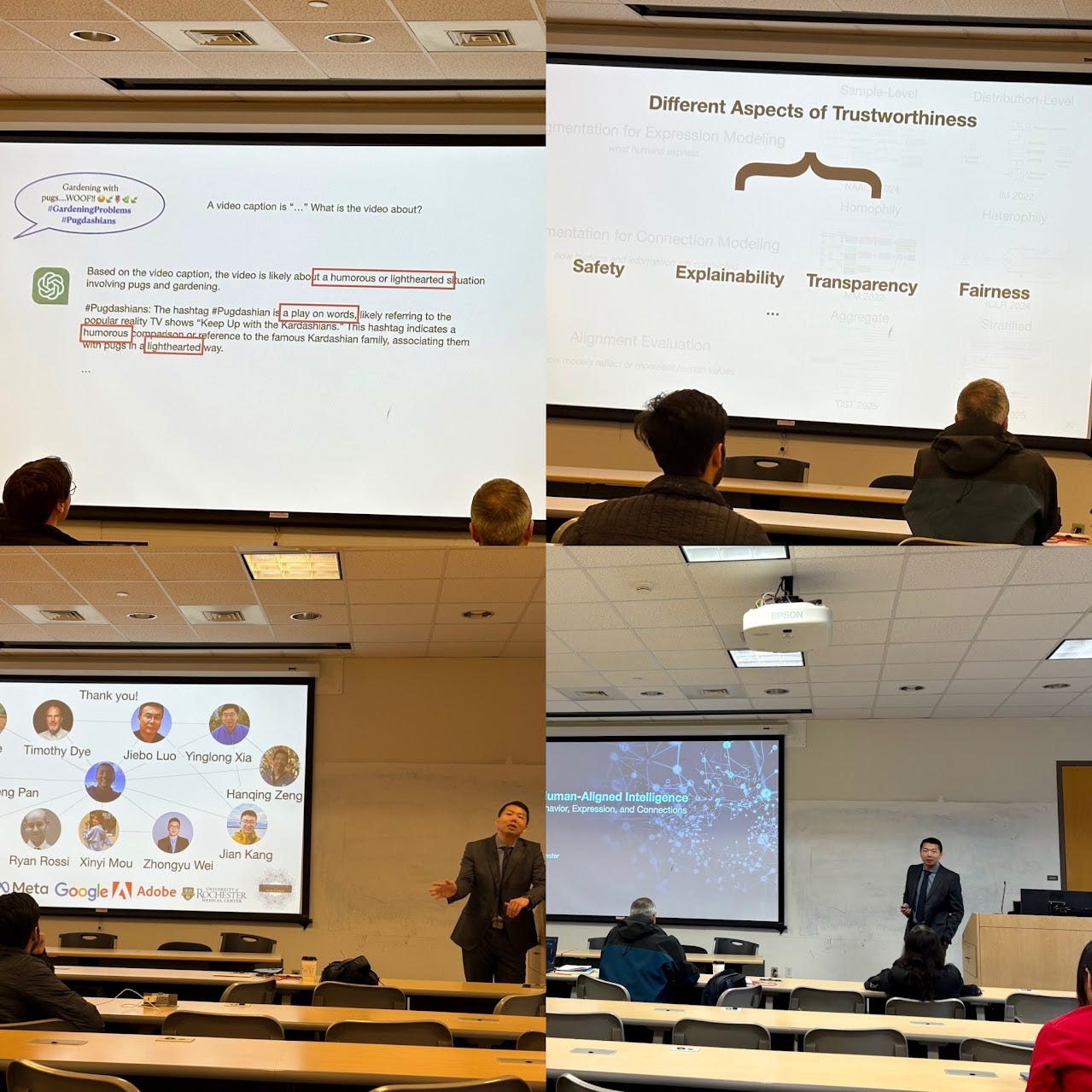
Attended a seminar on Wednesday where Hanjia Lyu (University of Rochester, Snap) went beyond high-level claims about multimodal and graph-based AI, grounding them in concrete case studies on data quality and alignment. What stood out was the emphasis on informative and selective data: from augmenting sparse video captions with language-model analysis in large-scale recommender systems, to human-in-the-loop filtering of vaccine-related tweets that dramatically reduced irrelevant data, and confidence-aware GNNs that adaptively handle heterophily in networked predictions. The talk closed with a sharp discussion on cultural misalignment in multimodal models (e.g., Simplified vs. Traditional Chinese), reinforcing a central theme: better human-aligned AI often comes not from more data, but from identifying the right data and understanding which human groups our models actually represent. I used Granola to record the talk while also taking my own notes. Afterwards, I wrote the copy you just read to expand and improve on those notes.
🪁 Leisure Line
The lack of ideas in this section is a clear sign that conference deadlines are approaching. Lots of routine work (blessed, nonetheless!). Wednesday was the feast of Saint Thomas Aquinas, and I’d like to mention that Pope Paul VI called him Lumen Ecclesiae—the Light of the Church. I think he’s a wonderful example of what it means to teach those who do not know, which is, in fact, a work of mercy. As educators, we have the opportunity to teach those who are unaware—and that’s a beautiful way to practice charity.
I recently listened to a podcast that explores his Summa. The episodes are short and definitely worth your time.
📖📺🍿 Currently Reading, Watching, Listening
This week, I watched Triumph of the Heart. It tells the powerful story of Saint Maximilian Kolbe during his imprisonment at Auschwitz. The film is available for $20 on this website—and it’s worth it.
I also watched American Sniper. A movie that does a great job portraying PTSD and its consequences. A devastating ending that shows the horrors of war. I really liked it.

A 40-minute session with James Baxter, where he explains how to animate walking cycles. This is essential viewing for anyone interested in learning animation or curious to see how a professional animator approaches walks.
Last Friday, Valentino’s funeral was held in Rome. The casket, carried on the shoulders of close friends, was accompanied by the sound of Il nostro concerto as it exited.
The designer’s stores, closed in his honor, displayed in their windows:

Issue #30 of Computing Education Things was written while listening to:
🌐 Cool things from around the internet
🔗 repere — exploring data without leaving the browser.
🔗 Flow — bring your unique voice to your writing.
🔗 TurboScribe — save hours transcribing audio with AI.
🔗 Maintenance: Of Everything, Part One — it looks amazing—just like everything Stripe puts out. They’re quickly becoming one of the best publishers when it comes to design.
🔗 Basheer Tome — this portfolio is wonderful, especially the interactive elements. Go ahead and give it a try.

🔗 Quick Links
🎧 Listen to Computing Education Things Podcast
💌 Let’s talk: I’m on LinkedIn or Instagram
If you’re enjoying Computing Education Things, please like, comment, or share this post! You can also support this work through Buy Me A Coffee. And if you’re finding value in the newsletter, consider forwarding it to a friend, colleague, or family member to help the community keep growing. Thanks for reading!