

#24 — What technical interviews teach us about computational judgment
Can our students judge AI-generated code?

What technical interviews teach us
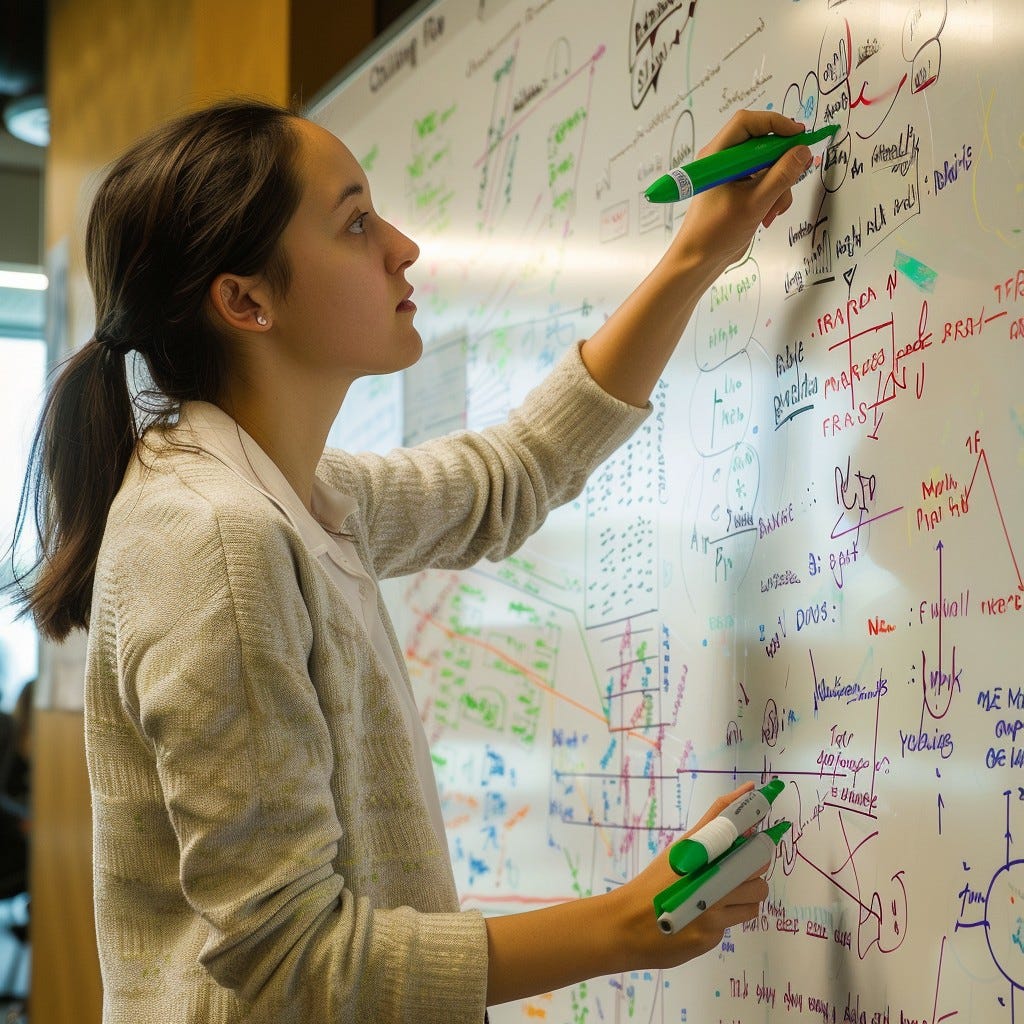
I loved this article about how AI has changed the reality of conducting technical interviews (because what we did in the 2010s no longer applies in the same way and we need to ask ourselves what we’re evaluating).
It starts by discussing the two most common formats in the industry: LeetCode-style, very common at large US companies, and technical challenges closer to actual work reality. It then touches on what I think is a common feeling: in the end it’s a gamble, there’s no way to know if the candidate is the right one, but one thing seems clear—the more people you involve in the process, the fewer biases, without dismissing common foundations or criteria.
And what about AI? Eduardo (the author) argues that what matters now is Computational Judgment, explaining why code does what it does. Eduardo proposes some ideas for distinguishing a good software engineer with AI:
Critical judgment: knows when generated code is wrong, insecure, or unmaintainable.
Architecture: Understands how pieces fit into a larger system.
Communication: Explains technical problems to non-technical stakeholders, and translates vague requirements into clear specifications.
Debugging: When AI fails (and it does), someone has to find the problem.
Process: Knows when to use AI and when not to.
He concludes that all these elements converge on deep understanding. Beyond that, we should be evaluating the following aspects:
Code review: Show them code with subtle bugs, security issues, or bad practices. Do they detect them? Can they explain why they’re problems?
System design: Given an ambiguous problem, how do they approach it? Do they ask questions? Do they consider trade-offs?
Live debugging: Give them a system that fails in a non-obvious way. How do they diagnose it? Do they use tools? Do they have a method?
Real pair programming: Work with the candidate on a small but real problem. Don’t evaluate whether they “know” the answer, evaluate how they think, how they collaborate, how they handle uncertainty.
References: Talk to past employers and colleagues. Sounds old-fashioned, but it’s still one of the most reliable signals.
After reading these ideas, don’t you think it’s time to include a course on Computational Judgment in computing degrees? I’m interested in hearing your opinion in the comments.
Think before executing

In the last issue, I talked about the new role of the software engineer because software engineering professionals are accepting that agents are transforming our work. The impact is undeniable.

Parallel programming with agents is doing the same thing that those who plan before programming have always done, but with an “orchestra of AIs executing the scores they’ve written.” Pure SDD doesn’t work in dynamic environments because specifications change very often (high uncertainty) and there’s a need to iterate quickly. It’s a rigid approach that works well in stable, well-understood domains.
That said, parallel programming depends on these prior specifications. Agents don’t improvise—they execute a plan. Returning to the earlier metaphor, specifications are the score and AIs are the orchestra. But if the human doesn’t provide order, we’ll have noise instead of music. We need a human coordinating and reviewing the code. This can’t be delegated for now. Someone has to be the conductor.
Traditionally, the problem with designing detailed specifications was time, and when there are changes, everything is costly. With AI agents, the cost is reduced. The design-implementation-redesign cycle accelerates.
One interesting thing about this shift is that vibe coding or relying on pure improvisation doesn’t make sense because you need to have a method—that’s why software engineering is important.
The real competitive advantage is clarity of thought: how clearly you can specify what you want, how coherent your system is, how well you can coordinate your agents working in parallel.
I think the danger lies in cognitive load. Reviewing the output of so many agents can be exhausting, but it’s more necessary than ever: thoroughly reviewing everything the AI generates.
Traditional software engineering skills gain importance in this new workflow: design, architecture, specification, dependency coordination, review, rigor, and iteration become more valuable, not less.
I believe that with this new mode of programming, classic methodologies—both waterfall and the incremental iterative method—have a very good opportunity to improve and adapt with the use of agents.
Learning podcasting as a CS educator
Loved hearing from an academic like Laura Otón from Nebrija—someone who’s not only well-versed in digital audio but also stays closely connected to the industry. I really enjoy learning through this kind of format.
Here are some scattered notes I took on how podcasts are getting a breath of fresh air:
It’s all about people bringing a different perspective. That’s where innovation can come from—new voices, new elements. Podcasts give us the chance to listen to creators who want to tell stories—not necessarily new ones, but told in fresh, original ways.
Something else that stood out to me: there are people in the podcast world doing really interesting work, but their distribution is lacking. They’ve got an amazing catalog, but hardly anyone knows about it because there’s no strong promotion behind it.
And finally, the idea that building listener loyalty in podcasts comes from quality—not just from grabbing attention in the first few seconds. Listening to top podcast creators is key if you want to come up with great ideas.
If you make a podcast about anything, think about this: if someone lends you thirty minutes of their life, the least you can do is not betray that trust and destroy their ears. People today don’t distinguish between radio and podcasts. They don’t follow schedules. They don’t wait for anyone. They consume fragments, moments, loose pieces. And yet, when they find something that speaks truth, they stay.

🔍 Resources for Learning CS
→ Addy Osmani’s Next Chapter
Addy Osmani announced this week that he’s leaving Google after 14 years. He’s quite active on Substack, where he often shares analysis on AI in software engineering and shares a lot of knowledge. A good resource to follow.
→ Duke’s AI Toolkit for Learning
This AI Toolkit from Duke’s Academic Resource Center provides practical, student-facing resources on using AI effectively for learning
→ Book Recommendation on Culture
Over these past few months, I’ve been in contact with many cultures and have come to better understand an idea I discovered in this book—something I’ve confirmed firsthand: people’s way of being is really their culture speaking through them. I recommend this book to anyone navigating diverse realities.
🔍 Resources for Teaching CS
→ Crafting Interpreters Book Recommendation
Just a few chapters into Crafting Interpreters, but the combination of deep technical coverage (of a very tough topic!) and good, funny writing is just so impressive. I believe that author Robert Nystrom brings it closer to a wider audience by reducing theory and increasing practice.
→ Teaching Programming: Global Perspectives
Four passionate CS educators from across the world (J. Ben Schafer, Laura James, Dorian Love, and Ethel Tshukudu) shared some practical tips and real-world examples to help you teach programming to your students. Whether you’re new to computer science or looking to expand your impact, this episode is packed with valuable insights. Some resources mentioned include: Micro:bit, Microsoft MakeCode, Microsoft MakeCode Arcade, MIT App Inventor, Scratch, Raspberry Pi, The Big Book of Computing Pedagogy, PRIMM, Parson Problems, adacomputerscience, and CAS. By the way, one platform that wasn’t mentioned but I really liked is Computer Science Educators Stack Exchange.
🦄 Quick byte from the industry
→ Kevin Zhu’s Journey
It was interesting listening to Kevin Zhu, a former Citadel quant and Palantir developer, share his journey from Berkeley CS student to landing roles at Citadel, Goldman Sachs, and Palantir, and why he ultimately left it all:
His answer to whether it’s still worth it to study CS? If the future of humanity is more and more tech, it’s still a very good skill to have. But he also warns that you have to be passionate about it because it’s something you’re going to stick with for a long time, and that the standards are higher now—you have to stand out and do good work.
🌎 Computing Education Community
Call for Papers for AIED 2026, ITiCSE 2026 and EduCHI 2026.
Great opportunity at JetBrains for recent PhD graduates interested in CS Education! Also, new PhD opportunity at KTH!
I’ve been following Data Council since the beginning. Now they’re becoming AI Council. Everyone who speaks at their conferences are great engineers—no bullshit, and real technical depth. Apply to speak at the next conference in SF.
Analysis of CS Tenure-Track Faculty Hiring for 2026.
Three tenure-track CS faculty positions: NC State (CS Education focus), Sonoma State (California), and Moravian University.
🤔 Thought(s) For You to Ponder…
I have lots of thoughts to share this week:
Great piece from Enrique Dans on the disappearance of the deliberate process, that beauty found in the very act of writing, programming...
Enjoyed so much this conversation between Joan and Ricardo on what makes us truly human:

Has AI ruined remote interviews? I don’t know, but what is clear is that we must focus on human reasoning, problem solving, and understanding/explaining code rather than writing it. Products like Interview Coder already have audio support and 20+ cutting-edge undetectability features to keep you invisible across every interview check... The ethics of products is a serious matter...
Adam Jacob also thinks that despite all the hype, we’re still in the earliest stages of understanding interaction models and humans must stay in the loop. Although the flow is different—much more iterative, trying different directions because the cost is so low. Here’s the conversation with the hosts of The Changelog.
I was reading Gravissimum Educationis with the desire to recover things in education that we’ve lost and also with the hope of updating things that have fallen into the background. I think we’re fortunate: as cs educators, we can make everything in our profession be service, and not just in the classroom—everywhere. This text from the Pope Paul VI has helped me reflect that everything can be an occasion to educate at the university: taking my students seriously, responding promptly to emails or Teams messages, preparing class well, etc. This document also warns against reducing education to functional training or an economic tool: a person is not a skills profile, cannot be reduced to a predictable algorithm, but is a face, a story, a vocation. This week I also spent some time reading the new apostolic letter Drawing New Maps of Hope.
Josh Brake, who is a constant source of inspiration, mentioned a week ago in his newsletter an idea on student motivation that already came up in issue #19 of my newsletter and that I think we shouldn’t forget in order to remain relevant:
Motivation matters more than ever. I am increasingly investing more time helping students to examine their desires and reasons for taking a particular course and helping them to build motivation that is guided by an understanding of why the work we are doing matters and how it is helping them to build a flourishing life.
I think he touches on other good points that are worth thinking about more deeply, such as: assessment redesign, human feedback, and learning environments. Check it out here:

And this from this week: In critique, failure is expected and productive. Everyone takes a turn, everyone has a voice, everyone moves forward together.
This essay from Alvaro de Vicente on improving mentoring conversations was the best thing I read this week.

The role of a mentor or parent is to accompany and guide, not to carry the boy. The true goal is for our mentorship to become obsolete. We want him to become a friend, not for us to remain his crutch. A question you can ask yourself: What is the quickest way to become unneeded by this mentee?
This monologue by writer Carolina Sanín about AI and (non) writing reminded me of what I wrote in this newsletter edition about the learning process or learning loop.
Writing is the journey. It’s not the result. It’s what you learn in the process. The additional stories that emerge from it.
Instagram announced to its employees that they’re returning to the office 5 days a week in 2026. Look at the bright side: Seeing people and social interaction. From home you don’t have casual conversations. Discovering things you weren’t planning to discover.
From this initial discussion about working for a big tech company or a startup, it seems the key question to ask yourself when you’re looking for ‘your ideal company’ is to figure out what you’re really optimized for:
📌 The PhD Student Is In
→ My AI Programming Assistant Project
Just published on ReUnir: my project on the AI assistant I developed for learning programming, a topic that regular readers know has been my main interest lately.
→ SIGCSE Technical Symposium 2026 Opportunities
In a previous issue, I told you that I applied to be a Student Volunteer at SIGCSE Technical Symposium 2026. I think I’ll receive the response soon. For those interested in, or currently in, a CS teaching-track position, CRA-E is running a pre-symposium professional development session at SIGCSE Technical Symposium on Feb 18, 2026!
→ AI Agents Simulating Users
In a previous issue, I mentioned that internally in the Lab we were thinking about simulating users with AI agents in browsers like Atlas or Comet. No need anymore. This open-source framework does exactly that and is open-source.
→ Fantastic Research Resource
I’m starting to read ‘The Effect’ by Nick Huntington-Klein—an amazing resource for all things research-related. Fantastic work!
🪁 Leisure Line
I was off for a few days for Thanksgiving on a 5-day retreat away from the world (somewhere in Texas), disconnecting from everything except the Lord. I like doing a retreat once a year because I do a thousand things, but learning to stop is part of my life training. This life is a whirlwind, but I believe the human being is body and spirit, so for me it’s normal to need a break to examine myself and return to the battle of daily life.


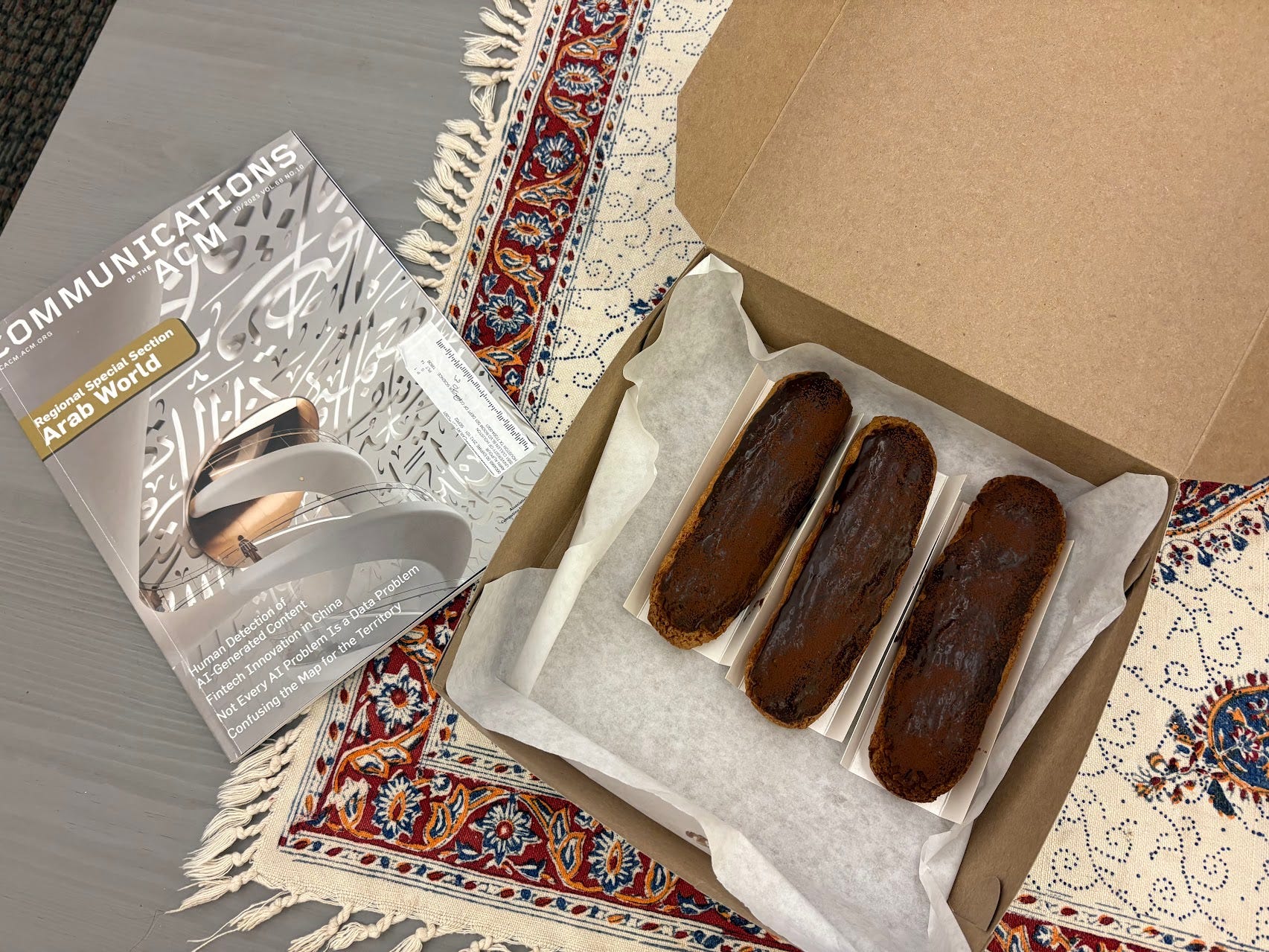
Hard to beat Magnol’s bakery. Somehow I managed to get a picture of these chocolate eclairs before they quickly disappeared in my lab. Of course, when you’re at Magnol’s you can’t just get eclairs, you have to get a Chocolate Religieuse too, but this time there were none left.
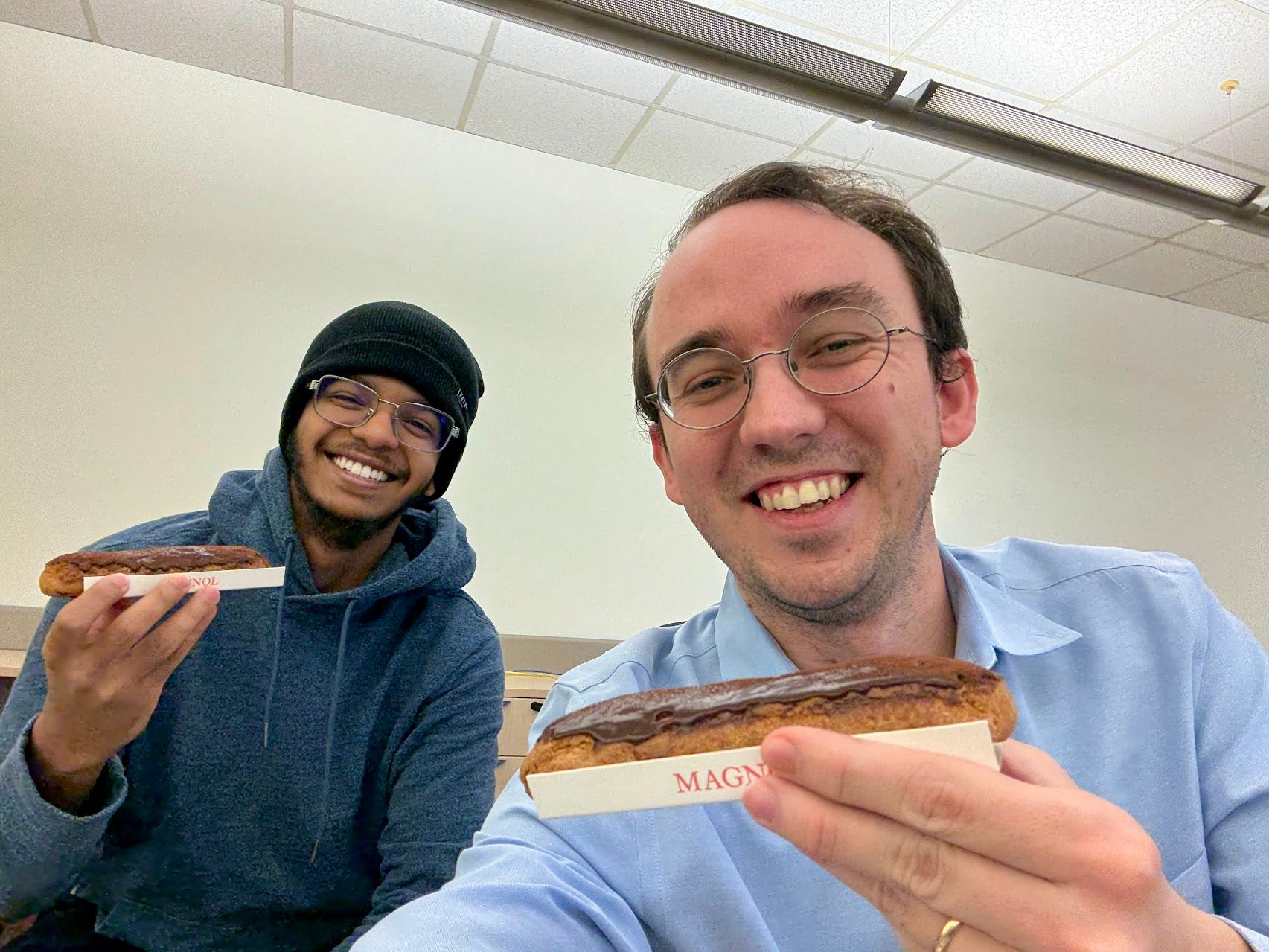
Last meeting on campus with Nebil. He’s graduating with his Master’s in CS this month. We’ll still see each other outside of school. It’s been a pleasure working with him in my Cloud Computing class.
The photo was taken before we dove into the eclairs, for reference…
📖📺🍿 Currently Reading, Watching, Listening
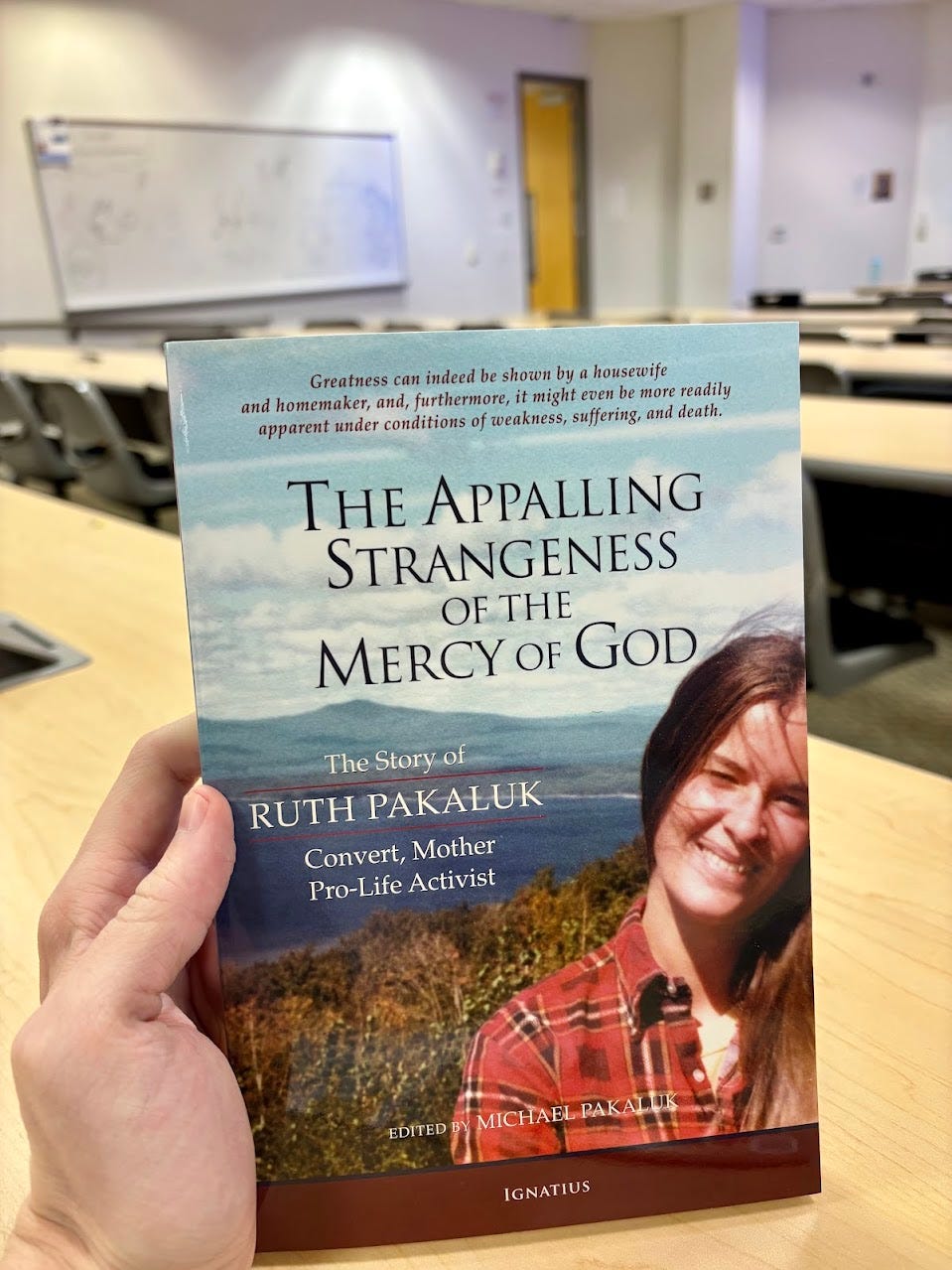
This week I found out that the Vatican has given the green light to proceed with Ruth Pakaluk’s beatification cause. Moved by curiosity about what her life must have been like, I bought this book that I’m really looking forward to reading during Thanksgiving break. Pretty impressive story.
I discovered a lot of great music this week, but perhaps the song I have more on repeat is this one:
💬 Quotable
Let’s keep this in mind when we create any digital product, not just AI products:
Technological innovation can be a form of participation in the divine act of creation. It carries an ethical and spiritual weight, for every design choice expresses a vision of humanity. The Church therefore calls all builders of AI to cultivate moral discernment as a fundamental part of their work—to develop systems that reflect justice, solidarity, and a genuine reverence for life.
― Pope Leo XIV

That's all for this week. Thank you for your time. I value your feedback, as well as your suggestions for future editions. I look forward to hearing from you in the comments.