

#45 — An anthropological approach to AI in Computing Education
Computing Education is not the filling of a pail, but the lighting of a fire

Reflections

Great conversation at Club Dalroy Podcast between Santiago Huvelle, Juan Serrano, and Francisco Javier Rubio. This topic opens the door to many different kinds of reflection. This discussion approached it more from the perspective of anthropology, the humanities, and the social sciences. A few ideas came up that I hadn’t really heard expressed this way before.
Thread below with some loose notes and reflections from the episode (not literal quotes):
There is no intention, objectivity, spirituality, or semantics inside these models. At their core, they are systems of probability and statistics though operating at extraordinarily sophisticated levels.
Memory becomes irreplaceable at crucial moments. It is a habit that needs to be cultivated, much like public speaking or writing.
The pace of learning matters. Immediacy removes process, rhythm, exposure, depth, effort, and the natural timing of education. It’s almost as if we’ve become scandalized by human limitation itself. One point they raised was that universities seem to produce fewer true intellectual “figures” today: Academics with authority, wisdom, and synthesis because those long, demanding formative processes are disappearing.
One example I found especially interesting: one professor increasingly uses close textual commentary in university classes and requires handwritten notes in secondary education, collecting them afterward. He realized that the effort students must make is so significant that, paradoxically, it ends up generating genuine interest and attachment to the subject even though a machine could technically perform those tasks perfectly.
Recovering the habit of wisdom. To know something through its deepest causes is, in a sense, to love it; and that requires time. Knowing involves participation. Even boredom in the classroom can become meaningful if the will remains engaged because choosing to remain attentive is itself a form of love for knowledge.
The loss of presence. One speaker mentioned that Humanities and Psychology programs at UFV prohibit laptops because they are tired of educational spaces, opportunities for shared presence, eye contact, and genuine dialogue between teacher and student, being interrupted by screens acting as physical and symbolic barriers.
One participant argued that thought is activated in three fundamental ways, all of which AI may interfere with:
Study and reading: reading, rereading, taking notes, pausing, returning to the text, questioning it. A deep process.
Conversation: speaking with students and colleagues. Thinking requires embodiment, presence, and relationship. We lose something essential when materiality and direct contact disappear.
Writing: struggling with the blank page, formulating ideas, expressing them, explaining them aloud. It is through that process of articulation that the mind becomes illuminated.
There is also the risk of mistaking simulation for understanding. AI can create the illusion that you understand something because the output “sounds right,” but the understanding is not actually yours. One speaker described it as “grading the work of nobody.” There is an apparent liberation, but it often requires endless iteration, diminishes the joy of thinking, creates dependence, and can gradually atrophy intellectual habits even if the productivity gains are real. The deeper threat lies in cognitive offloading: thought itself is our capacity to encounter reality as it presents itself.
To educate is an incarnational act. The educator helps illuminate the student’s mind and accompanies the transition from potential knowledge to actual understanding. The professor does this as someone who has already walked that path and can guide students in reproducing it within their own minds. As St. Thomas Aquinas might put it in a Christian key: “In the expressed word there is light.”
To teach or mentor someone is not only to share information, but also to awaken an attraction to the beauty of the subject itself.
A professor is also a witness: someone who opens horizons and brings will, passion, and commitment into the classroom. A true professor becomes an intellectual and moral reference point.
Evaluation methods are also changing: oral exams, interviews instead of traditional papers, more in-class writing, and essays completed on site.
If assessments continue to rely on deliverables that AI can easily solve, the system loses its ability both to measure learning and to truly educate.
Recommendations mentioned during the episode:
If you’re interested in education and formation from a more spiritual perspective, this meditation is definitely worth listening to:
Technology Adoption as a Design Problem
I’ve already recommended Afueradentro here and here before, and I’ll do it again. It’s one of my favorite podcasts in Spanish. Jorge Caraballo is, in my opinion, one of the best interviewers in the Spanish-speaking world right now.
This was a fantastic episode with Rafael Orduz, who has a PhD in Economics from The University of Göttingen (Germany), a remarkable career across both the public sector (senator, deputy minister of education, etc.) and the private sector, and who now dedicates himself to continuous learning and to helping entrepreneurs grow, adapt, and stay ahead through automation workflows and AI.
I’m leaving it here together with some of the ideas that resonated with me the most:
The root of wanting to learn is preserving autonomy.
Sustained reading is becoming harder because of the constant stream of short-form messages competing for our attention.
During his PhD, he became deeply studious because he was entering territories that were genuinely unfamiliar from a learning perspective. He compares that to studying automation workflows today: at first, tools like n8n, Make.com, or Zapier feel like “Serbo-Croatian,” but wrestling with them intellectually becomes enjoyable. Curiosity emerges from both necessity and genuine pleasure in learning.
One fear he had to overcome was teaching highly technical young people. He realized the field is so vast that nobody knows everything. His approach became practical: learn an automation process, build a small portfolio of examples, test them, and apply them professionally. Not knowing something is not a flaw, it simply means others know different things.
He strongly rejects the idea that older adults struggle with technology because of age or biology. In his view, it’s fundamentally a design problem. People need accessible tools, opportunities to practice, and practical learning experiences rather than abstract theory.
Once older adults learn these tools, many experience it almost as a personal revolution: the empowerment that comes from understanding how things work and realizing they can participate in this technological world too.
Heidegger said that “language is the house of Being.” In that sense, interacting effectively with LLMs also requires command of language. Professions centered around language are being profoundly transformed.
There is something deeply valuable about intergenerational learning: older people learning from younger people and vice versa. What matters is creating spaces for conversation. He mentioned the “Intergenerational University” initiative at the University of Caldas as an example.
He also emphasized the importance of connecting initiatives and learning from best practices across regions and institutions: “What are they doing in Manizales that we are not doing here?” There is already a small but meaningful social fabric that could begin to articulate itself more intentionally.
One line I especially liked: sometimes he “steals hours” to read history, even though it may seem completely “unproductive.”
Finally, he reflected on attention and time: he admits he checks his phone too much and has to consciously control it. The challenge is organizing time well, reducing distraction, and overcoming anxiety through action itself by simply doing the work.
Consciousness ≠ increasing computational power
Over the last few days, I’ve been reading very carefully the paper of Alexander Lerchner, Senior Staff Research Scientist at Google DeepMind, on what he calls “The Abstraction Fallacy.”
For example, an artificial heart may appear functionally equivalent because it pumps blood, but a human heart is not exhausted by that single function. It participates in many other physiological processes, releases hormones, and exists within a much richer causal network that the simplified model does not fully reproduce.
In the same way, processing information is not equivalent to generating subjective experience. The mistake lies in confusing the abstract description of a process with the process itself, or in assuming that if we reproduce the functional map of something, we have therefore captured its material reality.
Artificial consciousness remains, at least for now, a somewhat speculative and conceptually confused idea because what we actually have are systems for large-scale data processing: tools capable of reproducing certain high-level cognitive processes such as reading, painting, analyzing, or writing but not entities with genuine judgment or interiority. AI processes symbols, but it is still we who give them meaning and purpose.
This is why the paper also criticizes a certain emergentist faith surrounding AI: the assumption that if we continue adding enough complexity, scale, and computational power, consciousness will somehow emerge at some point. That feels like an unjustified extrapolation. More computation may lead to better outputs, stronger imitation, or more convincing linguistic and cognitive abilities but not necessarily to the emergence of the full human reality itself.
Are you also skeptical about this? I’d be curious to hear your thoughts in the comments.

🔍 Resources for Learning and Teaching Computing
→ A really good free lecture on system design
Watched Vasilis Syrakis’s viral “I Was Laid Off by Atlassian” video on YouTube. Pretty based take.
→ An Introduction to Software Engineering
A great online course pack covering the fundamentals of software engineering for college-level students, created by Prof. Will McBurney and Prof. Mark Sherriff at UVA. Speaking of UVA, I came across their UVA CS Advising Guide and found it really useful.
→ CS51: Introduction to Computer Science (Pomona College)
This course, taught by David Kauchak and Alexandra Papoutsaki, provides an intro to CS through a survey of its major subfields. Topics covered include the history and ethics of computing, computer systems, mathematical foundations, algorithms, theory of computation, programming languages, and machine learning. It assumes basic familiarity with programming while introducing more advanced concepts such as recursion. Programming instruction is primarily conducted in Python.
Other Pomona College courses offered in Spring 2026 that may also be worth visiting include Computational Design Tools and Data Structures and Advanced Programming.
→ Training for Teaching-Focused Careers
Really strong white paper from CRA. It explores how universities can better prepare and support PhD students for academic teaching careers, particularly those interested in teaching-focused roles.
🦄 Quick bytes from the industry
→ CS gives you a highly versatile skill set as the industry continues to evolve
I went on a marathon catching up on SWE Accelerator Podcast interviews with Aman Manazir. Here are my thoughts of this interview:
Being a software engineer is about far more than writing code. It’s about building reliable systems, handling edge cases, and navigating real stakeholder constraints. If you’re a software engineer or CS student right now, stay with it. There’s still huge learning potential in the field. You just have to adapt quickly, especially around AI.
Even with all the uncertainty, a background in software engineering or computer science gives you skills that go beyond coding: critical thinking, abstraction, problem-solving, and systems thinking. That’s an incredibly versatile foundation if the industry keeps changing.
🌎 Computing Education Community
Interesting postdoctoral opportunity at the University of Michigan School of Information with Nazanin Andalibi for scholars working at the intersection of computing and society.
Tarek Salah Uddin Mahmud is recruiting a fully funded PhD student at Texas A&M–Kingsville for Fall 2026 in AI + Software Engineering, cybersecurity, and software quality assurance.
Robert Ross is recruiting a funded PhD student in Human–Robot Interaction.
Yong Suk Lee is hiring a postdoctoral fellow at Notre Dame to study AI’s impact on work, labor markets, and agentic AI as a social science research tool.
Fred Martin shares UT San Antonio’s “AI for Everyone!” middle school summer camp (June 1–4), featuring ML, micro:bit projects, and GenAI ethics.
Ying Cheng announces a postdoctoral opening at Notre Dame focused on learning analytics, psychometrics, and interdisciplinary education research. Deadline June 12.
My WG colleague Maíra Marques has written a series of really thought-provoking LinkedIn posts about the four different “hats” she wore this semester (teaching, undergraduate program director, research, and service). Highly recommend them.
Majeed Kazemitabaar is recruiting students.
CCSC Northwestern 2026 (Oct 9–10, Whitman College, Washington) invites papers, tutorials, panels, workshops, and student posters across computing and CS education topics. Main submissions due June 30, student posters Sept 27. Shared by John Stratton.
AccessComputing is hosting a discussion-based book club on Digital Accessibility Ethics (May 21–June 11), exploring disability inclusion across AI, cybersecurity, healthcare, design, gaming, and broader technology practice. Shared by Brianna Blaser.
ICCE 2026 (Nov 30–Dec 4, Christchurch, New Zealand) is accepting submissions across seven subconferences, with the call for papers deadline on May 31. Shared by Tim Bell.
A pre-tutorial at ISCA 2026 (June 28, Raleigh) will explore practical strategies for recruiting, onboarding, and mentoring undergraduate researchers in computing. Shared by Susan Rodger and Kelly Shaw.
Koli Calling 2026 (Nov 5–8, Finland) invites full papers, discussion papers, posters, and demos, with full paper submissions due July 12 (or July 19 with abstract pre-registration). Shared by Rodrigo Duran.
Akesha Horton is recruiting computing educators for a study on redesigning authentic assessment in the age of GenAI, including interviews and collaborative assignment-design workshops.
AI4CAREER, a workshop on responsible AI for STEM career development in K–16 education, invites short papers and motivation statements on AI, career pathways, learner agency, and equity ahead of its June 27 event in South Korea. Shared by Si Chen.
Virginia Tech’s Echolab is recruiting CS instructors who use live coding for a paid study ($50) evaluating AI-generated lecture handouts derived from coding sessions and their pedagogical usefulness. Shared by Yuhang Zheng.
The Journal of Open Source Education (JOSE) is seeking reviewers to help reduce a backlog of 60+ submissions, including open-source teaching tools and classroom resources across disciplines. Shared by Zachary Kurmas.
ACM TechTalk (June 4) will feature Val Andrei Fajardo on building LLM agents from scratch covering tool abstraction, MCP integration, agent loops, and open standards without relying on black-box frameworks.
Researchers from UNC Charlotte and Embry-Riddle are recruiting instructors for a short survey study examining how student-centered practices are reflected in course syllabi. Shared by Nadia Najjar and Debarati Basu.
EduHPC 2026, co-located with SC26 in Chicago, invites papers and assignments on high-performance and parallel computing education, including AI impacts, workforce development, pedagogy, and classroom practices, with submissions due July 17. Shared by Suzanne Matthews.
🤔 Thought(s) For You to Ponder…
I found this interview with Jorge Carrión, who also has an academic side to him, really thought-provoking.
Here are some of the ideas that stood out to me the most:
1/8 Creativity and originality are becoming increasingly important in contrast to formulaic, easily reproducible content that AI can quickly imitate. In this context, the role of the content curator starts to make a lot more sense. When everyone can generate endless content and ideas, the real value shifts to the people who can curate, filter, and make sense of what already exists.
2/8 Instead of using human-AI collaboration to create beauty, humor, criticism, or high-quality audiovisual and written work, we’ve filled the digital space with “AI slop,” visual junk, and instant-consumption social media content, flooding the market with extremely low-quality material.
3/8 There is also growing human distrust toward AI. The moment we work with it, the sense of lived experience, documentation, and factual grounding seems to disappear. Everything generated by AI is often perceived as fiction. Many AI-generated texts feel detached from reality or lacking in substance — the same way those glossy, artificial-looking images do. That perception has partly prevented us from truly co-creating with these tools.
4/8 All streaming platforms ultimately rely on something deeply human and timeless: at the end of the day, we like having stories told to us.
5/8 We need to stop obsessing over trends and virality. The real work lies in storytelling and in capturing attention meaningfully. Readers are looking for distinction and singularity — not formulas. The challenge is preserving and cultivating that uniqueness while also making it economically sustainable.
6/8 We’re returning to theaters, cinemas, gyms, and other physical spaces because we need shared experiences and meaningful in-person connection.
7/8 Education matters. Study matters. We need to understand something before entering systems capable of reshaping our perception of reality.
8/8 The celebrity magazine Pronto has shut down its website and will now exist only in print because it does not want AI systems reading and profiting from its content. That’s obviously not a viable strategy for every publication — they already have a large print readership, and it doesn’t guarantee survival — but I still found it fascinating. It forces us to rethink strategy in this new landscape and reconsider how to differentiate ourselves.
Definitely worth taking some time to go through this thread.

There’s a mobile psychology clinic for people experiencing homelessness. An inspiring initiative by the cooperative Lotura Giza Garapena. They travel across San Sebastián and nearby towns providing mental health support to people living on the street or without stable housing.
They experience it as a sense of relief.
Sometimes we communicate using Google Translate or real-time translation tools focusing on small steps, little by little.
Reading on paper is important for several reasons:
It allows for slower, deeper reading, with real time and attention. It creates distance from the noise of social media and constant overstimulation.
It helps us follow lines of reasoning, reflect on ideas, and move from thought to thought instead of simply chasing sensations.
Reading also strengthens the imagination: the images are not handed to us.
Speaking of deep cognitive exercises, writing is one too, according to this Psychology Today article by Wendy Lustbader. Every time you sit down to write, your brain has to simultaneously coordinate memory (to retrieve facts and ideas), reasoning (to structure and connect concepts), and meaning-making (to give coherent and clear expression to what you think). That integrated act of thinking helps “wire” the mind toward clearer and more organized forms of thought. Writing is thinking with greater rigor and presence. It is not just about transcribing ideas, but about confronting them, organizing them, evaluating them, and transforming them into something understandable for others and for yourself. The constant practice of translating abstraction into language requires attention and mental engagement, activating neural networks involved in analysis, synthesis, and metacognition. All of this is to say that, in this context, using LLMs as support tools, although extremely useful for many tasks, can encourage a more passive “consumption” of thought if used without balance. When you delegate the generation of text to an AI system without actively participating in the process, you lose the opportunity to train those internal capacities. The machine may provide clarity efficiently, but your brain no longer practices the act of thinking through and organizing ideas itself.
Read this article by Irene Dorta in El País:
Nothing particularly new in the legal world: AI is mostly being viewed through a practical lens, improving efficiency and automating workflows, while the usual concerns about data and potential misuse remain front and center. The general feeling seems to be that a basic level of AI literacy is enough for now.
The same trend is playing out in medicine (American Medical Association). More than 80% of U.S. physicians now use AI in their work, compared to less than half just three years ago. Attitudes are changing quickly as well: over three-quarters of doctors believe AI improves patient care. AI is increasingly valued for reducing the burden of routine tasks, though concerns remain about loss of skills, data privacy, and the potential impact on the physician-patient relationship.
I love election nights. I really enjoyed following the coverage of the regional election night in Andalusia, one of Spain’s largest autonomous communities, with Carlos Alsina and his panel on Onda Cero’s YouTube channel. I’ll definitely be following the 2027 Spanish general election with them as well. I also thought Ignacio Varela made a very good point: in polling, what really matters is vote share and percentage of the vote, not seats, since seat projections are ultimately an artificial modeling assumption. The polls were actually quite accurate within the margin of error.
Excellent summary by George Jacobson about Pedro Ballester, who is on the path to sainthood. Really enjoyed it. If you’re interested in his life, I’d highly recommend a short book about Pedro called I’ve Never Been Happier. It’s excellent.
Send the arXiv AI-generated slop, get a year long vacation from submissions. Jay Peters (The Verge).
I’m a huge fan of the comparsas from the Cádiz Carnival. This was a really interesting glimpse into the creative process of Manuel Cornejo. Thanks to Daniel Fopiani for bringing this to my attention. Two things he said really stuck with me: he feels a responsibility to give something beautiful to his audience through the music, lyrics, and overall idea and because they never know how their performance will land each year, they’ve learned to enjoy the journey itself. Honestly, a great philosophy.
Manuel is also a high school teacher, and I really appreciated his optimistic perspective on education. The host mentioned that his sister is a university professor and feels like everything is changing dramatically because of AI, almost with a sense of frustration, as if saying: “A few years ago I really enjoyed my job, and now, with AI, it feels like your role is mostly just guiding students.” Students rarely ask questions anymore; whenever they have a doubt, they immediately look it up on a computer. But Manuel says he genuinely enjoys his students and his relationship with teenagers that they keep him feeling a little younger. He likes stepping into their world and finds a lot of joy in that. He also says he loves teaching and sharing knowledge, and that he believes education is something beautiful. Of course it changes, but everything changes. As a teacher, he says, you have to adapt to the times your students are living through and help them learn how to navigate the world well to become capable people with critical thinking skills. The goal is to do what’s best for them, both academically and personally: to make them think and encourage them to see things from different perspectives. He also points out that part of becoming a mature teacher is understanding the context in which a child is growing up, the conditions at home, the challenges they may be facing and trying to help however you can.
It’s official. Can’t wait to dive into it.


La Casa de Carlota in Barcelona is doing inspiring work in inclusion and employment opportunities for people with Down syndrome, autism, and other intellectual disabilities. Talent has always been viewed through a very ableist lens,” they point out. Their approach is to focus on people with talent because not everyone is the right fit and they also actively recruit and select candidates. I like that they don’t take the easy route. They set high standards. They know that combining diverse cognitive abilities and channeling them into creative work is what makes them unique, but they’re also clear that not everything goes and the final product still has to be strong.
Interview by María de la Peña Fernández-Nespral with Paloma O’Shea in XL Semanal:
Some ideas that stood out to me:
Music helps you live better.
I would love for the new building to include a cafeteria where students and professors could have breakfast and lunch together. That way, life continues beyond the classroom: conversations about the world, about music. Menuhin used to speak about the master-disciple relationship rather than simply professor-student.
I take great care in selecting professors; being with them is what I enjoy most. People say I have a good eye for choosing the right individuals. Teachers must be among the very best at their instruments, but they should also be good people, intelligent, and humble. If someone is arrogant, something is not working.
In the same issue of XL Semanal, Carlos Manuel Sánchez interviews José María Jorquera, a CS PhD from the University of Murcia working on security and trust at CyberDataLab:
The weakest link is still the human being.
Almost everything that is protected today will eventually be decryptable once quantum computing matures.
Some technologies are already combining classical and post-quantum cryptography to create a kind of dual-key protection. Satellites have already made that leap. But 100% security does not exist. We have to learn to live with uncertainty.
Are we entering the acceptance phase now?

Andrej Karpathy has joined Anthropic. One of the most influential researchers in deep learning, a founding researcher at OpenAI, and former Director of AI at Tesla. He’s easily one of the most respected voices in AI today. The team Anthropic is putting together is honestly amazing.

Last week I already opened the newsletter with Prof. David Malan, so I don’t want to repeat myself too much, but he’s always a joy to listen to. This episode of the Harvard MCS Career 411 Podcast is also highly recommended. I really connected with what he calls “educational theatricality” or teaching stylistically, a skill he traces back to his admiration for theater people and the kind of experience they create for an audience:
When it comes to my teaching style, I’m not sure how much of an impact it had, because I wasn’t exactly a theater kid in middle or high school, but I did spend a year or two in drama club. And I really loved it: the people, the atmosphere, the whole experience theater people create for an audience. Looking back, I think that may be part of why I never understood why education couldn’t feel more like that. Not entertainment exactly, but something engaging, inspiring, stimulating, a shared experience among everyone in the room. I think it’s those kinds of moments and unexpected experiences in completely different fields that ended up shaping what I do now.
New Fire (Maria C. Escobar): Whether you’re newly married, in the middle of married life, or many years into it, you can find some great resources here for growing in marital love.
Interesting point from Stephanie Palazzolo (The Information) about the expert data that major AI companies are already signing agreements to acquire in order to train AI agents capable of performing expert-level tasks.
Puerto Rico’s political and cultural struggles as expressed through its music. This episode of the No es el fin del mundo podcast by the El Orden Mundial team does a great job exploring it:
Here’s the playlist in case anyone’s curious.
Interesting interview with Santiago Schnell, now Provost of Dartmouth. Highly recommend this other article by Schnell as well. He starts from the idea that education is about forming someone capable of thinking, judging, and taking responsibility for what they affirm. No machine can replace the acts that shape a mind: paying attention, comparing evidence, sustaining a question, defending a thesis orally, recognizing what one does not know, or taking responsibility for the truth. AI should elevate that mind.
I came across this Pew Research Center study and found it really interesting to see how teenagers think about AI. After all, they’re the future of universities. Honestly, I’m glad that many of the concerns about AI’s negative impact revolve around overreliance and loss of critical thinking. If students themselves are already aware of those risks, maybe that will naturally push them toward a more balanced relationship with these tools.
There was a period in my life when I worked in what used to be called growth hacking, then growth marketing, outbound, product marketing… I’ve never been entirely sure where one ends and the next begins. What’s interesting now is that ChatGPT is gradually evolving from being just a product into something closer to a full advertising platform as well. Almost like a traditional Ads Manager, with budgets, bidding systems, banners, campaign management, and performance metrics. Ads will only appear on certain plans, but still, it’s a familiar trajectory. Most platforms begin with a cleaner, less saturated interface, and eventually drift toward the advertising incentives that shaped search engines and social media.
📌 Research Corner
When I explain my research, I always say that my goal is not to put more screens in the classroom, because that does not necessarily lead to better learning outcomes and may even weaken essential cognitive processes such as effort and concentration. What interests me instead is developing more visual educational tools that support computing educators and create better learning experiences for computing students. The integration of these tools does not necessarily have to happen directly inside the classroom, it can also take place in online or remote contexts. In many ways, as this Fortune article by Sasha Rogelberg suggests, the challenge is less technological than it is about integration.
Speaking about my research, this week has been less about implementation, that part will come in two weeks at Aalto, and more about thinking deeply about the problem space and the motivation behind my current project. I touched on this earlier in today’s second reflection. The design problems created by AI are present in academia as well. AI-generated work is increasingly impossible to detect, and fighting against the technology itself does not seem meaningful to me. One alternative, or at least part of the solution, is to redesign the way we assess learning. I think we need to move back toward forms of evaluation where the process matters: real-time thinking, oral defenses, in-class writing, and more authentic assessment practices. Not to avoid AI, but to ensure that learning is still actually happening. Because AI does not eliminate the need to learn but it does eliminate many of the traditional ways we used to demonstrate learning. And that is where universities risk losing their relevance. My tool is specifically designed to capture events such as attempts, block rearrangements, and moments of struggle, because those are traces of real thinking happening in real time. What interests me is not the final grade itself, but how the student arrived there.
Later today I have a catch-up meeting with my ITiCSE Working Group (btw, see you in Madrid at the conference in July!).
This week I’ll also be in full paper-reviewing mode for the assigned SIGCSE Virtual 2026 submissions.
Two really good discoveries this week: Learning in Context and Earli.
🪁 Leisure Line
I’ve been spending the last two weeks working from my parents’ hometown. It’s a place that really brings out my obsession with memories. I visited a few spots that transported me back to moments from my childhood:
On Saturday, we went with my parents, my brother, and his girlfriend to a Galician furancho, a family-run tavern where people sell homemade wine and simple traditional food. The food was amazing. The place also has an old muiño, one of the traditional watermills you find along rivers in Galicia.


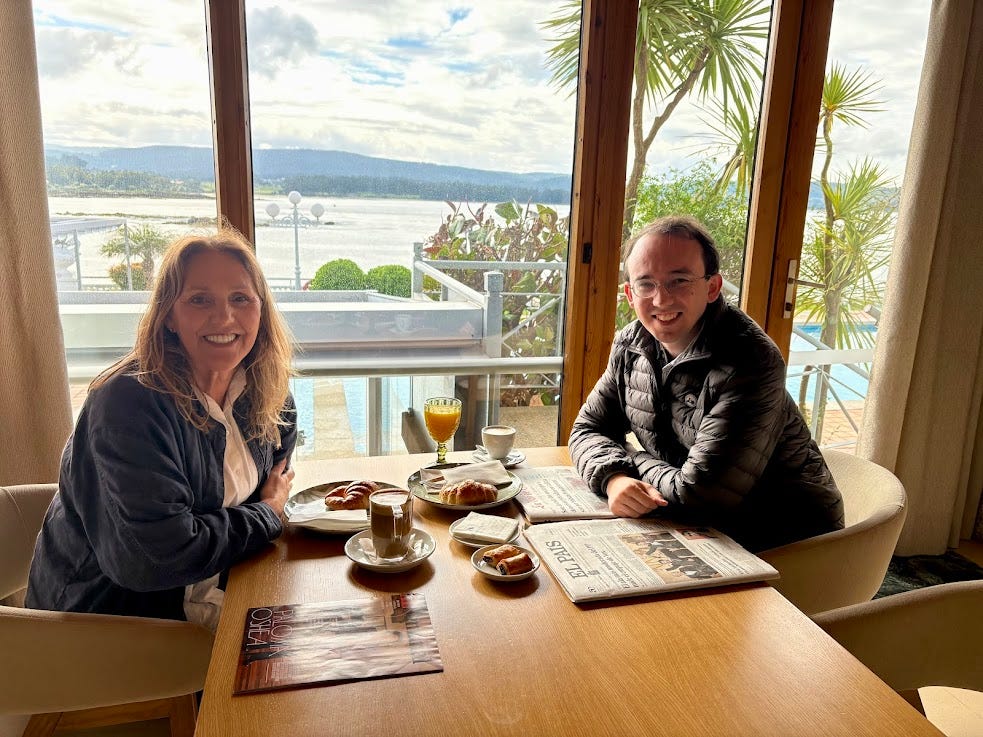
On Sunday, I had breakfast with my mom with beautiful views from the café at the Louxo Hotel on La Toja Island.
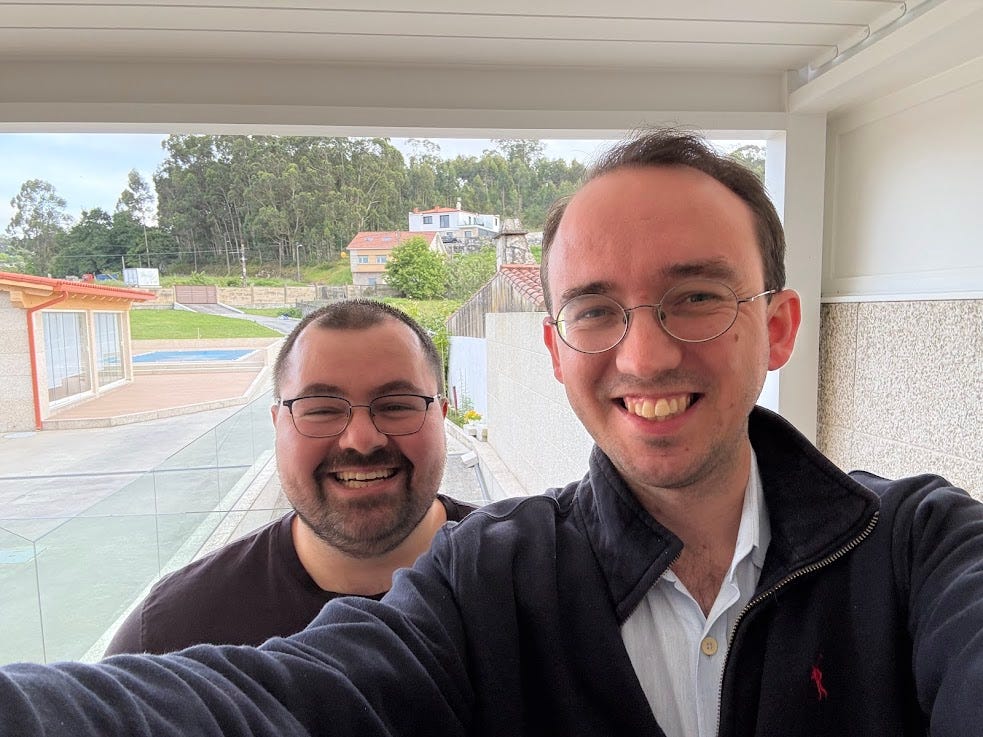
On Tuesday, I got to spend some time with my friend Marco, who’s building software from O Grove for the world. Always great catching up with him. He’s currently looking for a new role, and I’m sure he’s going to crush his next adventure whatever it ends up being.
📖📺🍿 Currently Reading, Watching, Listening
Saw Pixar’s Hoppers this week. Reinventing the classic environmental “humans vs. animals” story is tough, but I think the movie manages to do it without coming across as preachy because it’s more interested in opening a conversation than delivering a lecture. It’s packed with twists, moves at a great pace, and has a lot of humor and heart. Definitely a fun family movie. I also noticed some evolution in the animation style, which I really appreciated, while still preserving the core Pixar feel. It’s not a masterpiece or anything revolutionary, but to me it does recapture a bit of the magic of old-school Pixar. I really hope they keep moving in this direction.

F1 is back in Canada this weekend. Hopefully we get another race like Miami, great on-track action, real racing, and a sign that the worst of the early races is behind us. Canada has almost everything: high-speed sections, heavy braking zones, demanding chicanes, tons of speed, and that constant feeling that you’re one mistake away from the wall. It has that sense of risk that makes F1 special. Personally, I’m getting a bit tired of all the discussion around the “new F1,” the regulations, and the technical side of things. Since Miami, I’ve been hoping the focus shifts back toward the human element, the drivers, the battles on track, and the real emotion of Formula 1. For example, I’m really looking forward to the Antonelli vs. Russell battle, seeing whether Mercedes takes a real step forward with the latest upgrade package, or whether Ferrari and McLaren stay close enough that the field tightens up. I’m also curious to see if Carlos can keep the momentum going and whether Aston Martin can finally climb out of the hole they’ve been stuck in.

This interview with Erik Varden left me thinking long after I finished reading it. I found myself going back to several of his answers. He always seems to offer a fresh perspective. Sharing it here in case it resonates with you as deeply as it did with me.
💬 Quotable
A human life is a drawn-out affair. And things take time. Great things take time. That’s a principle that Newman liked to stress. And to be human is a great thing.
― Erik Varden
🌐 Cool things from around the internet
A collection of links to stuff I think are worth sharing.
🔗 Bose SoundLink Micro Portable Speaker (2nd Gen) — it probably won’t surprise anyone that one of my hobbies is listening to podcasts and learning from them. While looking for a speaker for a car I drive in Houston that doesn’t have Bluetooth, I came across the Bose SoundLink Micro (2nd gen), and honestly, the sound quality is amazing. Definitely going to get a lot of use out of it.
🔗 Sketchplanations — if you’re into cartoons, take a look at this artist (and a great talk here, about his process). He explains ideas through drawings in a really engaging way.
🔗 Cristine Bedfor — absolutely love this guest house in Seville.
🔗 Fellow — kind of obsessed with Fellow products right now.
🔗 It Builds in Seconds — entire buildings going up in seconds. Fascinating account.

Issue #45 of Computing Education Things was written while listening to:
🔗 Quick Links
🎧 Listen to Computing Education Things Podcast
💌 Let’s talk: I’m on LinkedIn or Instagram
If you’re enjoying Computing Education Things, please like, comment, or share this post! You can also support this work through Buy Me A Coffee. And if you’re finding value in the newsletter, consider forwarding it to a friend, colleague, or family member to help the community keep growing. Thanks for reading!