

#32 — AI can’t add flavor to Computing Education
The hidden power of human values

Reflections
Salt and AI

In Matthew 5:13–16, Jesus encourages his disciples to be salt in the midst of the world. I’ve always found that image powerful—salt is what gives food its flavor. In family life, in our relationships, in the classroom, in our daily work—in all things—we each have the ability to add that kind of flavor to the moments we share. And we do it in our own way: through our personality, our sense of humor, our presence, and our human values.
In today’s AI-centric world, we may need those “human ingredients” more than ever: joy, humor, deep listening, humility, collaboration, empathy, attention to small details, a word of comfort, the right advice at the right time. These are things AI simply cannot offer. We can sense that AI, for all its power, lacks flavor. Only we can bring depth and richness to Computing Education. Think of the local store customers choose not because they can’t buy the same products online, but because of the warmth of the service, the care, the personal attention—the sense that everything is done with love.
This “salt” is what restores flavor for those who feel disengaged by AI, helping preserve integrity not just in how we think, but also in how we act. Often these values go unnoticed, like a pinch of salt you never see but that transforms the whole dish. The same is true in Computing Education. Our pedagogy should cultivate the human values our moment so desperately needs. But to cultivate them in our students, we must first live them ourselves. If our classes have more flavor because they are engaging, because we serve with heart, carry a good attitude, and help each student leave with greater clarity than they came with—that alone makes the work worthwhile.
Only a few days remain before the deadline to apply for WG10 at ITiCSE 2026 (Teamwork in Computing Education: Skills, Values, and Virtues)— I’ve already applied!
A Lesser-Known Bottleneck in AI Scalability

In this week’s Numerical Analysis class, we covered interpolation and fitting, and it turned into a good opportunity to think about a question that keeps coming up in AI conversations: scalability.
That’s where this article by Paula Lamo, a former professor of mine from a Computer Technology course, fits in nicely. She explores a lesser-known bottleneck that’s increasingly shaping the limits of AI. It’s not just about how much electricity is consumed, but about a more subtle and deeply technical constraint: power electronics. As power density rises in the accelerators used to train and run AI models, managing and converting energy becomes a critical design challenge. Inefficiencies at this level lead to heat, instability, and hard physical limits that software alone can’t overcome.
Many of the infrastructure and cost issues we see today trace back to this very specific physical constraint. I found this piece especially valuable because it pushes back against the dominant narrative that places most of the emphasis on data and code, and instead highlights how the future of AI is increasingly constrained by physical and engineering realities.
Those who have lived in software land don’t realize they’re about to have a hard lesson in hardware - Elon Musk on the Dwarkesh podcast.
What skills do CS students need?
In the new job market shaped by AI, technical fluency alone is no longer enough. We need to think of AI not just as a tool, but as an “e-bike for the mind”—something that can extend our range, but also magnify our mistakes. In my opinion, it is important for CS students to develop four key skills:
Technical fluency: knowing how to use AI tools effectively, but also understanding how they work (and how they fail).
Ethical reasoning: the ability to wrestle with real trade-offs and to think seriously about societal, environmental, and human consequences.
Creative agency: using AI to expand human capability rather than outsourcing thinking to it—maintaining ownership over ideas, design, and direction.
Critical judgment: knowing when to trust, verify, or reject AI outputs, and even when not to build something at all.
If we want to prepare the next generation of computer scientists thoughtfully, CS educators should make space to intentionally teach and model these four capacities—not just as complementary topics, but as important parts of a well-rounded formation.

🔍 Resources for Learning CS
→ Rendering ASCII art
A technical article on high-fidelity ASCII rendering by Alex Harri that’s also a beautiful exercise in craft, full of 6D vectors, directional contrast tweaks, and a satisfying obsession with crisp edges.
→ Building a Trustworthy AI Data Agent
This post explains how OpenAI built an internal AI “data agent” that lets employees analyze large datasets using natural language. It’s a concrete look at what it takes to make AI genuinely useful for day-to-day analytics while preserving reliability, debuggability, and trust.
→ Find your next chart inspiration using AI
This project lets you search TidyTuesday contributions, Datawrapper’s Data Viz Dispatch, and FlowingData using natural language to find examples of specific visualization types, encodings, chart elements, statistical methods, datasets, and more.
→ How is data stored?
Dan Hollick explores how data is physically stored in computers, explaining the trade-offs between technologies like SRAM, DRAM, SSDs, and HDDs. He shows how memory architecture balances speed, capacity, power, and permanence—and why software is ultimately constrained by hardware design decisions.
🔍 Resources for Teaching CS
→ Accessibility for everyone
Designing for accessibility is a valuable skill in UX, and if you teach HCI and cover accessibility, you can now read Accessibility for Everyone by Laura Kalbag for free online.
→ Thinking critically about AI literacy
I loved this episode on thinking critically when someone is talking about AI literacy. It points out historical parallels with web literacy, where we didn’t know what it was and taught students very bad practices instead of waiting for research to determine what it should be.
→ Open Visualization Academy
I love this project. I think Alberto Cairo is a clear example of how an academic can go beyond the classroom and make a real impact by sharing knowledge through online academies like this one, while also building a strong sense of community among fellow academics and data visualization professionals.
🦄 Quick bytes from the industry
→ Adam Ernst’s Career Journey (Meta IC9)

Adam Ernst graduated in Computer Science from Princeton in 2010 and joined Meta in 2012, just ahead of the company’s IPO, during the mobile rewrite era. He has since spent more than 13 years at Meta, where he is now a Distinguished Engineer (IC9), building and leading critical iOS infrastructure with company-wide impact. In this conversation, Adam walks through his career—from early projects to ambitious platform bets—sharing concrete lessons on growing as an individual contributor, influencing without authority, and learning from both success and failure.
Early Builder Mindset
Adam’s trajectory starts long before Meta: as a middle-schooler he built and sold a real product (“Cosmic Soft”)—online testing software for teachers—using a beginner-friendly tool (RealBasic). He even handled payments through a proto-Stripe service (eSellerate) and accepted checks by mail, emailing license codes back. My takeaway: build something useful, get it into the world, learn by shipping.
Scaling iOS at Facebook
He joined Facebook in 2012 (right before the IPO) during the shift from an HTML5 app to a native rewrite—an environment where scaling problems created unusually large opportunities. His early impact came from replacing Apple’s CoreData, which didn’t scale to a rapidly growing iOS org. The key lesson: architect for scale while enabling incremental adoption (e.g., immutable “memmodels” to reason about thread safety and change safely across a fast-moving codebase).
Influence without authority
A recurring theme is how Adam persuades other software engineers without formal power: talk live when possible, acknowledge the other side’s worldview (“I like vanilla Apple frameworks too”), and arrive with data (even reverse-engineering black-box behavior when needed). His most effective tactic: do the work for people—show up with a migration or fix already implemented so the task becomes “approve” rather than “take on a huge task.” He applies that same influence model through code review, treating it as a concrete forum for technical dialogue—using real diffs to explain trade-offs, surface assumptions, and shape how other software engineers reason about code.
High-stakes platform bets
Adam’s senior-career arc is shaped by high-risk, platform-level bets. With ComponentKit, he helped introduce React-inspired declarative UI ideas to iOS years before SwiftUI or React Native, addressing News Feed complexity through components, immutability, and better performance—while navigating significant internal skepticism and the need for sustained buy-in across teams. The counterweight was ComponentScript, a cross-platform framework that was technically sound but failed to gain traction. Adam is explicit about why: unclear target users, real adoption friction, and ecosystem dynamics mattered as much as the quality of the architecture itself. His takeaway is clear and hard-earned: strong technical ideas still fail without alignment, incentives, and momentum—and senior engineers must be willing to shut projects down responsibly when they don’t work.
Technical Depth
Rather than chasing trends or frequently switching domains, Adam deliberately stayed deep in mobile infrastructure, allowing real problems to pull him into adjacent systems when needed. When blocked by GraphQL, build tooling, or codegen, he didn’t escalate—he dove in, traced the issue several layers deep, and either fixed it himself or arrived with a precise diagnosis. Over time, this pattern compounded into broad system knowledge rooted in necessity. Combined with his bias toward writing and reviewing real code, that depth became his leverage as an IC: influence earned through proximity to the work, not through titles or constant reinvention.
→ Bots, Agents, and Leverage
In this conversation with Aman Manazir, Ritesh Verma explains how he went from a traditional computer science path (University of Maryland, internship and full-time offer at Capital One) to making more from side hustles than from his six-figure software engineering job. His journey started with experimentation: a viral SAT YouTube channel in college, then niche automation projects like checkout bots that attracted high-paying clients.
Over time, he realized that what people now call “AI agents” are often just automation software with an AI layer—the evolution of the same bots he had been building for years. To him, the technical barrier is lower than people think. Tools like no-code automation platforms, web automation libraries, and AI-assisted coding environments mean that most software engineers already have more than enough skill to compete.
Computer science students are the best people to do this because of their unique advantage over anyone else.
The real differentiator is identifying a clear problem, packaging a solution quickly, and getting it in front of buyers. He repeatedly emphasizes that many profitable agents are simple: AI chatbots trained on a company’s website to capture leads instantly, automated content systems for e-commerce brands, or niche workflows that save small businesses hours of manual work. His playbook is deliberately practical: start with a niche you can access, find a time-consuming process, build a live demo, price it low enough to remove friction for the first customer, capture a video testimonial, and turn that into a landing page. He stresses that credibility compounds: once you have one paying client and proof of results, the second and third come much faster. Instead of building a perfect product in isolation, he advocates building in public and using real-world case studies as marketing fuel.
Distribution, in his view, is the true moat. Short-form content can generate attention quickly. X (Twitter) allows builders to tap into “build in public” communities. But he highlights Reddit as especially powerful: transparent posts about revenue milestones or lessons learned—without links, calls-to-action, or overt selling—can drive serious inbound leads. If the story is compelling enough, prospects will find a way to reach out.
Underneath the tactics is a broader philosophy. Ritesh sees this path not as hype, but as economic self-defense in a market defined by layoffs, shrinking junior roles, and increasing automation inside large companies. In his view, software engineers should treat side hustles not as hobbies but as leverage—cash-flowing systems that reduce dependence on a single employer. And if someone chooses to leave a salaried role, he suggests a simple rule: don’t quit for the dream—quit when the business reliably earns two to three times your salary.
🌎 Computing Education Community
Khoury College of Computer Sciences at Northeastern University is recruiting a Director of Computing Programs (Associate/Full Teaching Professor) for its Northeastern University Oakland Campus, starting July or September 2026 (apply via HigherEdJobs).
A new community on Epistemic Programming—programming for gaining insights—is forming! ITiCSE 2026 Working Group 7 is now recruiting participants. Apply by February 16 to join this in-person collaboration, taking place July 10–12 in Madrid.
The Florida International University College of Engineering and Computing is hiring a tenured/tenure-track Associate or Full Professor in the Multidisciplinary Engineering & Computing Education, Systems, and Management Department, with a strong interest in computing education (review begins today Feb. 13).
If you’ll be in St. Louis for SIGCSE Technical Symposium 2026, seats are still available for the affiliated event “Innovations and Opportunities in Liberal Arts Computing Education”.
The University of Pittsburgh Department of Computer Science is hiring two Teaching Assistant Professors to support in-person and online teaching—especially for adult learners.
La Salle University is hiring a Non-Tenure-Track Assistant Professor in Computer Science starting Fall 2026 to teach across CS, IT, Cybersecurity (and possibly AI/CIS graduate programs), with application review beginning Feb. 20, 2026.
ICER 2026 deadline reminder: abstracts for Research Papers are due February 20, 2026.
Koli Calling 2025 highlights: the keynote by R. Benjamin Shapiro, “The Coin Has Three Sides: Human–Computer Symbiosis in the Future of Computing Education,” set the tone, with Best Paper awarded to Henriikka Vartiainen & Matti Tedre, Best Presentation to Naaz Sibia et al., and Best Poster to Radu Mariescu-Istodor & Anssi Gröhn.
The California State University, Fresno Department of Computer Science is hiring a tenure-track Assistant Professor starting AY 2026–27, with priority areas including Computer Science Education, Cloud Computing, Theory, Cybersecurity, and AI (review begins March 1, 2026).
If you’re attending the SIGCSE Technical Symposium 2026 in St. Louis, consider joining the ACM Committee for Computing Education in Community Colleges for the CS Transfer 2Y Curricula Focus Group on Saturday, February 21, from 3:30 to 6:30 PM.
The ACM Education Board invites you to complete a brief survey on first-year CS student preparedness to help inform community-wide recommendations.
CSEd research students are invited to the CSEdRStudent Network online meetup on Feb 19, 2026 (6 pm GMT) to discuss Open Research with Laurie Gale from the Raspberry Pi Computing Education Research Centre (message Katharine Childs or Nicola Looker to join).
This Spring instructors can pilot an NSF-funded web app that brings peer instruction to asynchronous courses: integrating the tool into a class, collaborating with the research team, and receiving a $500 VISA gift card in appreciation for their participation.
Instructors attending SIGCSE are invited to a Feb 18 focus group (4–5 pm CST) on AI-augmented, performance-based assessment. Participants will receive a $100 gift card after the session and brief survey.
Westminster College seeks a tenure-track Computer Science faculty member (AI/ML focus) starting August 2026; full consideration by March 6, 2026.
Join SIGCSE Reads in St. Louis next week—attend the Friday 10:40 a.m. panel in Room 276 on persisting and empowering in CS education, explore this year’s selections (including Whistleblower by Susan Fowler, Service Model by Adrian Tchaikovsky, Annalee Newitz’s short story “When Robot and Crow Saved East Saint Louis,” or the Modern Figures Podcast), and share your ideas for next year’s read via the survey.
Kai Williams and Timothy B. Lee (Understanding AI) are looking to speak today with roboticists and software engineers/product managers about robotics and the recent progress of coding agents. Sign up for a time slot on their calendars (robotics | coding agents).
The Department of Computer Science at UMD is hiring a faculty member to lead curriculum innovation and course development focused on the impact of AI tools in computer science education, alongside a standard teaching load.
🤔 Thought(s) For You to Ponder…
What Alejandro Mora says in afueradentro ties into what I talked about in last week’s newsletter—about drawing from other disciplines so we don’t end up living in a bubble: Having a hobby changes your Instagram algorithm, so you’re not constantly seeing the same stuff. For anyone working in the cultural or creative industries, it’s important to be immersed in different things.
Interesting thread by Boris Cherny with some tips on how to get the most out of Claude Code. Along those lines, I loved this article by Mitchell Hashimoto about his journey adopting AI into his workflow.
Heard here: Andrej Karpathy is a great professor — it’s hard to find someone so technical who can explain things so clearly.
A highlight from ACM’s interview with Pei Cao, VP of Engineering at YouTube: Computer science is a fast-changing field. Every decade brings new challenges that require communities of researchers to solve. As you advance in your career, you won’t always work in the technical subareas in which you were trained. But a solid computer science foundation will enable you to learn any subfield of computer science quickly and then make contributions. So be prepared to learn continuously and don’t be afraid to venture into new areas.
Brendan Gregg is joining OpenAI. What a gig! There are very few places right now where the link between system performance and real business value is as strong as it is there.
I loved this piece from Julian Lehr, Creative Director at Linear, laying out a thoughtful case against conversational interfaces.

In the new version of Mozilla, set to release on February 24, you’ll be able to turn AI tools on or off. It looks like they’re trying to stand out from the competition by giving users the option to have a more controlled experience—based on their own preferences.
Thought-provoking piece from Josh Brake on what Cosmos calls the philosopher-builder.
At Mudd, the humanities, social sciences, and the arts are integrated throughout the curriculum. Students take them throughout their degree alongside their technical courses. Mudd’s core curriculum exposes students to fields across science, engineering, and mathematics. Breadth is a feature, not a bug.
If the first duty of the educator is formational, the question we need to ask is not “what are they learning?” but “who are they becoming?” What habits and practices are we helping our students to cultivate? What questions are we teaching them to ask?

A great quote from Kevin Kelly that touches on the paradox of choice:
We have not yet and never will, make a technology that we cannot abuse or weaponize. And I’ve been saying this for a while saying, Oh, and by the way, the most powerful technology that we just invented, the internet, we’re going to weaponize and we’re going to abuse it. It’s going to be abused powerfully. And this is the thing, the more powerful the technology, the more powerfully it will be abused. That’s the nature of it. AI, man, it will be really abused. However, and this is the curious thing, even those abuses of technology are increased choices. When the first humanoid picked up a rock and turns it into a hammer, either to make a shelter or to kill his brother, he suddenly had a new choice he never had before. That choice is good.
This piece from Every introduces compound engineering, a model where AI writes the code and software engineering centers on a four-step loop: plan, work, assess, and compound. Its key idea is that value now lies in planning and review, while accumulated agent learning makes each new feature easier to build.
Brilliant video by Jared Henderson tracing how our attention was monetized and arguing we should reclaim it as something we consciously choose to care about.
Looking back to when I wrote about the Orchestrator of skills in this post, this week Eduardo Diaz dives deeper into this new orchestrator role—how to know what to ask for, what context to provide, and when to step in…
VS Code extensions with sidebars are gradually becoming obsolete due to the new agent-based CLI workflow.
Hinton is Second Scientist With Over 1 Million Citations.
📌 Research Corner
This week, I attended two computer science seminars at UH. One of them presented by Gen Li, a third-year Ph.D. student at Clemson University, where he focused on the evolution of modern AI models and the growing challenges related to efficiency, safety, and real-world deployment and where he shared concrete research on dynamic sparse training, selective unlearning, and adversarial defenses—techniques that help make large models more practical, robust, and trustworthy under real-world constraints. The second seminar, given by Jerry Yao-Chieh Hu from Northwestern, took a more theoretical turn, offering a unifying view of what transformers actually do. He framed transformers around two core capabilities—memory and procedure execution—showing how attention can be interpreted as a physical memory retrieval process and how a single fixed model can act as a universal program executor when prompts are treated as programs. The talk connected deep theory with large-scale scientific applications in genomics and astrophysics, shedding light on why foundation models generalize so effectively across tasks.
I learned a lot from these two potential UH tenure-track faculty members.
Next week, from February 18 to 21, I’ll be attending the SIGCSE TS 2026 conference in St. Louis, Missouri. It’ll be my first time attending as a PhD student. If you’re around, feel free to say hi! I would love to talk computing education, AI in programming, etc.
Found a solid example of how clearly articulating the process can be powerful marketing for research.
What AI tools do you use for your literature review? If you’d like to see mine, I’ve put together a list here:
LLMs: Claude, ChatGPT, Gemini, Manus AI, Perplexity
🪁 Leisure Line
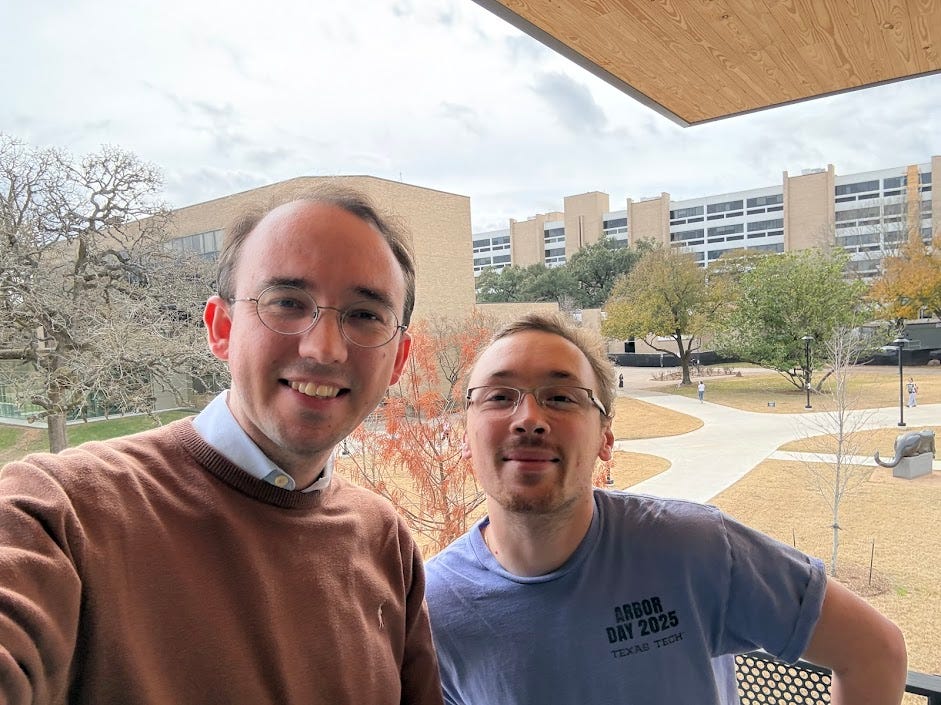
Great weather and blue skies are back in Houston. Nothing beats coffee with a view and a good conversation with Nick Anderson (PhD at UH CS) about life, research, and what’s ahead.
📖📺🍿 Currently Reading, Watching, Listening
This week, I watched Ordinary Angels—a beautiful movie based on a true story. Highly recommended!

Great podcast in Spanish: Chisme Corporativo—it has a really fun storytelling style to share the story of a company. It reminded me of Acquired Podcast. You end up learning the company’s history almost without realizing it. It’s hosted by two Mexican women with that sort of “posh” tone, which I think actually makes the content even more engaging. Plus, both of them have entrepreneurial backgrounds, and it really shows when they speak.
These two men are among my favorite living thinkers, so I absolutely loved their recent conversation.
If, as Brooks puts it, “all the things we care about in life are complex,” then learning computer science must be complex too. You don’t “solve” a marriage once and for all—“I’ll never solve my marriage. I can only live in my marriage.” In the same way, you don’t solve CS and move on; you live in it, wrestle with it, grow through it. The confusion, the bugs, the conceptual friction—those aren’t obstacles to learning. They are THE learning. In complex domains, you cannot skip the difficulty.
I highly recommend the BBC podcast Desert Island Discs, where each guest is asked to imagine they’re stranded on a deserted island. They have to choose eight albums, one book, and one personal item. Through their choices, you get a deep, revealing portrait of the castaway featured in each episode. What we listen to, what we read, and the story behind those choices say a lot about who we are!
🌐 Cool things from around the internet
🔗 Archivio Grafica Italiana — the first online archive dedicated to the entire Italian graphic design heritage.
🔗 25 years of Wikipedia — do you know how Wikipedia started?
🔗 S.C. GJØA — how Athletics rebuilt the brand of New York’s oldest youth soccer club.
🔗 Moody — a smart prompter in your Mac’s notch.
🔗 Parse.bot — turn any website into an API.

Issue #32 of Computing Education Things was written while listening to:
🔗 Quick Links
🎧 Listen to Computing Education Things Podcast
💌 Let’s talk: I’m on LinkedIn or Instagram
If you’re enjoying Computing Education Things, please like, comment, or share this post! You can also support this work through Buy Me A Coffee. And if you’re finding value in the newsletter, consider forwarding it to a friend, colleague, or family member to help the community keep growing. Thanks for reading!