

#49 — Programming as a Hobby, Excellent Sheep, and Educational Relationships
On programming as a career, the search for meaning, and making room for stronger professor-student relationships

Reflections

I enjoy Nate Gentile’s content. He strikes a great balance between deep technical knowledge and the ability to explain complex topics clearly. On top of that, he keeps raising the bar in terms of production quality. Huge respect for creators who keep investing in taking their work to the next level. And thanks to Tengo un Plan for having him on. Great conversation.
Programming May Become the New Horseback Riding
AI is extremely good at software development.
Before AI, you had to learn how to think like a machine and communicate with it through a language with specific rules and structures. Becoming a good software engineer required years of practice. You had to learn a particular way of thinking, organizing projects, and designing systems.
Now, AI can handle a huge amount of the implementation work for you. That changes everything.
Nate argues that software development is one of the areas where AI has had the biggest impact. In his view, the industry has changed almost overnight, and there’s no going back.
There are already companies where programmers rarely write code directly. Some senior engineers spend much of their time reviewing, editing, and guiding agents rather than implementing everything themselves.
The logical and architectural thinking still matters, though. Software Engineers still need to know how to build software and structure projects, but the burden of implementation has changed dramatically.
AI isn’t perfect. It still has limitations. But it’s improving at an astonishing pace.
Interestingly, companies are approaching AI adoption very differently:
Some actively encourage it and provide company-wide access.
Some expect employees to find ways to integrate AI into their workflows.
Some employees are pushing adoption from the bottom up because they already use these tools at home.
Others still discourage or even prohibit AI use entirely.
All three approaches coexist.
In Silicon Valley and many leading tech companies, the dominant attitude is often:
Here are the tools. Use them however you find most effective.
What surprised Nate is that many organizations still don’t have clear best practices. Even at major companies, employees are often given access to AI tools and told to experiment rather than receiving detailed training.
Everything is still evolving.
What seems increasingly clear is that AI is already being used extensively to build applications, websites, backend systems, and software of all kinds. Its impact is difficult to deny.
The open question is how to use it best.
That leads to a concern Nate raises repeatedly:
Those of us who learned software development before AI spent years writing code, debugging systems, and understanding how things work under the hood. We can usually inspect AI-generated code and understand the architecture behind it.
But what happens to future developers who never go through that process?
What should we teach beginners?
Perhaps some traditional skills will become less important. Perhaps some will disappear altogether. But there will still be situations where deep understanding of systems matters.
Nate referenced a comparison made by David Heinemeier Hansson, creator of Ruby on Rails:
Programming may eventually become like horseback riding. People still ride horses today, not because they need them for transportation, but because they enjoy it.
Traditional programming might eventually become something similar: a craft that some people continue to enjoy even when it is no longer required to build software.
The illusion of productivity
One of Nate’s most interesting observations is that AI tends to amplify existing strengths.
People who already understand a domain often become significantly more productive.
People who don’t understand the domain may gain a false sense of competence.
Someone with expertise can design the solution, evaluate tradeoffs, and recognize mistakes. AI then handles much of the tedious implementation work.
Nate compares it to architecture:
I’m the architect. AI is the construction crew.
I create the plans. AI builds the house.
What’s remarkable is that AI can also act as an advisor during the design process. It can provide ideas, references, and feedback while simultaneously helping execute the work.
However, there remains a gap:
The human part.
AI can retrieve information and generate outputs, but humans still provide judgment, context, goals, and meaning.
Nate also mentioned something many people have experienced:
A growing sense of dependence.
Tasks that we used to perform confidently now trigger the thought:
Maybe I should ask the AI first.
Even when we already possess the necessary expertise.
His concern is not that AI will make us less productive.
His concern is that we may gradually stop exercising our own thinking.
He drew an analogy with physical exercise:
Previous generations didn’t need gyms because daily life naturally involved physical labor and movement.
Modern life removed much of that activity, so we now exercise intentionally to stay healthy.
The same thing could happen cognitively.
If AI increasingly handles thinking for us, we may need deliberate ways to exercise our minds.
Maybe we’ll need a mental gym someday.
It’s a provocative idea.
Exploring AI Content Effectiveness
Nate argues that AI-generated content often struggles with something fundamentally human:
The sense that someone cared.
When people encounter advertisements, videos, images, or creative work that appears to have been generated with minimal effort, they often perceive:
Opportunism
Lack of dedication
Lack of craftsmanship
Lack of care
The technical quality may be impressive, but something can still feel missing.
In many creative domains, audiences aren’t only evaluating the final product. They’re responding to the human intention and effort behind it.
That’s why, even as AI capabilities improve, the human element remains difficult to replace. It isn’t just about producing content; it’s about conveying attention, commitment, and care.
Excellent Sheep
William Deresiewicz coined the term Excellent Sheep to describe a generation of students who excel at playing the academic game but often struggle to answer a more fundamental question: Why am I doing all of this? His central concern is the gap between achievement and purpose. Students learn how to ace exams, build impressive résumés, and collect extracurricular accomplishments, yet many never develop a clear sense of direction or an examined vision of the life they want to live.
According to Deresiewicz, this problem begins long before college. The admissions race encourages families to start accumulating credentials at an increasingly young age. Standardized test preparation, advanced courses, leadership positions, volunteer activities, and carefully curated résumés become part of an endless competition in which slowing down can feel like falling behind. As a result, childhood and adolescence are transformed into a series of strategic steps designed to maximize future opportunities.
The consequences are significant. Students become highly skilled at meeting external expectations but often grow anxious, risk-averse, and dependent on validation. Activities that once had intrinsic value are redefined as résumé builders. Service becomes a credential, leadership becomes a status marker, and even artistic pursuits can be reduced to achievements that look good on an application. In the process, many students begin to feel disconnected from the deeper reasons they once had for pursuing those activities.
Getting into an elite college, Deresiewicz argues, is often a false summit. The moment one goal is achieved, another immediately appears: prestigious internships, consulting firms, finance jobs, graduate programs, or top technology companies. Achievement simply generates new forms of achievement. The cycle continues, but the underlying question of purpose remains unanswered.
His proposed alternative is to pursue a vocation rather than merely a career. He encourages young people to pay attention to the activities that genuinely engage them, the things they would do even without external rewards or recognition. This does not mean ignoring practical realities—everyone needs to make a living—but it does mean trying to bring one’s work into closer alignment with one’s deepest interests and values.
Deresiewicz also offers practical advice. Give yourself time. Treat your twenties as a period of exploration rather than optimization. Take small risks. Resist the temptation to see your résumé as a blueprint for your future. Make room for friendships, family, leisure, and unstructured time. Some of the most important discoveries about who we are happen when we are not chasing the next achievement.
Underlying all of this is a defense of the liberal arts. Their value, he argues, is not primarily vocational. They teach people how to think, write, reason, question assumptions, and take intellectual initiative. These capacities remain useful regardless of profession and help individuals develop a richer understanding of themselves and the world.
Despite his critique, Deresiewicz ends on a hopeful note. Institutions may reward certain behaviors, but students have more freedom than they often realize. With courage, supportive relationships, and a willingness to make deliberate choices, it is possible to resist the résumé arms race and pursue a life defined more by meaning than by credentials.
Making Room for Human Connection in Universities
This week I read a paper by two researchers from Elon University (no, not that Elon), and it opens with the following quote:
Decades of research demonstrate that educational relationships are central to student learning, motivation, well-being, and persistence in higher education.
I’ve always believed that meaningful contact with professors matters. It not only improves academic outcomes, but also contributes to students’ confidence, sense of belonging, and long-term success.
At the same time, the article made me wonder how much we actually do, as universities, to make these encounters possible and to make education more human.
It’s true that a strong professor-student relationship isn’t something that can simply be captured in a dashboard or managed through a system. It depends largely on the initiative, generosity, and availability of the professor. But it’s also true that if a university genuinely believes those relationships are central to education, it cannot design a system that works against them.
A professor can only build meaningful relationships with students if there is enough time and space for those interactions to happen. If both the student and the professor have to rush off immediately after class to the next meeting, lecture, or obligation, even a brief conversation becomes difficult.
That is why having time and space around the classroom matters. The opportunity to sit down, talk, and be present with students is not a luxury, it is part of the educational process itself.
If relationships matter, then the system should be designed to make room for them. Education should be structured around time, attention, and human presence.

🔍 Resources for Learning and Teaching Computing
→ The Long Road of RL
In this episode of CoRecursive, Adam Gordon Bell and Don McKay explore the history of reinforcement learning, from Sutton’s early ideas to AlphaGo’s famous victory over human champions. The key theme is Richard Sutton’s Bitter Lesson: systems that learn through reward and massive computation often outperform approaches built around human knowledge and handcrafted rules. A great historical perspective on why RL looks the way it does today.
→ A Hands-On Course on LLMs
A course that takes you from zero to deploying an LLM-based system in production: fundamentals, RAG, agents, observability, and much more. It’s bilingual (Spanish and English), provider-agnostic (Claude, GPT, Gemini, DeepSeek, and others), and released under the MIT License, so there’s no paywall. Fourteen modules and roughly thirty hours of content.
🦄 Quick bytes from the industry
→ How to Land a Frontier Lab Job with Vlad Feinberg
The research skill set is going to become increasingly important. These are exactly the kinds of skills you develop during a PhD.
If you’re a software engineer looking for new challenges, there’s a huge opportunity right now in frontier labs, especially in areas like pre-training and post-training. Think of it this way: if you have strong skills in backend engineering, infrastructure, or distributed systems, consider how you can transfer that expertise to an applied AI or research team.
Great insights and very inspiring!
→ ML Job Interviews: The Ultimate Guide
Here’s a practical look at today’s tech interview process from a ML perspective. Silvia Sapora breaks down the differences between startup and big-tech hiring, effective interview prep strategies, ML learning resources, mock interviews, salary negotiation, and the key lessons she’d take with her into her next job search.
On that note, Papers With Code has a new website! It’s still in the early stages, but it looks promising for keeping up with fast-moving ML research.
→ An inside look at the smartphone business
After listening to Nate Gentile, where he talked a bit about Nothing, I got curious and ended up finding this episode from Itnig with David Sanmartin.
It turns out that Nothing is a London-based company founded by Carl Pei, the former co-founder of OnePlus. They’re trying to stand out through their transparent design language, branding, and overall narrative.
I haven’t tried any of their products myself, but from what I’ve read, their audio devices are supposed to offer very good sound quality, although their noise cancellation reportedly falls a bit short of Apple’s AirPods.
Nothing also makes smartphones, which is a pretty ambitious move given that they’re competing against giants like Apple and Xiaomi.
I liked this initial step (Nothing Playground) toward making the OS adapt to the user.
🌎 Computing Education Community
On June 25, ACM will host a TechTalk with Guglielmo Iozzia exploring the business potential of small, domain-specific language models.
The ICER 2026 Works-in-Progress (WiP) Workshop offers a dedicated space for established computing education researchers to receive constructive feedback from peers. Participants work in small groups, sharing early-stage ideas, ongoing projects, rejected papers, methodological challenges, or theoretical framings, with the goal of improving research through focused discussion before the main ICER conference. Shared by Joseph Maguire and Sue Sentance.
The SIGCSE TS 2027 Program Committee is looking for volunteer reviewers.
Researchers from Creighton University, RIT, and Western Washington University are recruiting computing instructors for a study on integrating accessibility into undergraduate computing courses. Participants will attend a two-day training workshop, develop accessibility-focused teaching materials, receive ongoing support throughout the academic year, and contribute to research on evidence-based instructional practices. The study includes up to $500 compensation and travel support for in-person attendees. Shared by Catherine Baker, Kristen Shinohara, Yasmine Elglaly, and Rolando Mendez.
The University of Portland is recruiting for a faculty position in engineering/computing through its Shiley School of Engineering. Shared by Joseph Hoffbeck.
CRA-E is launching a new regional summit for teaching-track faculty in computing on June 30 in Chicago. Shared by Borja Sotomayor.
🤔 Thought(s) For You to Ponder…
Restore Britain is likely to do very well in the UK. They seem poised to capitalize on the current wave of social unrest and public frustration. Immigration has become a particularly contentious issue, and the overall situation feels increasingly tense.
From this interview on Rebeldes Podcast, one idea from Quique Mira particularly stood out to me: the importance of nurturing our relationship with Jesus every day. Setting aside time for prayer, embracing silence, and reading the Gospel gradually transforms the way we see reality, helping us see things as God sees them.
Other takeaways:
Dating is a journey of discernment. It requires effort and intentionality.
Learn to embrace the other person’s limitations.
The value of exclusivity in this season of life. Fall in love with God’s vision of chastity. Fall in love with the proposal itself. Christ desires our happiness.
Relationships can make it difficult to see clearly. Sometimes it’s hard to know whether you are with someone for who they are or for what they give you.
If someone is capable of waiting, that says a great deal about their character and commitment.
Sex is something good when it is ordered within love.
Chastity is not about repression; it is about rightly ordering our desires and affections.
It is important to distinguish between negotiable and non-negotiable differences. Personality traits and character quirks may often be workable, but shared values are essential. If there are serious red flags such as abuse it is better to end the relationship.
The speakers strongly encourage people to invest in their formation and education regarding dating, relationships, and marriage. For those interested in learning more about dating.
I love the way Pepa Fernández and her No es un día cualquiera team (RNE) make radio. To me, it’s a textbook example of how great radio can be done without relying on noise. The show’s rundown seems completely unhurried, giving everything the time it needs.
Mabel del Pozo:
The theater is a demanding master. This profession requires you to be willing to ride a constant roller coaster. The characters take over my life.
A fascinating article by Paula Lamo on biomedical signals in sports (soccer and tennis).
Data doesn’t replace the expert eye. It complements it or, perhaps more accurately, it disciplines it.
This brings clear advantages: better injury prevention, more individualized training, and less reliance on blind intuition. But it also introduces a new form of dependence. When the body becomes a dashboard, the risk is forgetting that not everything that matters can be measured.
There are days when an athlete looks “fine” according to the device but feels far from it. And there are other days when they perform beyond what the metrics would suggest is possible.
Possibly the best summary of Magnifica Humanitas that I’ve seen in Spanish (by Fr. Juan Carlos Vasconez):
Technology will never be able to reach into people’s hearts.
Shrivu Shankar argues that current models are already capable enough to power these end-to-end “software factories.” In his view, the main bottleneck is not the models themselves, but rather the lack of context (for example, well-maintained .md files) and robust testing. Whether or not he is right, what interests me is the shift in where human effort is invested. The focus is definitely no longer where it used to be.

Fable didn’t last very long. Let’s see how long it takes for it to come back.
Concha Monje on humanoid robots, speaking on A Vivir:
These robots are finding it easier and easier to get back on their feet. In fact, I’ve made quite a few videos of them falling down and getting back up, because that’s what interested me most. And they’re becoming more and more human-like in the way they recover their posture—the mechatronics side of it is largely a solved problem.”
It’s a combination of advanced AI programming, sophisticated mechanics, and careful fine-tuning.
A robot has to learn how to perform tasks in an unfamiliar environment, such as a home. In industrial settings, the learning curve is much more limited and controlled. There are still hardware challenges to overcome, particularly with components like actuators.
Beyond humanoid robots, there’s a whole world of robotics: drones, self-driving cars, medical applications, and much more.
Anthropic and pretty much every AI company wants you to keep agents running in 24/7 loops. But Sergio (Serudda) makes an important point in this video: every attempt costs tokens. Keep an eye on the spending. Configure, customize, and use good judgment.
Listening to the new episode of El primer vuelo by Pedro Blanco brought back memories of my trip to Naples in 2023.
Manu de la Chica believes that what Leo XIV will want to emphasize throughout his pontificate is the importance of recognizing our calling and vocation as human beings.

This master’s program from Fundación Tatiana looks very interesting. Bringing neuroscience and the humanities together seems like a powerful combination.
I’m still reflecting on what the Pope told us…
We need to cultivate an appreciation for silence.
Things happen in silence.
We need to protect ourselves so that we can direct our attention toward what truly matters and what we intentionally choose to focus on.
Very often, it is precisely in the experience of silence that God can speak to us, or where we can learn to discern His voice.
I never get tired of recommending No es el fin del mundo, the podcast from El Orden Mundial that I subscribe to. Kudos to Fernando Arancón, Eduardo Saldaña, and Alba Leiva for a job well done.
Some articles are worth slowing down for and reading carefully. This essay by David Cerdá is one of them.
It is in the tidied-up kitchen while everyone else is asleep, in the shirt neatly folded when no one will praise us for it, in the flowers placed in a vase when there is no feast day or birthday in sight. The gestures that do not build a reputation are the ones that truly reveal who we are.
The truth is that surrounding ourselves with a certain degree of order and cleanliness is a simple way of telling ourselves—and, by extension, the world—that reality deserves to be treated with care, even when no one is watching.
Want to push back against the noisy hall of distorted mirrors that is social media? Start with the kitchen. There is a special dignity in doing small things well; there is an accessible kind of transcendence in honoring the tasks that must be done again and again.
More than our big decisions, it is the small ones that shape us. Love is made up of these tiny acts; it requires fewer grand gestures and more meals prepared and cleaned up afterward. There is something beautiful about making life easier for another person. Leaving behind a trace of order is a remarkable calling card. A ray of light shines through our ordinary acts.
I’m excited to follow Paul Blaschko’s journey in the months ahead. It’s encouraging to see an entire generation of academics committed to doing meaningful and ambitious work at liberal arts colleges across the U.S., and that makes me very happy.

Marcela Duque wants to introduce slow reading into her classes next academic year. It seems that initiatives like Incarnatus, which seek to foster a more contemplative way of life, are not isolated efforts and are gaining momentum. She’d like to apply the four stages of lectio divina to any book whose truth and beauty contain something sacred within its pages.
An interesting discussion on remote work for people early in their careers. Alex Rayón makes a good point:
Remote work can be effective for those who already know how to work independently, understand how organizations operate, and have developed professional judgment over time. But for those just starting out, distance comes with a different cost—less feedback, less informal learning, and fewer small course corrections. Less opportunity to learn the craft, as my grandfather would have said.
The Next Platform: The biggest bottleneck for AI data centers is electricians! It’s a profession that’s in high demand right now.
Sam Altman’s brother is a GP at Benchmark and a Managing Partner at Alt Capital, so investing is very much his game. He also remains Chairman of Lattice. Here’s his story and the philosophy that guides his investment decisions:
I found this piece by Mónica Belda in The Conversation on teenage digital language quite interesting. My takeaway is that the key lies in understanding the context in which language is being used.
Great 7-minute clip of Ed Catmull:

UC Berkeley School of Law will completely prohibit the use of AI starting in Summer 2026.
Big fan of Radio Clásica on RNE. I listened to this episode featuring Eva Sandoval, Director of Radio Clásica, and really enjoyed it.
Classical music helps us live better. It is a necessary form of spiritual nourishment. It reconciles us with life because it is one of the most beautiful, sublime, and sophisticated creations of the human spirit.
It can be therapeutic and has something to offer in every stage and circumstance of life. It also trains us in other ways—helping us listen more attentively, cultivate patience, and develop greater empathy.
The passion we feel for it is something we try to share with others. It is a kind of music that lives within us.
📌 Research Corner
I’ve spent a good part of this week reading papers and dissertations. Here are a few that have influenced the paper I’m working on right now:
Students’ topic-specific difficulties in learning data structures and algorithms - Artturi Tilanterä
Scaling Assessment of Student Models with LLMs: Integrating Feedback into Practice - Maximilian Sölch, Stephan Krusche
Investigating the Role and Impact of Distractors on ParsonsProblems in CS1 Assessments - David H. Smith IV, Max Fowler, Craig Zilles
Runestone: A Platform for Free, On-line, and Interactive Ebooks - Barbara J. Ericson, Bradley N. Miller
Epplets: A Tool for Solving Parsons Puzzles - Amruth N. Kumar
Distractors in Parsons Problems Decrease Learning Efficiency for Young Novice Programmers - Kyle J. Harms, Jason Chen, Caitlin Kelleher
How Do Students Solve Parsons Programming Problems?— An Analysis of Interaction Traces - Juha Helminen, Petri Ihantola, Ville Karavirta, Lauri Malmi
A Review of Research on Parsons Problems - Yuemeng Du, Andrew Luxton-Reilly, Paul Denny
Automated assessment of programming assignments - Petri Ihantola
CodeTailor: LLM-Powered Personalized Parsons Puzzles for Engaging Support While Learning Programming - Xinying Hou, Zihan Wu, Xu Wang, Barbara J. Ericson
A Mobile Learning Application for Parsons Problems with Automatic Feedback - Ville Karavirta, Juha Helminen, Petri Ihantola
iSnap: Towards Intelligent Tutoring in NoviceProgramming Environments - Thomas W. Price, Yihuan Dong, Dragan Lipovac
ProgSnap2: A Flexible Format for Programming Process Data - Thomas W. Price, David Hovemeyer, Kelly Rivers, Ge Gao, Austin Cory Bart, Ayaan M. Kazerouni, Brett A. Becker, Andrew Petersen, Luke Gusukuma, Stephen H. Edwards, David Babcock
Bridging Gaps Between Student and Expert Evaluations of AI-Generated Programming Hints - Tung Phung, Mengyan Wu, Heeryung Choi, Gustavo Soares, Sumit Gulwani, Adish Singla, Christopher Brooks
AI-Generated Slides: Are They Good? Can Students Tell? - Juho Leinonen, Lisa Zhang, Arto Hellas
Research from Stanford and Oxford involving more than 3,000 people found that users start engaging in conversational interactions with a flattering LLM after only three weeks.
It’s encouraging to see that there are still students who don’t want to use AI to write reports or solve programming problems for them. That has been my experience as well: many students genuinely want to do the work themselves.
🪁 Leisure Line
These are some of the researchers I’ve been working with over the past three weeks. The building in the background is Helsinki Cathedral.
We also had a fantastic group dinner where I got to try Finland’s famous salmon soup, reindeer meat, and a warm blueberry tart with vanilla ice cream that was absolutely amazing.


Tried these two new beers this week. Karhu is a Finnish lager (nothing special, to be honest), while Carolus is a really good Belgian beer:


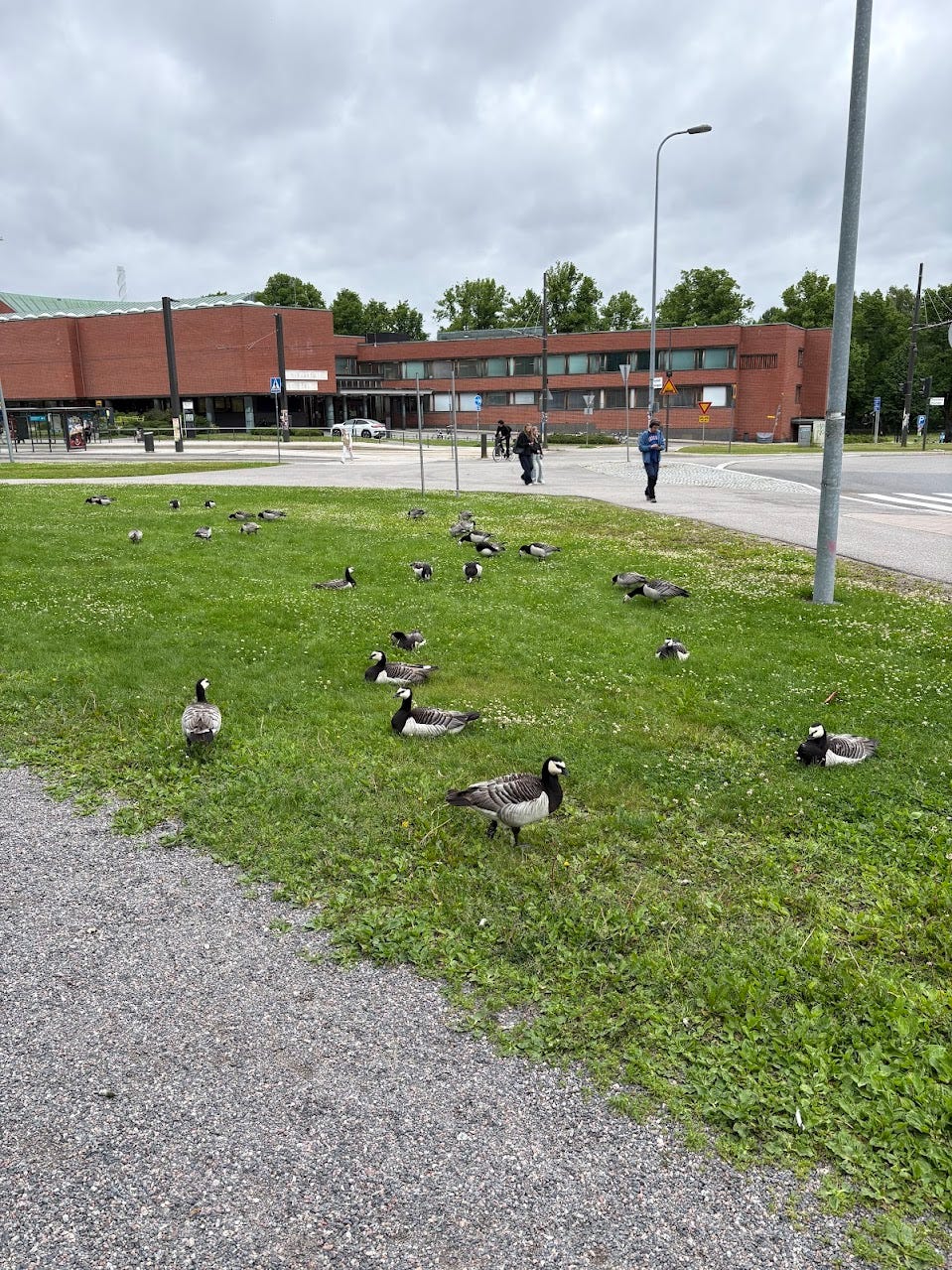
Canada geese are everywhere on the Aalto campus:
📖📺🍿 Currently Reading, Watching, Listening
I really enjoyed this episode in Onda Cero’s series about the work of Spain’s Customs Surveillance Service. It moves at a great pace, with no narrator, just the people involved telling the story from the inside. They explain how they investigate and combat drug trafficking, smuggling, and financial crime in Spain.

I’m getting closer to the end of The Confessions by St. Augustine. This week I finished Book 10.
The greatest thing in life is to be with Christ. That is the reward. St. Augustine understood that perfectly. And that’s why, even though he still had so much left to live, to do, to love, and to write, he could say:
Late have I loved You, Beauty ever ancient, ever new, late have I loved You!

Hamilton’s first win with Ferrari, by a margin of nearly 20 seconds, his third consecutive podium of the season, and a Ferrari that got the strategy right and brought upgrades that actually worked—both in qualifying and in the race. Hamilton’s pace was outstanding.
I’m really happy for him and for the chance to see him performing at his best again. I think this Ferrari has surprised all of us. We shouldn’t count Lewis Hamilton out—he’s a genuine title contender.
It’s a real shame about Antonelli, because he was absolutely flying. Mechanical issues ended his race, but before that he was comfortably outperforming Russell.
This race leaves the championship wide open, and I’m loving the Ferrari–Mercedes rivalry. The Mercedes cars are no longer untouchable.
It’s a real event whenever a new Steven Spielberg movie hits theaters, especially when he’s returning to the world of extraterrestrials.
Yago De la Cierva coordinated the Pope’s visit to Spain. He loves teaching in business schools, and sharing what he has learned is one of his passions.
I’ve had the chance to attend some of his classes at IESE on crisis management and storytelling, and they’re outstanding. He’s a pleasure to listen to.
Set aside 45 minutes for this one.
A good communicator knows how to adapt.
🌐 Cool things from around the internet
A collection of links to stuff I think are worth sharing.
🔗 bigset — what if you had all the data in the world?
🔗 SQL to ER Diagram — ER diagram generator.
🔗 Diccionario de ideas afines — search for a word, and it returns the entire network of related ideas around it. A must-have tool for writers. A project by Máximo Gavete.
🔗 RevPDF — tired of Adobe? This PDF editor works great, it’s free, and covers everything you need.
🔗 Wiretext — design interfaces with unicode characters.

Issue #49 of Computing Education Things was written while listening to:
🔗 Quick Links
🎧 Listen to Computing Education Things Podcast
💌 Let’s talk: I’m on LinkedIn or Instagram
If you’re enjoying Computing Education Things, please like, comment, or share this post! You can also support this work through Buy Me A Coffee. And if you’re finding value in the newsletter, consider forwarding it to a friend, colleague, or family member to help the community keep growing. Thanks for reading!
Interesting and insightful read, as always! From this issue I’m saving the essay from David Cerdá, the course on LLMs and the podcast from Onda Cero. Thank you and keep up the good work!